South Asia Discovers A New Arena Of Strategic Competition In The Form Of The Indian Ocean.

January 2026: As a vital strategic expanse, the Indian Ocean possesses a distinctive feature: not only are multiple stakeholders embracing the vast maritime territory, but there is no any single power who is fully capable of establishing a stable order and binding rules.
In a sharp contrast, Europe, where North Atlantic Treaty Organization (NATO) and institutional regulations have shaped a relatively structured security environment, or East Asia, where frameworks such as United Nations Convention on the Law of the Sea (UNCLS), and various regional agreements have helped entrench certain norms, the Indian Ocean lacks strong institutional mechanisms to manage competition and prevent confrontation. The Middle East is openly unstable, yet the Indian Ocean lies on the border between order and disorder.
In such an environment, any military or diplomatic action can carry multiple meanings. A single move may be defensive in intent while simultaneously appearing as a potential threat to a rival; it may act as a warning, and, at the same time, serve as a prelude to intensified competition. The absence of transparency and confidence-building mechanisms heightens the risk of misperception and compensatory reactions. As a result, actions by regional actors in the Indian Ocean may, rather than sending clear deterrent signals, evolve into a persistent cycle of tension and reciprocal response. Missile tests and the deployment of nuclear-powered submarines, for example, can both generate strategic miscalculations among regional actors.
For decades, South Asia’s security logic has been grounded on land: the Line of Control in Kashmir, disputed borders, and crises that almost invariably began on land. Recent developments in the Indian Ocean and the Arabian Sea, however, suggest that the true centre of gravity in the regional balance of power is gradually shifting toward the maritime domain.
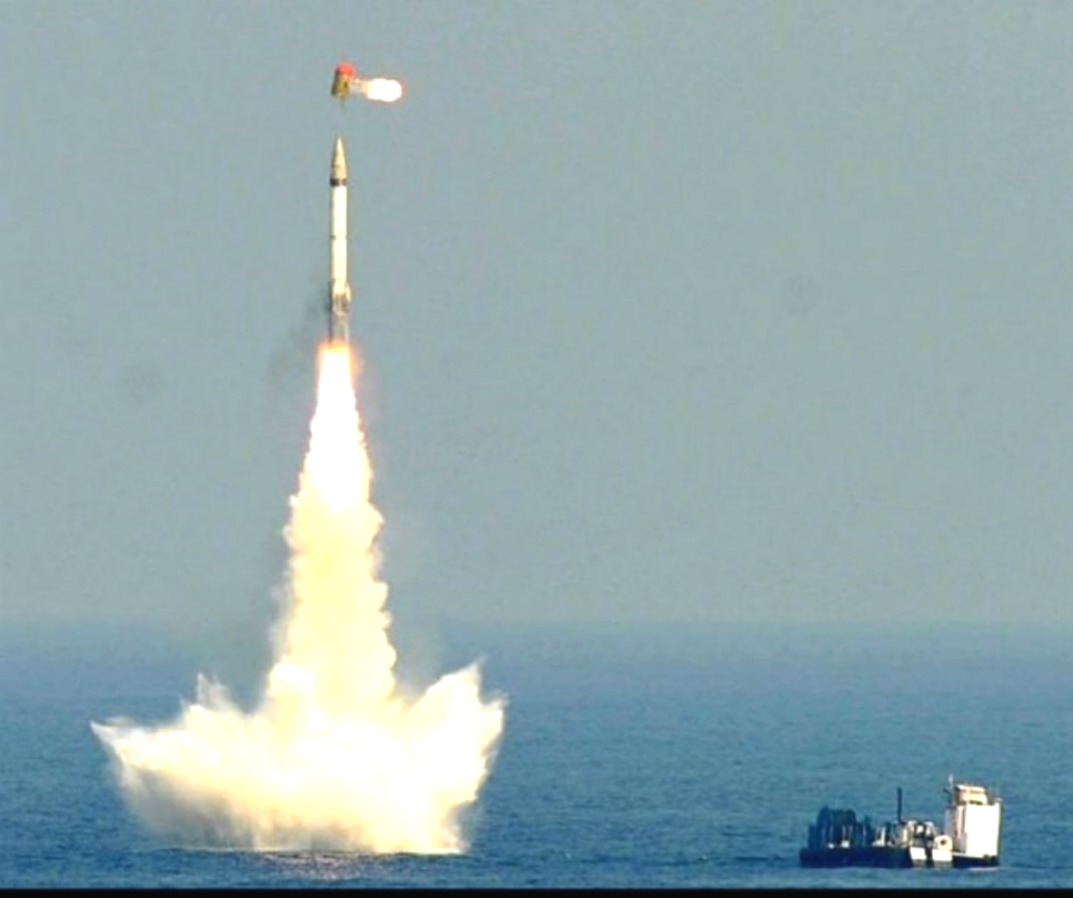
What is unfolding today in these waters is not a momentary display of force, but rather a quite yet fundamental shift in the region’s deterrence architecture. India’s tests of the sea-based K-4 ballistic missile, with an approximate range of 3,500-km, conducted from Arihant-class submarines, alongside the sustained presence of Chinese intelligence and research vessels in the northern Indian Ocean – may appear, when viewed in isolation, as technical or even routine developments. However, assimilating these facts and figures together, an architecture exhibits – that of South Asia entering a multi-layered and multi-domain nuclear deterrence phase.
In recent years, India’s maritime strategy has been shaped with the aim of strengthening its nuclear deterrence capability. Through the expansion of its blue-water navy, the deployment of nuclear-powered submarines, and an increased presence along vital sea lanes, India has sought to consolidate its second-strike capability. The test of the K4 missile, launched from Arihant-class submarines, has brought India closer to complete its nuclear triad and has conferred operational credibility to its maritime deterrent.
Yet maritime deterrence can contribute to stability only when it is transparent, reciprocal, and predictable. The Indian Ocean lacks such conditions. Unresolved rivalries between India and Pakistan, China’s growing presence, and a lack of effective confidence-building mechanisms make that every Indian military or diplomatic move carries multiple interpretations. From the perspective of regional rivalry, India’s expanding naval power is seen less as a guarantee of stability than as a shift in the balance of power, one that can provoke compensatory responses.
The deployment of ballistic missile carrying submarines in the shallow and congested waters of the Arabian Sea, while enhancing second-strike capability, also introduces specific operational risks. Reduced operational transparency and the heightened potential for misperception make rushed decision-making in any future crises more likely. India’s maritime deterrence thus functions simultaneously as an instrument of stability and a potential source of instability, a domain whose management requires careful diplomacy, confidence-building mechanisms, and operational transparency to prevent defensive measures from evolving into a cycle of escalating tensions.
Indian Ocean Is Where China Demonstrates Its Deterrence –
China’s behavior in the region should not be interpreted merely as reactive or crisis-inducing. Beijing’s strategy is to build around “persistent presence at low cost”; data collection, oceanographic studies, and sea lanes surveillance are more tools to reduce strategic uncertainty and protecting its interests in times of crisis than a costly display of power. This creeping, data-driven competition distinguishes itself from the overt confrontations of the Cold War, proceeding largely out of public view and with long-term implications on the balance of power. China’s increased presence, particularly during in India’s missile tests, enable the tracking missile flight paths and the collection of telemetry data.
For Pakistan, this situation offers a temporary opportunity: access to an “informal information umbrella” that partially mitigates information asymmetry with India. However, this short-term gain simultaneously deepens Pakistan’s dependence on Beijing and limits its operational freedom in managing maritime crises.
The continued presence of China’s research and data-gathering vessels in the northern Indian Ocean is a visible part of Beijing’s long-term strategy to cement its role as a regional maritime power. Although these activities are often framed to scientific or monitoring missions, practical evidence indicates that they actively collect critical information on the missile capabilities and naval capacities of other actors, particularly India.
These activities have transformed the Indian Ocean into a multilayered arena of intelligence, military, and technological competition; an environment where the lines between deterrence, surveillance, and provocation are quickly blur. In other words, regional and trans-regional actors are confronted with a situation of “gradual, unannounced militarisation”; a scenario that is more difficult to control than overt competition and increases the likelihood of miscalculation.
The northern Arabian Sea and Indian Ocean have become a high-risk flashpoint, where nuclear submarines, surface fleets, and intelligence-gathering vessels from multiple major regional powers are operate simultaneously. There are no effective confidence-building mechanisms or clearly established emergency communication channels to prevent misinterpretation and hasty reactions. Historical experience show that many crises have not emerged from deliberate decisions to go to war but rather from miscalculations and misreading of signals.
The simultaneous presence of nuclear submarines, aircraft carrier groups, and intelligence vessels within a geographically limited space significantly increases the likelihood of accidental encounters and escalatory responses. Even actions taken purely in self-defense can be perceived by other actors as a threat, triggering chains of reciprocal measures.
Under these conditions, South Asia faces serious “maritime risks”, a reality that demands operational transparency, urgent confidence-building mechanisms, and continuous engagement among regional and trans-regional powers. Without such measures, the likelihood of unintended crises and rapid escalation of tensions remains exceedingly high.
Regional stability ultimately depends, above all, on the ability of actors to manage competition, understand each other’s red lines, and maintain effective trust-building mechanisms. Without such mutual understanding, the Indian Ocean, once considered the security fringe of South Asia, could become the epicenter of instability, unintended crises, and disruptions to global trade and energy flows.
The Indian Ocean serves as a vital artery for global trade and energy. Major communicating sea lines including routes near India, Sri Lanka, and the Andaman Sea, carry enormous volumes of oil and petroleum products to Asian markets. Disruptions in these waters could sharply affect energy supplies, maritime insurance in South Asia, without clear arms control frameworks, risk normalising the deployment of nuclear-capable forces in international waters, setting potentially dangerous precedent for other regions.
This shift not only enhances nuclear deterrence capacity but also raises the risk of miscalculation and escalatory tension. The 2025 clashes between India and Pakistan showed that crises in South Asia have a strong tendency to spread horizontally. The transfer of tensions from land to sea, particularly in the absence of emergency communication channels, has made crisis management far more difficult.
Team Maverick.








CM Yogi directs action on 2,200 proposals: Budget to be released by July 15, projects to be launched on the ground from August 15
CM takes a tough stand during PWD review, warns of action over delays in pending projects …

CM Yogi directs action on 2,200 proposals: Budget to be released by July 15, projects to be launched on the ground from August 15
CM takes a tough stand during PWD review, warns of action over delays in …