India Revises Export Taxes on Petroleum Products; Cuts Diesel Duty, Hikes Petrol Levy

New Delhi, May 2026 : The government has revised export tax rates on petroleum products, introducing a fresh special additional excise duty (SAED) structure that raises the levy on petrol exports while reducing duties on diesel, according to an official notification issued by the Ministry of Finance on Saturday.
As per the revised framework, petrol exports will now attract a special additional excise duty of Rs 3 per litre. In contrast, the duty on diesel exports has been reduced to Rs 16.5 per litre. The government clarified that the change comes into effect immediately.
The notification further stated that the road and infrastructure cess on both petrol and diesel exports has been reduced to zero, offering partial relief to exporters while maintaining differentiated taxation between fuel categories.
Importantly, the Centre has maintained that domestic fuel prices and tax rates remain unchanged, and the revised structure applies only to exports of petroleum products.
The latest revision marks the first imposition of a fresh SAED on petrol exports since geopolitical tensions escalated in West Asia, which has disrupted global energy markets and increased price volatility.
In recent months, export duties on diesel have undergone multiple revisions. Initially fixed at Rs 21.50 per litre on March 26, the rate was sharply increased to Rs 55.5 per litre on April 11 amid global supply concerns. It was later reduced to Rs 23 per litre on April 30, and has now been further lowered to Rs 16.5 per litre.
Aviation turbine fuel (ATF) has also seen similar fluctuations in duty structure. The levy was first set at Rs 29.5 per litre, then increased to Rs 42 per litre before being reduced to Rs 33 per litre. With the latest revision, the duty on ATF exports now stands at Rs 16 per litre.
Officials said the windfall tax framework was introduced as part of a broader strategy to ensure adequate domestic fuel availability while preventing excessive exports during periods of global oil price volatility. The policy aims to balance domestic energy security with export competitiveness.
The global energy environment continues to remain uncertain amid ongoing geopolitical tensions in West Asia. The situation has been further complicated after negotiations between the United States and Iran failed to yield a breakthrough, with US President Donald Trump reportedly rejecting Iran’s proposal, stating: “I don’t like it — TOTALLY UNACCEPTABLE.”
Analysts say the revised tax structure reflects India’s attempt to respond dynamically to fluctuating global oil conditions while safeguarding domestic fuel stability and government revenue considerations. The differential treatment of petrol, diesel, and aviation fuel also signals a calibrated approach to managing export flows in a volatile energy market.
Officials indicated that further adjustments to the windfall tax regime could be made depending on international crude price movements and geopolitical developments in the coming weeks.







Vice-President releases book “RSS @100: A Century of Service, Unity & Sacrifice”
RSS has strengthened the ideals of service, unity and national consciousness over the past…
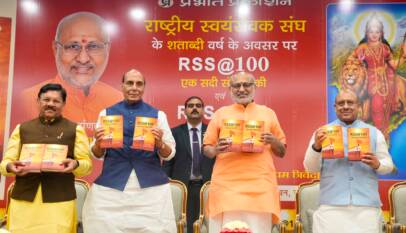
Vice-President releases book “RSS @100: A Century of Service, Unity & Sacrifice”
RSS has strengthened the ideals of service, unity and national consciousness over the past …