European Council Approves Additional Assistance Of €500 Million In Loans To Jordan.

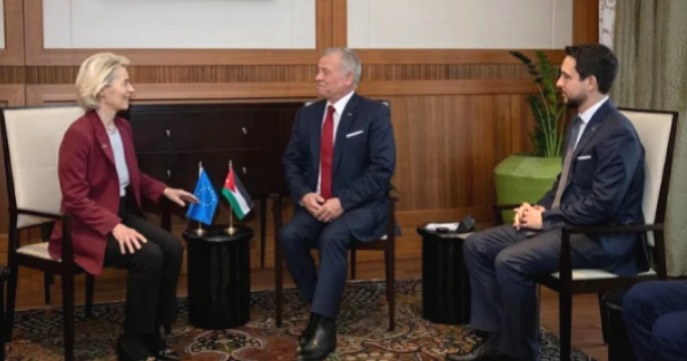
Amman; January 2026: Jordan is one of the European Union’s closest partners in the Middle East, with an important role in ensuring stability in the region. This 08th January 2026, brought the 01st ever EU-Jordan summit, which took place in Amman, where leaders reaffirmed their willingness to work together as reliable and predictable partners for stability, peace and security, and shared prosperity, and their commitment to the universal values of democracy, the rule of law and human rights.
In January 2025, the EU and Jordan entered into a strategic and comprehensive partnership. It deepens their already strong relationship and focuses on supporting Jordan’s stability amid extraordinary geopolitical challenges. The partnership also supports Jordan’s vision on political, economic and administrative modernisation, and on fostering economic resilience.
The two sides identified five key areas of common interest:
- political relations and regional cooperation,
- security and defence,
- economic resilience, trade and investments,
- human capital,
- migration, and protection and support for refugees.
To support the partnership, the EU proposed a €3 billion financial package for Jordan. This includes:
- €640 million in grants;
- €1 billion in concessional loans (macro-financial assistance);
- €1.4 billion in additional investments.
Today, 20th January 2026, the Council formally adopted a decision to provide a further €500 million in macro-financial assistance (MFA) to Jordan. The EU assistance will help bolster Jordan’s economic stability and support its ongoing reform agenda in the face of mounting internal and external challenges. It aims to support the restoration of a sustainable external financing situation for the country, thereby supporting its economic and social development.
The assistance, provided in response to Jordan’s request for additional support in January 2025, will be available for two and a half years and provided in the form of long-term loans, disbursed in three instalments.
The EU has earlier provided Jordan with €1.08 billion under three previous MFA programmes since 2013. A fourth MFA programme, also worth €500 million, is currently underway and with a first instalment of €250 million disbursed on 17 September 2025. The funds continue to support key reforms in public finance management, social and labour policy, and governance.
The assistance agreed today is subject to a memorandum of understanding (MoU), to be agreed by Jordan with the Commission. Disbursement of instalments will be strictly linked to Jordan’s progress with the reforms outlined in that MoU. Jordan must also respect democratic mechanisms, the rule of law, and human rights throughout the programme’s duration. The Commission and the European External Action Service (EEAS) will monitor the fulfilment of this precondition for the duration of this fifth MFA programme.
Jordan continues to face high unemployment, chronic external deficits, and rising public debt which reached 90.4% of GDP in 2024. Regional instability in the Middle East has further strained Jordan’s public finances and trade balances.
The EU and Jordan have been linked by an Association Agreement since 2002. In 2022, the two sides signed partnership priorities, which aim to strengthen cooperation further and to guide the partnership until 2027. An EU-Jordan strategic and comprehensive partnership was agreed in January 2025. This partnership is backed by a €3 billion financial and investment package for 2025-2027, including through MFA. The package focuses on supporting Jordan’s stability amid extraordinary geopolitical challenges, on furthering political, economic and administrative modernisation, and on fostering economic resilience.
The EU’s support to Jordan therefore also assists the country in mitigating the impact of the war in Syria and the resulting large number of refugees as well as the impact of other regional conflicts, including the war in Gaza.
MFA is a form of financial aid extended by the EU to partner countries experiencing a balance of payments crisis. It is available to enlargement and EU neighbourhood countries experiencing severe balance-of-payments problems. The implementation of the proposed operation is further complemented by EU bilateral cooperation under the Neighbourhood, Development and International Cooperation Instrument – Global Europe (NDICI-GE).
Team Maverick.



China Open: Lakshya, Sindhu and Ayush Shetty Advance to Second Round After Gritty Wins
Changzhou (China), July 2026 : India’s top badminton stars Lakshya Sen, P.V. Sindhu …

China Open: Lakshya, Sindhu and Ayush Shetty Advance to Second Round After Gritty Wins
Changzhou (China), July 2026 : India’s top badminton stars Lakshya Sen, P.V. Sindhu and …