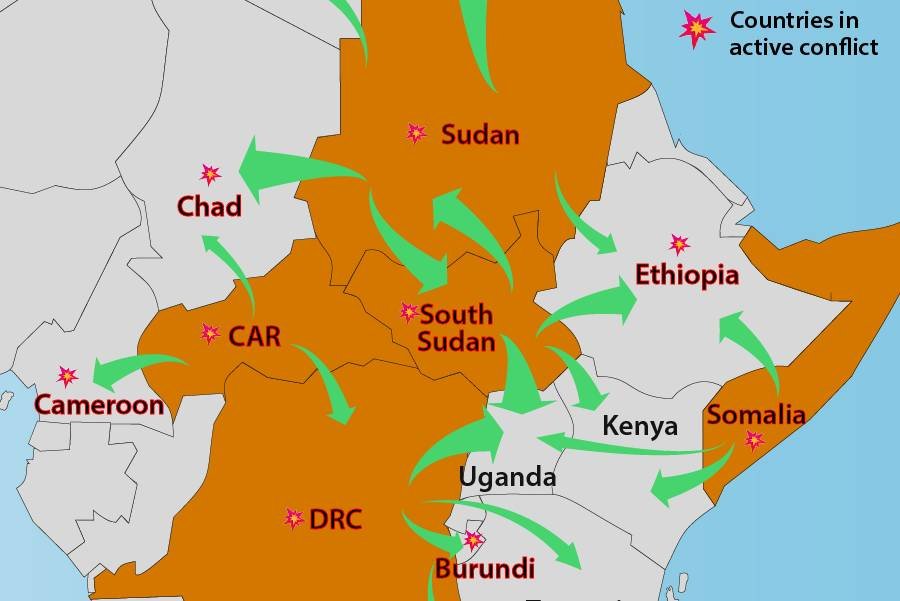
Washington DC; September 2026: Conflict remains the dominant driver of forced displacement across the entire African continent. The top 10 leading countries of origin for displaced people on the continent are all in conflict. These conflicts, moreover, tend to persist.
As reiterated earlier, of the top 10 source countries of displacement, all have been in conflict for at least 08 years. As these threats endure, the coping mechanisms of communities wear down, and the number of people who feel compelled to move to survive grows over time. Over half of the top 10 displacement-producing African countries, for example, have the same or larger displaced populations than they did in 2023. Reflective of the compounding effects of conflict, seven African countries have between 17 and 28 percent of their populations displaced.
Nearly 45 million Africans (03% of the African population) are forcibly displaced, having fled conflict, violence, and repression. 07 countries, namely Sudan, the Democratic Republic of the Congo (DRC), Somalia, Nigeria, Burkina Faso, South Sudan, and Ethiopia account for roughly 85% of that number.
The total represents a slight reduction from the figure of more than 45 million forcibly displaced observed in 2025, largely due to a return of some 1.5 million Sudanese despite the ongoing conflict there. The plateauing in the level of displacement is noteworthy as it breaks a decade-long pattern of consistently increasing numbers of forcibly displaced people on the continent. As a point of comparison, there were 19.9 million Africans forcibly displaced in 2017.
In cases where displaced people return home, these movements tend to be tenuous. Despite some refugees returning to Sudan, the country still has the highest number of forcibly displaced people, illustrating the continuing high levels of risk and instability caused by the ongoing conflict. Similar sizable returns of displaced people following the end of the Tigray conflict in Ethiopia have been offset by an increase in displacement of almost 495,000 Ethiopians over the past year as armed violence has ticked up in parts of the country. Somalia, Nigeria, Niger, and Cameroon also saw notable increases in their displaced populations over the past year.
Perpetuating a consistent pattern, roughly 70% of displaced Africans are internally displaced (IDPs) within their countries. This reflects the preference of displaced people to remain as close to their homes as possible. In addition to those primary source countries of forced displacement listed above, Cameroon stands out for having more than 01 million people displaced internally. It is of omnipotent importance that the internal displacement tends to be more informal and less easily recorded.
These IDP figures are likely an undercount of the true scale and scope of the displacement. Internal displacement tends to be more informal and less easily recorded. In some cases, national officials see value in downplaying the scale of instability. In Burkina Faso, for example, the military junta is accused of preventing civilians, sometimes through violence, from fleeing towns under siege by Islamist insurgents of the Jama’at Nusrat al Islam wal Muslimeen (JNIM) coalition in an effort to project an image of stability. Combined with the military authorities’ decision to stop reporting internal displacement figures in March 2023, these actions suggest that the true number of displaced in Burkina Faso, as well as the neighbouring junta-led Sahelian countries, is likely significantly underestimated.
When displacement becomes protracted, those who can may seek resettlement toward networks in more economically robust areas: typically, cities in the neighbouring countries, possibly cities farther away—particularly when neighbouring countries are facing insecurity or limited livelihood opportunities. The DRC, for example, has refugees and asylum seekers residing in 31 African countries.
A review of the top 05 countries of origin for African refugees and asylum seekers suggests that displacement patterns are influenced by a range of factors, including the length of conflict, conflict-related economic conditions, existing diaspora networks, and common language. The DRC, Sudan, and Somalia have established diasporas that can provide transitional support. Refugee movements from CAR, by contrast, suggest that language may play an important role in destination selection when diaspora networks are less established. Following initial displacement to neighbouring countries, CAR nationals have moved into the Francophone West African countries.
For some nationalities, this search for stability and security has driven them to take increasingly dangerous risks: citizens of Sudan, Mali, and Somalia (three countries experiencing protracted conflict) made up almost 30% of the African nationalities intercepted on European borders in 2025. This was up from almost 24% the prior year, and 13% the year before that.
African countries experiencing conflict and mass population displacements are unsurprisingly also often experiencing severe food crises.
· More than 945,000 people are displaced in South Sudan, where almost half the population (around 7.5 million people) is facing crisis or above levels of hunger. An estimated 73,300 people are facing famine in Upper Nile and Jonglei States, where conflict has displaced more than 300,000 since December 2025. Jonglei has also seen health facilities looted and damaged, leaving some 1.4 million without access to health care.
· In Nigeria’s Borno State, the epicentre of the Boko Haram and Islamic State in West Africa violence, more than 3 million people are experiencing acute food insecurity, including more than 1.7 million forcibly displaced people. More than 750,000 people, primarily in towns and villages northeast of Maiduguri, are facing emergency levels of hunger, while another 10,000 people are facing famine.
· Sudan is the Locus of Africa’s Forced Displacement Crisis. Sudan is the country with the largest number of forcibly displaced (14.4 million people) which is a 14% increase from a year previously. Sudan’s forcibly displaced population represents 32% of the African continent. This underscores the brutality of the Sudan conflict, which continues to expand since erupting in 2023.
Sudan’s 10.1 million IDPs represent the largest internal displacement of any country globally.
Sudan is now the African country with the largest share of its population that is forcibly displaced (29%), surpassing South Sudan.
04 of the countries with over 01 million people displaced are neighbours of Sudan, highlighting the compounding regional implications of ongoing conflicts. Illustratively, an estimated 800,000 South Sudanese refugees have crossed back into South Sudan since 2023, escaping the spiralling violence in Sudan. Along with them are roughly 380,000 Sudanese refugees who are fleeing into a country that has been devastated by a civil war for more than a decade. In Sudan, where food insecurity is widespread, nearly 400,000 displaced people in North Kordofan, a focus of RSF attacks, are facing emergency levels of acute food insecurity.
· In the DRC’s eastern provinces, more than 6 million people are facing emergency levels of food insecurity. The Ebola outbreak in eastern DRC in May 2026 has grown rapidly, in part due to the insecurity in the conflict-affected region. The outbreak threatens more than 2 million forcibly displaced people crowded in IDP camps.
Team Maverick.