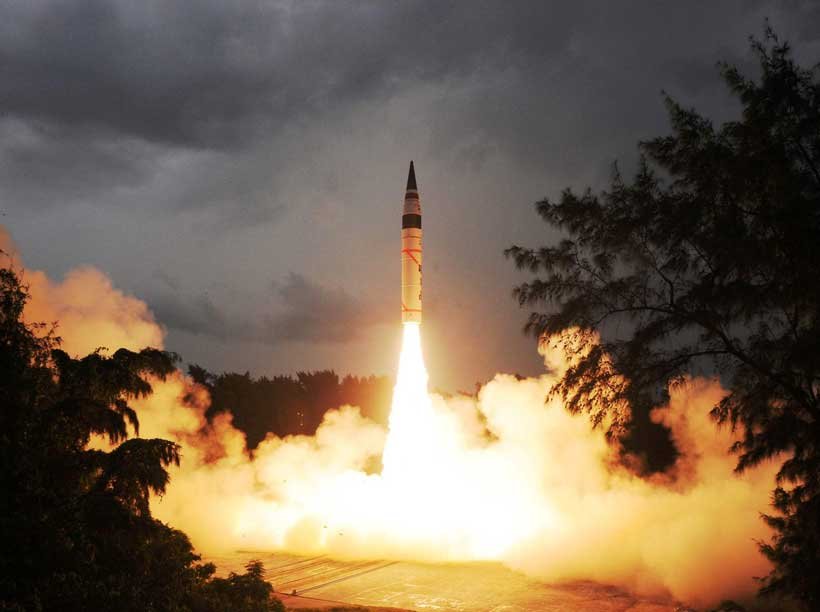
New Delhi, Aug 2026 : India’s Agni-V ballistic missile has undergone a series of significant technological improvements, strengthening its role as a key component of the country’s strategic deterrence architecture. The advanced configuration, often referred to as Agni-V Mk-2, builds upon the established Agni-V design while incorporating newer materials, propulsion technologies and systems aimed at improving efficiency, reliability and survivability.
The Agni-V is a three-stage, road-mobile, canisterised and cold-launched ballistic missile. One of its most significant strategic features is its ability to employ a Post Boost Vehicle (PBV), which enables the deployment of multiple re-entry vehicles. The missile is associated with Multiple Independently Targetable Re-entry Vehicle (MIRV) technology, allowing several warheads to be carried on a single missile and directed towards separate targets.
One of the most notable technological changes involves the missile’s structural materials. The first-stage casing has moved away from the conventional maraging steel construction towards a carbon-composite casing produced using filament-winding technology. The development represents an important achievement in India’s indigenous expertise in advanced composite materials.
Carbon composites have also been incorporated into other major structural components, including motor casings, inter-stage structures and the nose cone. These materials offer considerable weight savings compared with the earlier Agni-V configuration, which was reported to weigh around 50 tonnes.
Reducing the missile’s overall weight has several advantages. It can provide greater flexibility in balancing range and payload while improving transportation and deployment efficiency. The use of lighter materials also reflects a broader trend in modern strategic missile development, where advanced composites are increasingly used to achieve higher performance without substantially increasing the size of the system.
Another major improvement is the adoption of electromechanical actuators for flex-nozzle control across the missile’s stages. Earlier configurations relied on electro-hydraulic systems, which were comparatively heavier and more complex.
Electromechanical systems can reduce mechanical complexity and weight while offering potential advantages in reliability, precision and maintenance. Their integration reflects India’s broader effort to develop strategic systems that combine advanced technology with greater operational robustness.
The missile’s stage-separation architecture has also been refined. The introduction of retro-rocket-assisted nose-cone jettison is intended to facilitate cleaner and more reliable separation during flight. Such improvements are particularly important in a multi-stage ballistic missile, where the successful functioning of each stage is critical to overall mission performance.
The canisterised launch configuration further enhances the missile’s operational survivability. Keeping the missile sealed inside a protective canister allows it to be transported and maintained in a ready-to-launch configuration while providing protection from environmental conditions. Its road-mobile nature also contributes to deployment flexibility.
The development of MIRV technology represents another important milestone in India’s strategic missile programme. A MIRV-equipped missile can carry multiple re-entry vehicles, allowing a single delivery system to engage more than one target. Such technology is increasingly relevant in an environment where major military powers are developing sophisticated ballistic missile defence networks.
The combination of multiple warheads, improved structural efficiency and advanced guidance and control systems can enhance the ability of a strategic missile to penetrate complex defensive environments. The Post Boost Vehicle plays a key role in enabling the controlled deployment of re-entry vehicles during the later stages of flight.
The evolution of Agni-V reflects a broader transformation in India’s missile development philosophy. The focus is no longer restricted to achieving greater range. Increasing emphasis is being placed on survivability, accuracy, mobility, reliability and the ability to operate in an increasingly sophisticated strategic environment.
The programme also represents decades of research and development undertaken by India’s defence and scientific establishments. Technologies developed through the country’s missile programmes have increasingly benefited from advances in materials science, electronics, guidance systems and manufacturing capabilities.
The growing use of indigenous composite materials is particularly significant because it demonstrates India's expanding technological capabilities in areas that have historically been subject to international technology restrictions.
Strategically, the Agni family forms an important part of India's deterrence posture. While shorter-range systems are primarily relevant to regional contingencies, longer-range missiles such as Agni-V provide India with a broader strategic reach, particularly in the context of China's expanding military and missile capabilities.
The development of MIRV technology also assumes significance as countries increasingly deploy layered missile defence systems, hypersonic weapons and advanced surveillance capabilities. In such an environment, maintaining a credible deterrent requires systems capable of surviving increasingly complex security challenges.
From the first Agni technology demonstrator tested in 1989 to the development of increasingly sophisticated, mobile and MIRV-capable systems, India’s missile programme has evolved considerably.
The latest improvements to Agni-V therefore represent more than an incremental upgrade. They demonstrate India’s growing ability to integrate advanced materials, propulsion control, guidance technologies and survivability features into strategic systems.
The evolution underscores a fundamental shift in India’s strategic missile development—from simply extending range to building systems designed around precision, survivability, reliability and credible deterrence in an increasingly complex security environment.
(Disclaimer :The content of this article is sourced from a news agency and has not been edited by the Mavericknews30 team.)