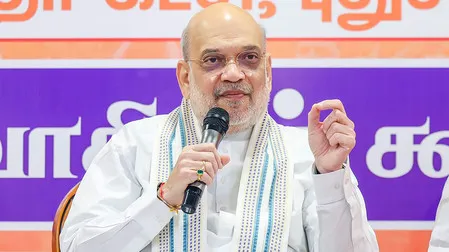
New Delhi, Aug 2026 : Union Home Minister Amit Shah on Friday described the return of alleged drug kingpin Virender Singh Basoya from the United Arab Emirates as a significant achievement in the government’s ongoing “zero tolerance” campaign against narcotics and international drug trafficking.
In a post on X, Shah said the Narendra Modi government was pursuing drug traffickers operating from overseas and working to dismantle the networks and support systems that enable them to continue their activities.
Shah said the return of Basoya, secured by the Narcotics Control Bureau (NCB), marked another milestone in the government’s efforts to bring fugitives accused of involvement in major drug operations back to India.
According to information shared in connection with the case, Basoya was brought to India from Dubai on an Air India flight following coordinated efforts by Indian authorities. He is an accused in the Pune drug case involving narcotics allegedly valued at around Rs 6,000 crore.
The NCB had issued a Red Corner Notice against Basoya, following which he was arrested in Dubai. He was subsequently deported to India as part of efforts by the Government of India to pursue individuals accused of operating major narcotics networks from abroad.
Basoya is reportedly considered close to Sandeep Dhunia, who has been described as the main accused in a separate Delhi Police drug case involving narcotics allegedly worth approximately Rs 13,000 crore. According to the information provided, Dhunia had managed to travel from Dubai to Pakistan.
Shah said the latest operation demonstrated the ability of Indian enforcement agencies to track criminal networks across different levels and jurisdictions. He stressed that drug traffickers attempting to evade Indian law by operating from foreign locations would continue to face scrutiny from Indian agencies.
The Home Minister said the agencies had followed the criminal network using both top-to-bottom and bottom-to-top approaches, reinforcing the government's message that fugitives involved in narcotics trafficking cannot remain beyond the reach of Indian law indefinitely.
The development is being viewed as a significant achievement for the NCB and other Indian agencies involved in investigating and pursuing international drug trafficking networks.
The government has consistently maintained that its anti-narcotics strategy extends beyond targeting individual drug traffickers. Its broader approach focuses on identifying and dismantling the financial, logistical and operational ecosystems that support large-scale narcotics syndicates.
The return of Basoya is therefore expected to provide investigators with an opportunity to pursue further leads into the wider network allegedly involved in the Pune drug case and its international links. The government has reiterated that coordinated action against drug syndicates operating across national borders will remain a key component of its fight against narcotics.