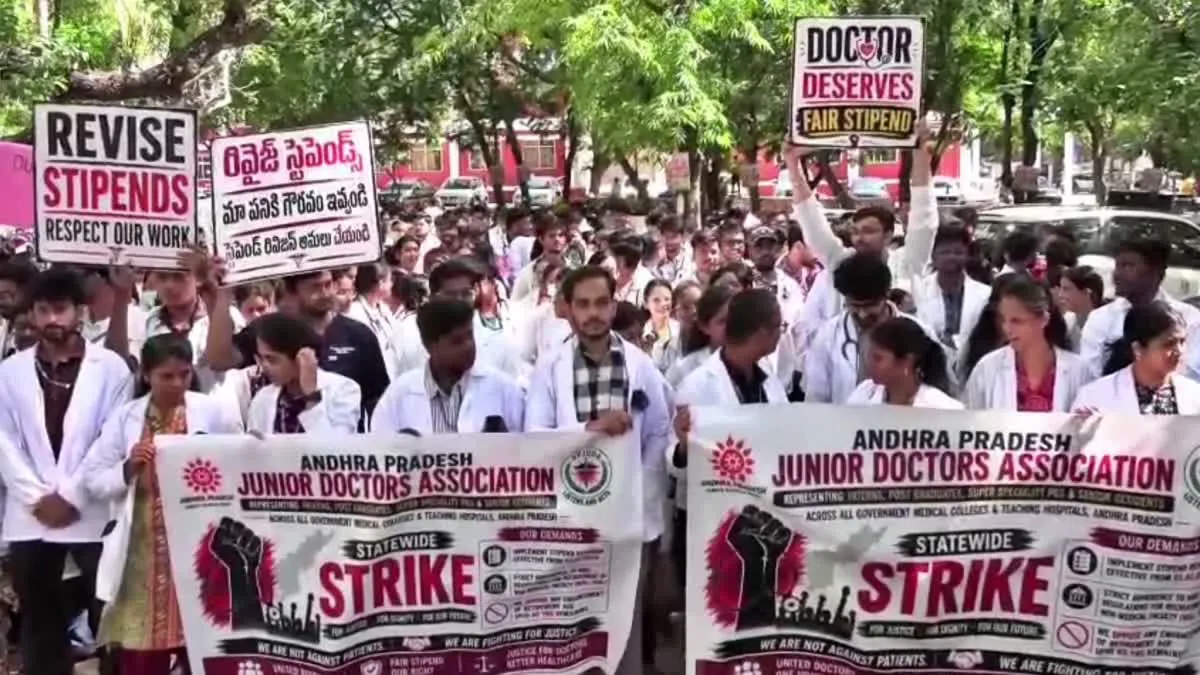
Amaravati, Aug 2026 : Healthcare services across government medical colleges and teaching hospitals in Andhra Pradesh were disrupted on Monday as junior doctors intensified their protest over a long-pending demand for revision of their stipends and began a total boycott of emergency services.
The Andhra Pradesh Junior Doctors’ Association (APJUDA) had announced the emergency services boycott after the government failed to provide a written assurance on their key demands. The protest involves around 9,000 resident doctors, medical interns, junior residents, postgraduate students in super-speciality courses, senior residents and doctors working under the District Residency Programme (DRP).
Junior doctors from all 19 government medical colleges in the state are participating in the agitation. Their withdrawal from duties has affected critical areas, including Intensive Care Units (ICUs), casualty and emergency wards and labour rooms. Non-emergency medical services have also remained suspended at government teaching hospitals, super-speciality units and peripheral medical colleges.
The agitation began in a phased manner on August 11, when junior doctors initially withdrew from non-emergency services for a limited period. With no written commitment from the government on the stipend revision, APJUDA subsequently escalated the protest and announced a complete boycott of emergency services.
The state government, meanwhile, said it had put contingency arrangements in place to minimise the impact of the strike on patients. The Health Department is monitoring the situation in coordination with District Collectors, principals of medical colleges and hospital superintendents.
According to the government, additional doctors are being kept on standby wherever required. Authorities have also made special arrangements to ensure the continued functioning of emergency departments, ICUs, maternity services, operation theatres, neonatal and paediatric intensive care units, dialysis centres and trauma services.
The government has also directed officials to ensure adequate stocks of medicines, oxygen, blood and other essential medical supplies so that critical patient care is not affected.
At the heart of the dispute is APJUDA’s demand for a 15 per cent increase in stipends. The association says the revision has been pending since January 1. It has cited a 2009 order issued by the Health, Medical and Family Welfare Department, which provides for biennial revision of junior doctors’ stipends by around 15 per cent.
APJUDA leaders said they had repeatedly approached the authorities seeking implementation of the revision but failed to receive a clear assurance. This, they said, left the association with no option but to intensify the agitation.
The government, however, has proposed a substantially lower increase. It has offered a 3 per cent hike for postgraduate junior doctors and a 5 per cent increase for house surgeons and interns.
During discussions with APJUDA representatives, the government reportedly said the Finance Department was not favourably inclined towards a 15 per cent increase in view of the state’s present financial position. It proposed instead that a specific percentage increase be implemented annually for interns and postgraduate students and assured the doctors that the annual increment mechanism would continue.
The government has appealed to junior doctors to accept the proposal, citing the state’s financial constraints and expenditure on various public welfare schemes.
APJUDA has also raised other issues, including implementation of National Medical Commission norms for recruitment of MSc and PhD holders to clinical faculty positions. The association is also opposing a proposal to increase the retirement age of doctors from 62 to 65 years.
The financial implications of the stipend demand remain a major point of contention. According to the government, it currently spends around Rs 586.08 crore annually on stipends for 9,501 junior doctors. A 15 per cent increase would result in an additional annual financial burden of approximately Rs 87.91 crore.
With the emergency services boycott now underway, the dispute has entered a critical phase. While the government has sought to maintain essential healthcare services through alternative arrangements, junior doctors have maintained that their demands require a concrete and written commitment. The outcome of further negotiations is likely to determine whether the strike is withdrawn or extended in the coming days.