London; August 2026: Since taking office in July 2024, the Labour government has made several policy changes. The government has initially scrapped the previous government’s Illegal Migration Act and started processing all applications from people arriving by small boat, which had been suspended. It also cancelled a related scheme to relocate asylum seekers to Rwanda, which had been repeatedly delayed by legal challenges. The government later implemented different restrictions.
Starting in March 2026, refugees in the UK are given a form of temporary protection status that needs to be renewed every 2.5 years, and may have to wait up to 30 years before receiving settlement under a proposed plan. In contrast, the previous system granted refugees a five-year residence permit before allowing them to apply for settlement. Refugee family reunion was suspended in September 2025, meaning that those wanting their close family to join them in the UK face a minimum income requirement of £29,000 a year. The asylum grant rate also fell significantly in recent years, from a high of 76% in 2022 to 42% in 2025 — potentially because of changes to country guidance and stricter rules initially brought in by the previous government’s Nationality and Borders Act 2022.
The government continued and scaled up existing enforcement efforts. This included spending more resources on disrupting smuggling operations and supply chains, expanding cooperation with police forces in the EU, reaching new agreements with countries of transit in the Middle East and Western Balkans, and introducing new sanctions against smugglers. It extended the previous government’s enforcement deal with France to fund increased patrols on departure beaches. It also negotiated a change in French maritime law to allow boats to be intercepted at sea in limited circumstances, though it remains unclear how often this has been implemented in practice.
The government also signed a deal that allows it to return some people who arrived by small boat to France, in exchange for accepting a similar number of asylum seekers from there. Around 1,100 people were returned to France between September 2025 and June 2026, equivalent to 4% of those who arrived by small boat during this period.
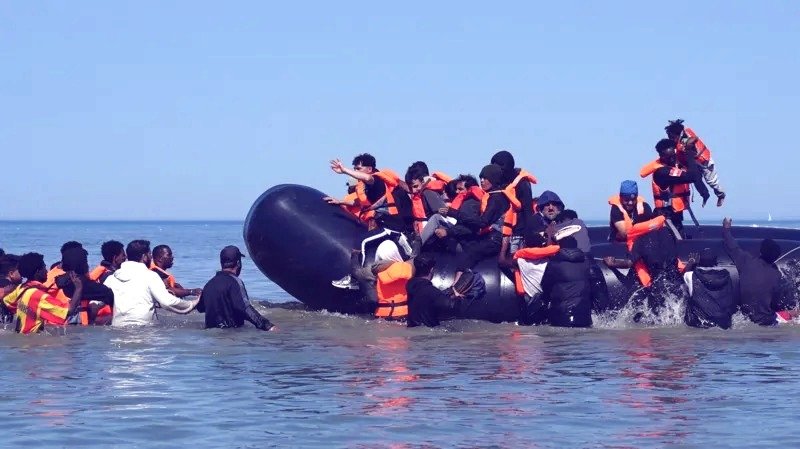
Small boat arrivals over the English Channel declined significantly in the first seven months of 2026. Around 14,200 people had arrived by small boat by the end of July this year. That was 44% fewer than in 2025, and 16% fewer than in 2024. A total of 30,200 people arrived by small boat in the year ending 31 July 2026. That was slightly less than when Labour took office – arrivals stood at 31,500 in the year ending 5 July 2024.
While there is evidence on the types of factors that tend to drive small boat arrivals, it is difficult to know what caused changes in small boat arrivals during a specific period. This applies to the recent decline, as well as previous ups and downs, such as a spike in Albanian arrivals in 2022, a subsequent decline in 2023 and early 2024, and a sustained increase after the autumn of 2024.
Over the last few months, there are some policies that may have played a role in the recent decline, but there are also competing explanations not related to UK policy. Weather conditions in the Channel are unlikely to have had a significant impact. While conditions can influence the timing of crossings in the short-term as people wait for an appropriate day to travel, they have less of an impact on arrivals over longer periods of time.
As explained above, it is difficult to envisage the extent of increment in boat arrivals in 2025 or the sharp decline in 2026 were at all driven by the actions of the government, as opposed to other factors. Importantly, this does not mean that policies are not having an effect, only that we cannot say with any certainty what their impact has been.
In theory, at least some of the measures taken by the government may have had an impact on arrivals. Physical interceptions to prevent boats from departing – the kind that are happening on departure beaches but also in some limited cases in the water after a change in French maritime law – appear to have reduced unauthorised crossings in several cases around the world, including the EU and Australia. Research suggests that lower asylum grant rates and more restrictive refugee family reunion policies, changes seen in the UK over the last couple of years, are often associated with a decrease in asylum applications. The returns deal with France might deter some people from trying to reach the UK if a high share of arrivals were to be swiftly removed, though this share remained relatively low at the time of writing, at around 4% of all arrivals between September 2025 and June 2026.
While their effect on arrivals is hard to quantify, there are indications that recent policy changes have led to changes in behaviour among smugglers and migrants. In the first half of 2026, there was a shift towards more small boats leaving from Belgium, which may suggest that enforcement efforts on the French coastline were making departures less viable. After returns to France began in late 2025, some smugglers reportedly responded by taking returnees back to the UK free of charge, including on alternative routes like in the back of lorries. Such repeat crossings then led to an agreement to update the original deal in May 2026, allowing for the accelerated removal of those who re-enter the UK after being returned. These dynamics illustrate one of the main challenges in reducing unauthorised migration: smugglers often rapidly adapt their strategies in response to government action. The ultimate impact on crossings depends on the cumulative effects of all these responses.
Factors external to the UK may have also played a role in the decline in small boat arrivals, however. Most notably, there has been a sharp decline in detected unauthorised border crossings into the EU – arrivals fell 26% in 2025, before declining another 37% in the first half of 2026. This is likely to lead, with a lag, to fewer unauthorised crossings to the UK, since most small boat migrants travel through the EU before reaching beaches in Northern France.
Developments in key origin countries, such as relative improvements in the security situation in Syria, can also influence unauthorised arrivals in destination countries like the UK. The number of Syrians arriving by small boat fell by 67% between 2024 and 2025, a trend the Home Office has attributed to the fall of the Assad regime in December 2024.
Both UK policy and non-policy factors are likely to have contributed to recent changes in boat arrivals, but it is difficult to isolate the effect of each factor. Just as it is difficult to say whether government policy contributed to higher boat arrivals in 2025, it is hard to know how much restrictive measures contributed to reducing them in 2026. There is evidence that some recent policy changes can have an impact, such as the restriction on refugee family reunion introduced under the current government, and the reduction in the asylum grant rate that followed legislation introduced by the previous government. On the other hand, the reduction in the number of asylum seekers entering the EU may have contributed to recent declines in boat arrivals, alongside regime change in Syria. Finally, small boat arrivals fluctuate over time, often unpredictably. Since crossings tend to be highest in the summer, the coming weeks will give a better indication of whether the trend towards lower arrivals is durable.
Team Maverick.