
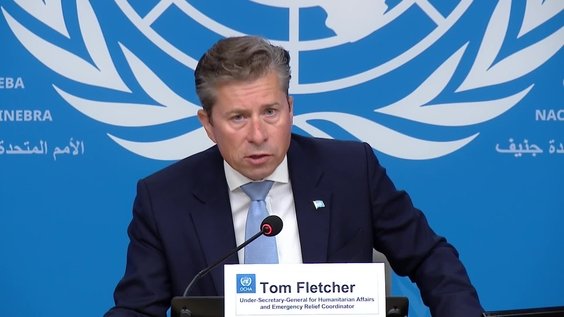
United Nations, Aug 2026 : The rapid spread of inexpensive armed drones is fundamentally changing the nature of modern warfare, allowing attackers to target civilians and humanitarian workers from increasing distances while making accountability more difficult, United Nations relief chief Tom Fletcher has warned.
Fletcher, UN Under-Secretary-General for Humanitarian Affairs and Emergency Relief Coordinator, issued the warning after visiting Ukraine, where he said the growing use of drones had created an alarming new dimension to the dangers faced by civilians and aid workers. Speaking on World Humanitarian Day, he said the technology was extending the reach of armed conflicts while creating what he described as a growing gap between those responsible for attacks and the people suffering their consequences.
According to Fletcher, nearly 1,000 humanitarian workers have been killed, injured or kidnapped in conflicts around the world. He stressed that the violence directed against aid personnel could no longer be regarded as an isolated or temporary phenomenon.
“This is not a temporary spike that we’re seeing. This is a stain,” Fletcher said, warning against the normalisation of attacks on humanitarian personnel. He said the international community must reject the idea that violence against aid workers had become an unavoidable feature of modern conflicts.
Fletcher said one of the most disturbing aspects of the current situation was the widespread sense of impunity surrounding attacks. Accountability, he argued, must extend beyond the individual who physically carries out an attack to those who order it, supply the weapons or create the conditions that allow such violence to occur.
His comments came after a visit to Kherson in southern Ukraine, which he described as an epicentre of armed-drone attacks on civilian areas. Fletcher travelled several times along the route between Mykolaiv and Kherson, known locally as the “Road of Death”, where protective netting has been installed over sections of the road in an attempt to prevent or deflect drone attacks.
The UN official said he had rarely encountered a conflict zone where drones had become such an integral part of everyday life and public conversation. Residents, including children, have learned to distinguish different types of drones and weapons by their sounds, including first-person-view drones, fibre-optic drones, medium-range unmanned aircraft and loitering munitions.
Fletcher said this familiarity with weapons technology was particularly disturbing because it demonstrated how deeply drone warfare had penetrated civilian life.
He also highlighted the terrifying precision with which some attacks can now be conducted. Drone operators can observe potential targets before deciding whether to strike, making it possible to deliberately identify civilians, aid workers or others on the ground.
“If they fly around the person selling fruit and vegetables in the market, or the humanitarian delivering food, they have a good look at them before they take the shot,” Fletcher said, describing the ability to observe victims before an attack as a chilling development.
The consequences are already visible in Ukraine's hospitals. Doctors told Fletcher that around 70 per cent of wounded patients at one hospital had suffered blast injuries caused by drones. Because medical facilities themselves have become vulnerable, hospital wards and operating theatres are increasingly being moved underground to protect patients and medical personnel.
Fletcher cited the example of a drone that caused significant damage to Kherson Hospital and reportedly cost only about $300. The example, he said, illustrated how inexpensive technology could now inflict potentially devastating damage.
He warned that the declining cost of armed drones was making them increasingly accessible and enabling warfare to be conducted over greater distances. At the same time, he said, the physical separation between attackers and victims appeared to be accompanied by a growing separation between victims and justice.
International humanitarian law, Fletcher stressed, must remain applicable regardless of technological advances. Civilians and humanitarian workers must continue to receive protection under international law, irrespective of whether attacks are carried out with conventional weapons or sophisticated remotely operated systems.
The threat, he added, extends far beyond Ukraine. Fletcher said women in Somalia had told him they were fleeing drones, rather than famine or conventional violence. He also pointed to the increasing use of armed drones in conflicts and security crises in Sudan, Colombia, Gaza and Lebanon.
“From Sudan to Colombia to Gaza to Lebanon, these cheap armed drones are extending the reach of war and allowing people to kill at greater distance,” he said.
Fletcher called on governments, weapons manufacturers and suppliers to take greater responsibility for understanding how their technologies are being deployed. He urged states to ensure that the development and use of armed drones comply fully with international humanitarian law.
He also rejected the idea that expressions of concern from governments were sufficient, saying immediate action was required to strengthen accountability and prevent further attacks on civilians and humanitarian personnel.
At the same time, Fletcher acknowledged that drone technology could provide major humanitarian benefits. Unarmed drones can deliver vaccines and other essential supplies to isolated communities, assist in search-and-rescue operations and help locate survivors following natural disasters.
The central challenge, he said, was ensuring that technological progress did not move faster than the international systems designed to regulate its use.
“We need to ensure that technology does not outpace humanity and that technology does not outpace accountability,” Fletcher said, underscoring the urgent need for governments and the international community to adapt existing legal and accountability mechanisms to the rapidly changing character of warfare.
(Disclaimer :The content of this article is sourced from a news agency and has not been edited by the Mavericknews30 team.)