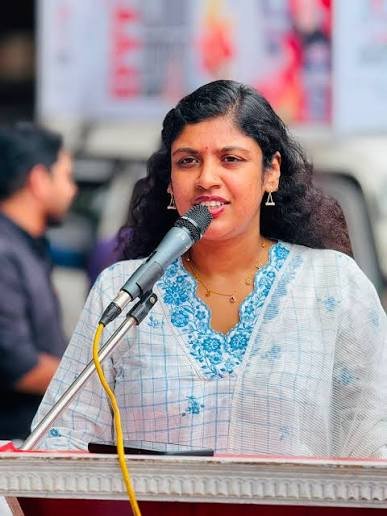
Thrissur, Aug 2026 : The Democratic Youth Federation of India (DYFI), the youth organisation of the CPI-M, has for the first time appointed a woman as president of its Kerala unit, with Chintha Jerome taking charge at a politically challenging juncture for both the organisation and its parent party.
Jerome, a native of Kollam who began her political journey through the Students’ Federation of India (SFI), was elected DYFI Kerala State President at the organisation’s 16th State Conference, which concluded in Thrissur.
The new leadership was announced by DYFI All-India President A.A. Rahim. Kalliasseri MLA and former SFI State Secretary M. Vijin has been elected State Secretary, while R. Rahul will serve as Treasurer.
Jerome’s elevation marks a significant moment in the history of the youth organisation, but her political journey has also been accompanied by controversies. She has faced criticism and questions over issues including her doctoral thesis and some of her public statements. Despite these controversies, her advancement within the CPI-M’s organisational structure has continued steadily.
She is currently a member of the DYFI Central Committee as well as the CPI-M State Committee. Jerome also holds a doctorate in English Literature from the University of Kerala.
The reshuffle, however, also came with a setback for former Thiruvananthapuram Mayor Arya Rajendran, who had reportedly been considered for a prominent position in the new DYFI leadership. Instead, she has been inducted into the organisation’s 25-member State Secretariat.
Rajendran’s political career provides an important backdrop to the leadership changes. She became Thiruvananthapuram Mayor in 2020 at a relatively young age, with the CPI-M presenting her as a symbol of a new generation of leaders.
However, controversies during her tenure affected that image. Among the most prominent was an incident involving Rajendran and her husband, then CPI-M legislator K. Sachin Dev, and a KSRTC bus driver, which attracted considerable public attention.
The political consequences became more evident during the 2025 local body elections, when the Bharatiya Janata Party (BJP) made a historic breakthrough by wresting control of the Thiruvananthapuram Corporation from the CPI-M after more than four decades.
Sachin Dev subsequently suffered defeat in the Assembly elections but has now been included among the four new vice-presidents of the reconstituted DYFI leadership.
For much of the past decade, DYFI operated in a relatively favourable political environment, particularly during the years of the Pinarayi Vijayan-led Left government in Kerala. The organisation became known for its highly visible street protests and political mobilisation, while several of its leaders subsequently moved into significant positions within the CPI-M.
However, the political circumstances have changed considerably following the Left’s major setback in the recently concluded Assembly elections.
The new DYFI leadership therefore inherits a considerably more difficult task. The challenge before Jerome and her colleagues will extend beyond organising youth programmes or mobilising supporters for protests.
They will have to reconnect with younger sections of society, respond to changing political aspirations and rebuild public confidence in the organisation’s social and political role.
Jerome’s appointment as the first woman president of DYFI Kerala gives the organisation an opportunity to project a new leadership narrative. But translating that symbolic change into renewed political relevance will be the larger test for the new team.
With the CPI-M itself seeking to regain lost ground, DYFI’s ability to reconnect with Kerala’s youth could become an important component of the Left’s broader effort to rebuild its political base in the state.