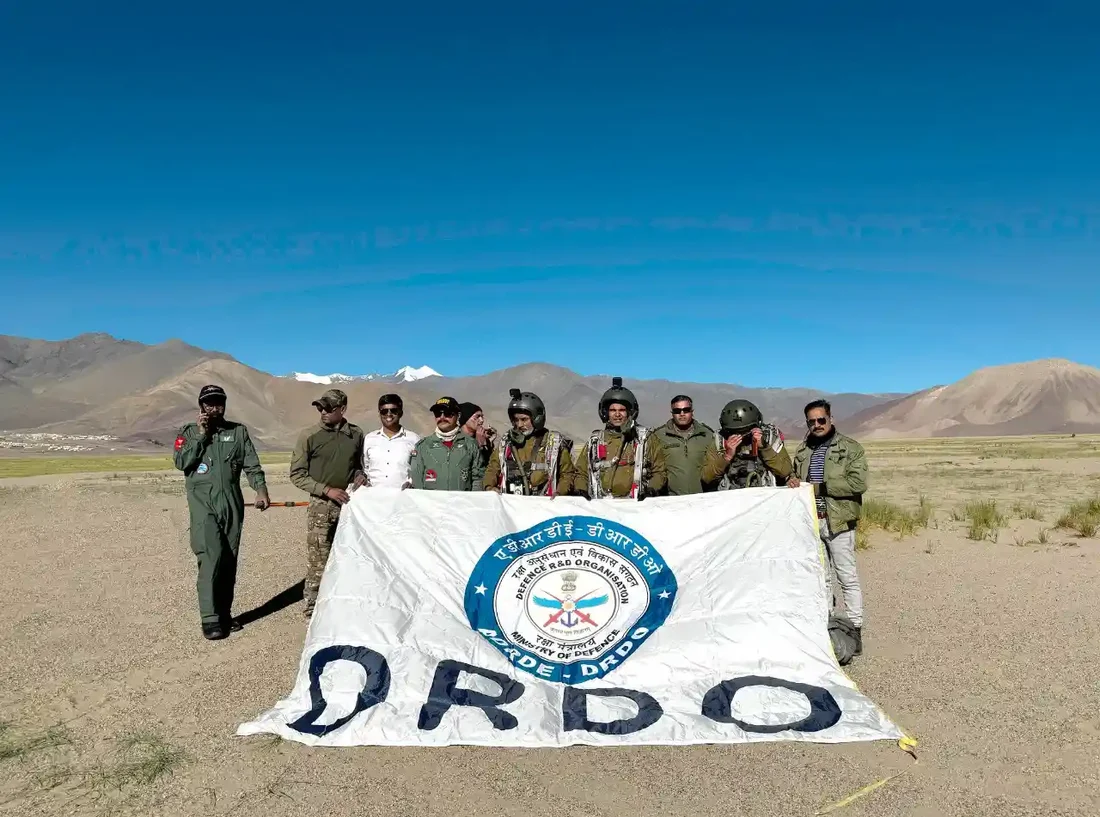
New Delhi, Aug 2026: India’s Defence Research and Development Organisation (DRDO) has successfully conducted a high-altitude trial of its indigenously developed Military Combat Parachute System (MCPS) at the Nyoma-Mudh Drop Zone in Ladakh, demonstrating the system’s ability to support specialised airborne operations in extreme conditions.
During the trial, test jumpers carried out a combat free-fall jump from an altitude of 22,000 feet above mean sea level in temperatures of around minus 15 degrees Celsius. The parachutes were deployed at 20,000 feet and the jumpers landed safely at an altitude of 13,700 feet.
The successful demonstration is being seen as an important validation of the MCPS for tactical operations in high-altitude environments, where low atmospheric density, limited oxygen, severe cold and difficult terrain pose significant challenges to airborne personnel and equipment.
The MCPS has been designed and developed by DRDO’s Aerial Delivery Research and Development Establishment (ADRDE), Agra, in collaboration with the Defence Bioengineering and Electromedical Laboratory (DEBEL), Bengaluru.
The system is intended primarily for the tactical insertion of special forces personnel carrying combat loads into designated operational areas. Its design incorporates features aimed at improving control, navigation and landing accuracy during high-altitude parachute operations.
The latest trial was conducted by ADRDE test jumpers Wing Commander Rahul Jha, Chief Test Jumper, Master Warrant Officer R J Singh, VM(G), and Master Warrant Officer Vivek Tiwari. Along with the MCPS, the team used a range of indigenous subsystems, including a para computer, oxygen system and specially designed jumpsuits.
These integrated systems provide essential navigation, breathing support and thermal protection during high-altitude descents, where environmental conditions can rapidly affect both human endurance and equipment performance.
The MCPS incorporates advanced tactical capabilities, including a lower rate of descent and enhanced steering. These features allow paratroopers to leave an aircraft, deploy the parachute at a predetermined altitude, navigate towards a selected landing zone and make a controlled descent.
Another significant feature is its compatibility with Navigation with Indian Constellation (NavIC), India’s indigenous satellite navigation system. NavIC integration can reduce dependence on foreign navigation systems and provide greater resilience in situations where access to external navigation infrastructure may be restricted or disrupted.
The parachute system is designed to support multiple specialised modes of deployment, including High Altitude High Opening (HAHO), High Altitude Medium Opening (HAMO) and High Altitude Low Opening (HALO) operations.
The overall system includes a main parachute, reserve parachute, harness and container, automatic activation device, deployment mechanisms, navigation equipment, an altimeter and satellite navigation capability. It also provides for the integration of communication and oxygen equipment.
The broader configuration incorporates a high-altitude oxygen breathing system and individual equipment developed by DEBEL, enabling personnel to operate more effectively during missions conducted at extreme elevations.
The MCPS weighs approximately 22 kg and is designed to carry payloads ranging from 50 to 200 kg. It can support free-fall deployment from altitudes of up to 30,000 feet, making it suitable for specialised missions where conventional low-altitude parachute insertion may not be practical.
The latest trial builds on earlier high-altitude demonstrations of the system. In October last year, Indian Air Force test jumpers successfully conducted a combat free-fall jump from 32,000 feet using the MCPS. The system has been described as the only parachute system currently operational with the Indian Armed Forces capable of deployment above 25,000 feet.
The Nyoma-Mudh demonstration is particularly significant because operations at such altitudes present complex technical and physiological challenges. Reduced air density affects parachute performance, while limited oxygen availability increases the risks for personnel. Extreme temperatures can also affect equipment and human endurance, while mountainous terrain demands precise navigation and landing control.
The successful test therefore provides an important indication of the MCPS’s reliability and tactical utility under demanding operational conditions.
Beyond the immediate technological achievement, the trial underscores India’s continuing efforts to develop critical defence capabilities domestically. Indigenous systems can reduce dependence on foreign equipment, simplify maintenance and upgrades, and improve operational preparedness.
For the armed forces, an indigenous high-altitude combat parachute system could prove particularly valuable for special forces operating in strategically sensitive mountainous regions. It can provide greater flexibility for airborne insertion and help troops reach difficult or inaccessible operational areas.
The successful Ladakh trial marks another step in the development of India’s specialised airborne capabilities. It reinforces the country’s focus on equipping its armed forces with advanced indigenous systems designed specifically for the demanding conditions of high-altitude warfare and specialised military operations.