Regular flower supplies reach several districts of Odisha; 12–15 vehicles dispatched daily during the season
Family-run farming enterprise provides regular employment to 15–20 villagers
Raipur, November 2026: With innovative farming practices, hard work and a keen understanding of market demand, a farmer from Chhattisgarh’s Raigarh district has turned marigold cultivation into a profitable business, while also generating employment for local residents.
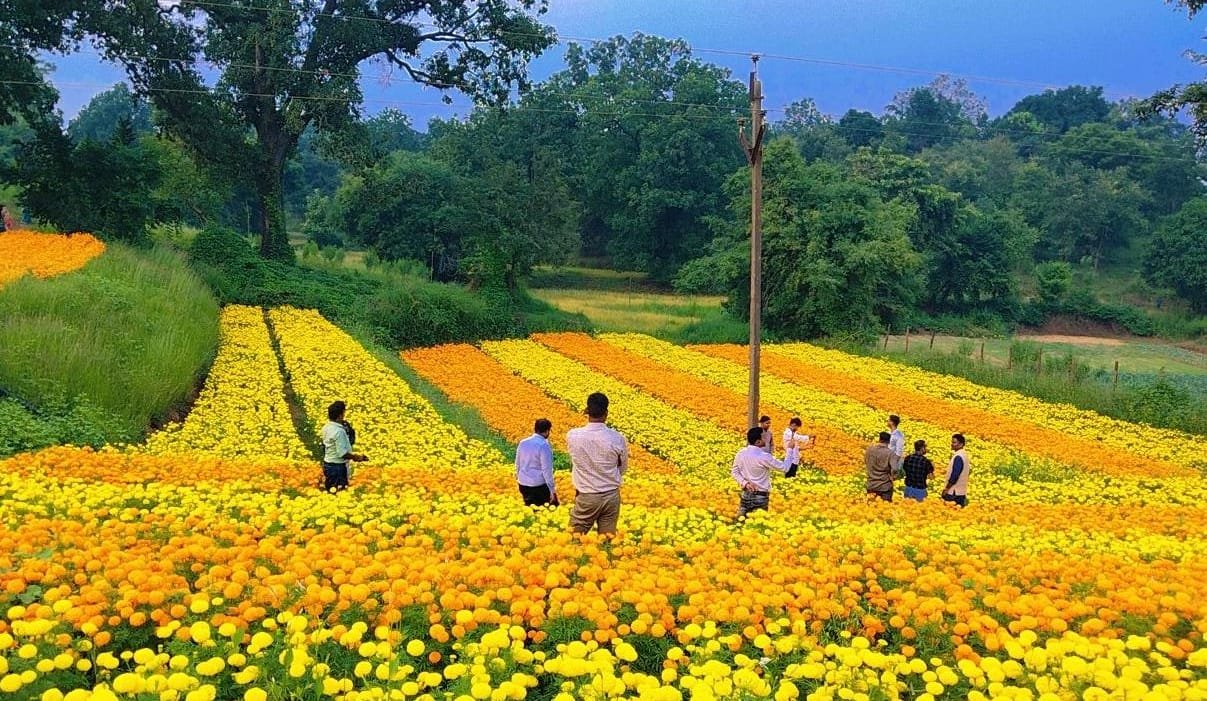
Vidyadhar Patel, a resident of Kodkel village in Lailunga development block of Raigarh district, has been cultivating marigold flowers since 2007–08. Today, he grows the flowers across 7–8 acres, supplying markets in various districts of Chhattisgarh as well as neighbouring Odisha.
Through his farming enterprise, Patel has not only established a steady source of income for his family but has also created regular employment opportunities for people in his village.
Idea to cultivate flowers emerged from agricultural exhibitions
Patel says he had been engaged in vegetable cultivation since 1994–95. During this period, he participated in agricultural exhibitions organised in Raipur and Raigarh, where he demonstrated vegetable cultivation in pots.
It was during these exhibitions that he noticed the growing demand for marigold flowers and their strong sales potential. This encouraged him to explore commercial flower cultivation. He began growing marigolds in 2007–08 and gradually expanded the area under cultivation as he gained experience.
Polybag technique helps reduce cultivation losses
In the initial years, Patel faced several challenges in growing marigold plants. Earlier, he prepared seedlings directly in open fields. However, poor seed germination often forced him to procure fresh seeds and repeat the sowing process.
This delayed plant preparation and sometimes prevented him from supplying flowers during the peak Dussehra and Diwali seasons. Delayed sales also increased the risk of flowers getting damaged and the investment going to waste.
To overcome these difficulties, Patel adopted the practice of raising seedlings in polybags. The technique gave him greater flexibility in managing production and sales. Even if flowers could not be sold during Diwali, they could be marketed later, reducing the possibility of losses and helping him maintain a better balance between production and market demand.
Sales of up to ₹5 lakh per acre
According to Patel, marigold cultivation generates sales of approximately ₹5 lakh per acre, against an estimated cultivation cost of ₹1 lakh to ₹1.5 lakh per acre.
Demand for marigold flowers is particularly high between Dussehra and Diwali. He plans his cultivation and marketing activities around this peak-demand period.
For irrigation, Patel has two private borewells. He has also laid pipelines across his fields and uses drip and sprinkler irrigation systems wherever required.
Markets across Chhattisgarh and Odisha
The marigold flowers produced on Patel's farm have a strong market not only in Chhattisgarh but also in several parts of neighbouring Odisha.
Regular supplies are sent to Sundargarh, Jharsuguda, Rourkela, Sambalpur and Bargarh in Odisha. Within Chhattisgarh, his markets include Sarangarh, Raigarh, Sakti, Champa, Korba, Ambikapur and Jashpur.
During the peak season, approximately 12–15 vehicles are dispatched daily to distribute the flowers across these markets.
Patel follows a cash-based sales system and ensures timely payments to agricultural workers and vehicle operators, helping maintain smooth operations throughout the season.
Family support creates employment for villagers
Patel's family plays an important role in managing the farming business. His wife and all three daughters actively assist him in agricultural activities.
In addition, around 15–20 workers from the village are regularly employed on the farm. To transport flowers to different markets, Patel uses his own vehicles and hires another 8–10 vehicles every day, depending on demand.
The enterprise therefore generates direct employment for farm workers and indirect livelihood opportunities for transport operators.
Vegetable cultivation diversifies farm income
Apart from marigold cultivation, Patel grows seasonal vegetables on approximately 4–5 acres. His produce includes okra, yardlong beans, cabbage and cauliflower.
After the marigold season ends, he shifts his attention to vegetable cultivation and marketing. He also grows traditional Chhattisgarhi varieties of leafy vegetables, locally known as Chhattis Bhaji, in his kitchen garden.
By combining flower cultivation with seasonal vegetables, Patel has diversified his agricultural activities and developed multiple sources of income for his family.