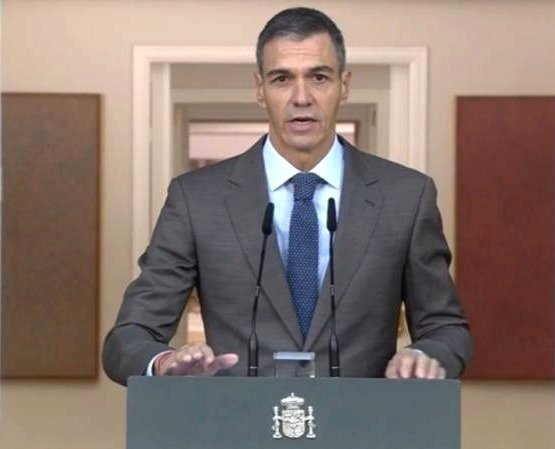
Madrid; October 2026: Yesterday the Spanish government has announced that the general elections are going to be held on Sunday, 29th November this year (2026).
The Prime Minister has stated that the dissolution of Parliament and the official announcement of the elections will be formalised by a decree, which is scheduled for publication today (Wednesday - October 07th IST). Although ordinary administration and contracts already in place can continue under the caretaker government within its powers, procedures that depend on new political decisions, budget authorisations, multi-year funding, or the approval of new programs may be subject to greater administrative caution and, after the elections, to the priorities of the next government.
Meanwhile, the Special Modernisation Programs (PEM) launched by the Spanish Government in 2025 to strengthen the capabilities of the Armed Forces and increase defence efforts are facing difficulties in extending their reach to the wider industrial sector. Supplier companies, especially technology and supply chain SMEs, warn that several projects are progressing slowly and that the effects of the committed investment continue to be concentrated among large contractors, as per official sources.
The modernisation portfolio is one of the pillars of defence industrial policy. The Ministry of Defence have launched 31 initiatives, which were ultimately broken down into 35 Strategic Modernisation Projects (PEMs), aimed at modernising capabilities, strengthening strategic autonomy, and generating employment within the Defence Industrial and Technological Base. Their implementation extends over several years and, in theory, should mobilise not only major integrators but also their supplier networks, technology centres, and specialised companies.
The projected cost for 2026 of the PEM projects launched in 2025 amounts to 2,272.7 million euros, according to a report by Opina 360. Of that figure, the projects led by Indra account for 1,365.65 million, equivalent to 60.1% of the total.
The largest program this year is the self-propelled tracked artillery, awarded to the joint venture of Indra and Escribano Mechanical & Engineering. It has an allocation of €653 million in 2026, within a contract of approximately €4.554 billion. This is followed by the mid-life modernisation of the F-100 frigates, led by Navantia, with €349 million, and the Airbus multi-purpose light helicopter for training purposes, with €290 million.
Also included is the Tracked Support Vehicle (VAC), with €245 million earmarked for 2026. However, the contract was still pending signature at the end of September, according to the initial document. This is one of the projects most likely to face delays: not simply due to the election, but because an incomplete tender or formalisation process enters a period of institutional transition and limited political impetus.
The modernisation of the F-100 frigates, on the other hand, has a more continuous schedule, with €349 million allocated in 2026 and €421 million planned for 2027. The Strategic Expansion Plans (PEM) are multi-year instruments; an election does not, in itself, eliminate obligations already undertaken. However, it can affect the pace of authorisations, the implementation of new phases, and the completion of projects that still require significant administrative decisions.
On the otherside, the SMEs have demanded effective access; The sector's criticisms focus on two areas:
·One, companies denounce the lack of agility of public institutions in launching highly complex projects.
·Two, they warn that some contracts are slowed down when they reach the large contractors responsible for structuring and activating the supply chain.
By the time programs reach the award stage, a significant portion of their activities are already defined or assigned. This makes it difficult for new technology providers to join later, even if they possess unique capabilities. One of the business sources cited in the Aesmide report estimated that approximately 05% of the funds would reach SMEs .
This concentration is not necessarily anomalous in complex platform programs: large systems such as a frigate, an aircraft, a combat vehicle, or an artillery system need a lead company with integration capabilities, contractual responsibility, and support for decades. The question raised by SMEs is whether this model ultimately generates enough orders, visible timelines, and real opportunities for the auxiliary industry .
Predictability is especially important for companies that need to expand facilities, hire technical staff, certify processes, or finance their own developments before securing a firm order. Without this visibility, private investment is postponed, and the risk is that large-scale industrial projects will not produce the promised industrial multiplier effect.
The defence schedule already included the incorporation of at least 15 new PEMs (Projected Equipment Modules) by 2026, with an initial announced investment of over €1.4 billion. Furthermore, the official forecast placed the incorporation of the National LEO Capability, linked to secure satellite communications, by 2027 as Spain's contribution to a future European system.
The snap election now necessitates separating three categories:
·The first includes contracts already awarded and formalised, whose execution must continue according to their clauses.
·The second encompasses programs with approved funding but pending industrial milestones, subcontracting, or manufacturing authorisations.
·The third covers new initiatives, budget increases, and projects in the definition phase, which will be the most sensitive to the formation of the new government and its defence and industrial policies.
The case of the ATP (Assisted Transport Program) on tracks illustrates this difference. The program was awarded to Indra and Escribano, and both companies subsequently advanced their industrial and technological implementation, including cooperation with Hanwha for the K9 platform. The system includes 128 howitzers, ammunition resupply vehicles, recovery vehicles, command, maintenance, and support vehicles, with a target completion date of 2034. Its continuation will depend primarily on contract execution, although future budgetary decisions will remain crucial.
The programs without signed contracts or those requiring further impetus are more uncertain. The industry will have to wait to see if the election period alters specific timelines or if the Ministry of Defence maintains the technical and administrative processing of ongoing projects.
The Ministry of Defence maintains that the 35 Special Military Projects (SMPs) in the 2025 plan have a combined spending ceiling of €34 billion until 2042 and could generate more than 155,000 jobs during their implementation cycle. For this impact to materialise, the announcements must translate into contracts, orders, and a supply chain that extends beyond the main integrators.
The calling of elections does not automatically halt the modernisation of the Armed Forces, but it comes at a delicate stage: several major programs are still trying to move from budgetary decisions to actual production. For SMEs, the decisive indicator will not only be the volume committed, but also the speed with which large contracts translate into verifiable and sustained workload.
Team Maverick.