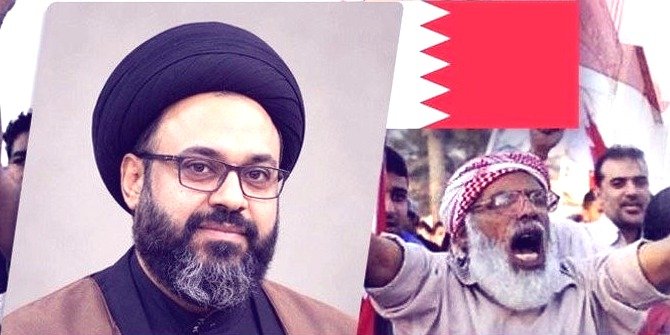
Manama; November 2026: Sheikh Sayyid Abbas Shubbar al-Musawi, a member of Bahrain’s Al-Wefaq National Islamic Society, says Bahrain’s targeting of Shia scholars is aimed partly at undermining religious institutions and weakening the public space for expressing opposition to the regime. “A sweeping Bahraini court ruling sentencing dozens of Shia clerics and other defendants to life imprisonment will not silence the community or make its legitimate demands disappear”, said Al-Musawi who is an opposition activists facing a life sentence himself.
“These verdicts may impose a harsh reality on the convicted and their families and deprive society of the presence of a number of its religious scholars and figures, but they cannot erase people’s beliefs or deprive them of their right to uphold their positions and legitimate demands”, Al-Musawi has said.
The prominent Bahraini political activist, who currently resides in Iran and was himself among those tried in absentia and sentenced to life imprisonment, was commenting on a sweeping court ruling against 69 defendants, most of them Shia scholars and seminary teachers.
The so-called "High Criminal Court in Manama" have sentenced 64 defendants to life imprisonment and handed five others 15-year prison terms. Not a single defendant was acquitted, a development that, al-Musawi said, raised fundamental questions about the nature of the case and whether the defendants had received the guarantees necessary for a fair trial.
The ruling marks a significant escalation in the Bahraini regime’s long-running crackdown on the country’s Shia majority, which has faced political marginalisation, restrictions on religious and civil liberties, and the imprisonment of prominent religious and opposition figures, particularly since the 2011 pro-democracy uprising. The case also comes amid heightened regional tensions and a broader crackdown on voices opposing Bahrain’s involvement in the US-Israeli war on Iran or expressing solidarity with the Islamic Republic.
A mass conviction have raised several fundamental questions about justice for the nations netizens. Al-Musawi said his opposition extended beyond the severity of the sentences to the entire legal basis of the case and the allegations underpinning it. He noted that the proceedings could not be separated from the religious and academic activities of the defendants, their connections with religious authorities, and their roles in education, religious guidance and social affairs.
Such activities, he stressed, should not be turned into evidence of criminality or treated as security threats. More troubling, he said, were accounts the defendants had reportedly conveyed directly to their families about torture, coercion and threats, as well as the difficulties they encountered during interrogation and trial.
Families had described mistreatment, pressure and the signing of documents under circumstances that undermined the defendants’ free will and the integrity of legal procedures. They had also reported problems concerning the right to mount a defence and the conduct of the proceedings, he added.
The Bahrain Institute for Rights and Democracy (BIRD) and 20 other human rights organisations recently said defendants had reported being subjected to coercive practices, threats against themselves and their families, and pressure to sign lengthy statements without being allowed to read them. The organisations also raised concerns about restrictions on the defendants’ ability to defend themselves.
Al-Musawi said torture could not be dismissed as a minor procedural violation. “Torture is not merely a temporary procedural violation; it is a flagrant violation that undermines human dignity and destroys confidence in the evidence and confessions obtained through it. Both legally and ethically, authorities could not legitimately rely on confessions extracted through coercion, nor could the mere fact that a court had issued a verdict serve as sufficient proof that the proceedings had been fair. Therefore, our objection is not limited to the severity of the sentences; rather, it concerns the entire basis of the case, the violations committed, and the problems that the defendants have conveyed to their families. We believe the primary task is to overturn these verdicts, secure the release of those convicted, investigate allegations of torture and coercion, and hold those responsible accountable".
The context of the case has further intensified concerns over its fairness. Fifty-six (56) defendants were reportedly arrested in May and June after Bahraini regime forces raided Shia-populated neighbourhoods without judicial warrants and took detainees to undisclosed locations.
Thirteen (13) defendants, including exiled senior cleric Ayatollah Sheikh Issa Qassim, the leader of Bahrain’s Shia community, were tried in absentia. The prosecution had accused the defendants of involvement in a so-called “terrorist” group, claiming that it sought to overthrow the constitutional order and promote the doctrine of Velayat-e Faqih (Guardianship of the Islamic Jurist) by gaining control of mosques and local religious gatherings. Al-Musawi maintained that religious affiliations and scholarly activities should not be confused with criminal conduct.
Addressing whether the heavy sentences could break the resolve of Bahrainis or deter religious scholars from expressing their positions, al-Musawi stressed the authorities were mistaken if they believed imprisonment could eliminate the influence of religious figures or erase the beliefs of the people.
“The will of nations is not measured by the number of prisoners or the length of sentences, just as the standing of religious scholars does not derive from those in power”, he said while explaining that the standing of religious scholars came from their knowledge, religious responsibilities and the trust placed in them by the public.
Al-Musawi acknowledged that imprisoning prominent religious figures could impose genuine hardships on society. Their absence could disrupt religious and social activities and damage the institutions in which they had served or undertaken educational responsibilities. However, he noted, removing the individuals who carried those beliefs could not eliminate the beliefs themselves or erase their place in society’s collective consciousness.
He also invoked the Qur’anic principle of justice, which, he said, must prevail regardless of differences or hostility. Quoting the Qur’an, he cited the verse: “ill feeling for a people should never lead you to be unfair [5:8]. This principle requires respect for the rights of dissenters and prohibits the use of the judiciary or punitive measures as tools to silence voices whose religious or political positions do not align with those of the authorities”, added al-Musawi. He said religious scholars should not be expected to abandon their responsibilities simply because they faced pressure through harsh sentences. Instead of responding to differences through punishment and exclusion, the regime in Manama should address them through dialogue and respect for rights, added the scholar.
“Clearly, this case goes beyond the mere trial of individuals. The charges and issues surrounding religious authorities, the doctrine of Velayat-e Faqih, and regional relations raise a fundamental question: the need to distinguish between religious beliefs and intellectual or political positions, on the one hand, and criminal acts, responsibility for which can only be established through specific evidence, on the other. Connection with a religious authority, acceptance of a particular jurisprudential position, or association with religious scholars and authorities does not, in itself, constitute evidence of committing a crime”, said the scholar.
The same principle, he argued, should apply to political positions on regional developments. “Therefore, affiliation with a religious authority, adherence to a particular jurisprudential interpretation, or ties with religious scholars and authorities cannot, in themselves, constitute evidence of a crime; likewise, taking a position on regional developments, expressing solidarity with the Palestinian cause, or opposing the normalisation of relations with the Zionist regime should not be turned into grounds for criminalising those who hold such views”, while further adding “the severity of the sentences, combined with reports of torture and procedural irregularities communicated by defendants to their families, raised serious questions about the independence of the judicial process from political and security considerations”.
He rejected the notion that simply attaching a security label to a case could shield the proceedings and judgments from scrutiny. “National security is not achieved by restricting religious freedoms or punishing those who hold different views. Genuine security depended on justice, respect for pluralism and the protection of citizens’ dignity. Whenever the judiciary is used as an instrument in political conflicts, public trust in institutions erodes, widening the gap between the government and society”.
Turning to the role of the international community and human rights organisations, al-Musawi said statements expressing concern and general calls for respect for human rights were no longer sufficient following the mass convictions. He added that the scale of the sentences, without a single acquittal, and the reports of torture, coercion and procedural violations require concrete action.
He outlined six measures that international and human rights organisations should pursue:
·First, he called for the annulment of the sentences handed down against the defendants and their release, stressing the need to end the legal and human consequences of the rulings.
·Second, al-Musawi urged an “independent and serious investigation” into incidents of torture, ill-treatment and coercion that the defendants had reported to their families through direct contact. He said anyone proven to have been involved in such violations must be held accountable.
·Third, he called for a review of the grounds and evidence underpinning the convictions, verification of the validity of confessions and statements, and the exclusion of any material obtained through “torture, threats or coercion.”
·Fourth, he pointed to the importance of documenting violations committed during interrogations and trials, particularly those involving the right to a defence. He also called for defence lawyers to be given access to case files and enabled to “fully perform their duties.”
·Fifth, al-Musawi called for the activation of international mechanisms aimed at combating torture and protecting freedom of religion and belief, as well as freedom of expression. He also urged the relevant authorities to monitor the situation of those convicted in prison and ensure their safety and fundamental rights.
·Finally, he called for legal and humanitarian support for the families of detainees, warning against leaving them alone to shoulder the “psychological, social and economic burdens” resulting from the sentences.
“Human rights are indivisible, and legal protection for a human being must not be diminished because of his religion, opinion or political position”, he said.
Team Maverick.