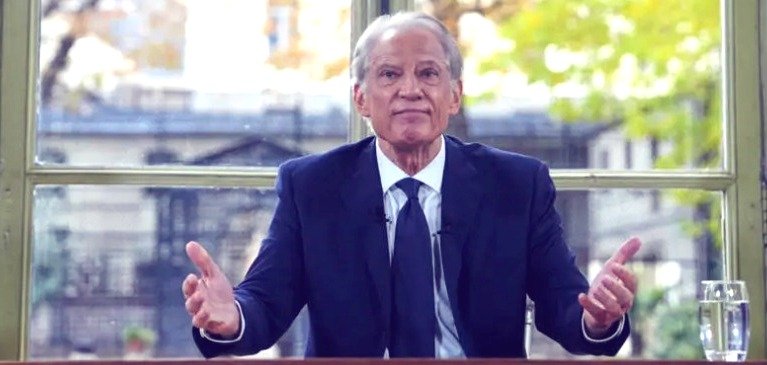
Paris; November 2026: Former French Prime Minister Dominique de Villepin has announced his candidacy for the 2027 presidential election, promising to restore France's international influence, tackle growing inequality and challenge the rise of the far-right. The veteran conservative also delivered a blistering assessment of President Emmanuel Macron's leadership, accusing him of allowing the country's political and social divisions to deepen.
Yesterday (Friday – 20th November 2026) the former French prime minister entered the race for the Élysée, presenting himself as a defender of France's republican traditions and warning that a far-right victory in next year's presidential election could plunge the country into turmoil. The 73 years old, who served as Prime Minister under President Jacques Chirac, announced his candidacy in Paris, invoking the legacy of General Charles de Gaulle and calling for a fundamental change in the way France is governed.
His announcement comes amid weeks of demonstrations over wages, living costs and education, mounting concerns over public debt and growing political divisions ahead of the April presidential vote.
De Villepin has described France as suffering from "social decay", pointing to widening inequality, environmental setbacks and deteriorating public finances. "The coffers are empty", he declared, accusing successive governments of failing to confront the country's problems.
He reserved some of his sharpest criticism for Macron, whose second and final term ends next year, describing him as a "ghost president" who had lost touch with ordinary French people. He has also accused the authorities of ignoring protesters' demands and resorting to repression, arguing that government failures had strengthened both Marine Le Pen's far-right National Rally and Jean-Luc Mélenchon's hard-left France Unbowed party.
While criticising both political extremes, de Villepin insisted that Le Pen and Mélenchon did not represent equivalent threats to the republic. He argued that National Rally continued to carry a legacy of xenophobia, racism and antisemitism. "Who can seriously believe that Marine Le Pen's planned election next May would unfold peacefully?" he asked.
Opinion polls have consistently placed Le Pen among the leading presidential contenders, raising the prospect of a far-right victory after her defeats against Macron in the second rounds of the 2017 and 2022 elections. With Macron constitutionally barred from seeking a third consecutive term, the contest is expected to be fiercely fought.
De Villepin's entry adds another prominent figure to the centre-right field, although his political positioning sets him apart from much of the traditional conservative establishment. He has increasingly appealed to voters on the left through his criticism of economic inequality and Israel's war in Gaza.
Internationally, he remains best known for his February 2003 speech before the United Nations Security Council opposing the US-led invasion of Iraq – an intervention that established his reputation as a defender of multilateral diplomacy and French independence. He is now seeking to draw on that legacy, promising to restore France's diplomatic influence and reaffirm its independent voice on the international stage.
De Villepin has also placed France's economic difficulties at the centre of his campaign, pledging to confront public debt, which has reached around 119 percent of gross domestic product. He called for a new "night of August 4" – a reference to the abolition of feudal privileges during the French Revolution in 1789 – proposing a review of tax advantages and exemptions that he believes contribute to inequality.
"The French people need to be convinced that it is not a case of the richest 1 percent on one side and the remaining 99 percent, who are always the ones being asked to make sacrifices, on the other", he said.
Beyond economic reform, de Villepin challenged what he called Macron's "hyper-president" model, arguing that the head of state should return to the role envisaged by de Gaulle when he established the Fifth Republic in 1958. The President, he said, should act as "an arbiter, a guide for the country", rather than becoming involved in every aspect of government.
However, his path to the Élysée remains uncertain. Before his candidacy can be formally validated, de Villepin must secure sponsorship from at least 500 elected officials – a requirement that prevented him from reaching the ballot when he attempted to run in 2012.
With the first round scheduled for 18 April 2027, the former Prime Minister must now turn his public profile and cross-party appeal into electoral support in an increasingly crowded contest.
Team Maverick.