MOSCOW, Nov 2026 : Russia is seeking to revive and expand its prewar security demands as the United States explores discussions on a broader European security framework alongside efforts to end the war in Ukraine. Nearly five years into the conflict, the Kremlin has welcomed the proposal from US President Donald Trump's envoys, viewing it as an opportunity to revisit long-standing objections to NATO's eastward expansion and the presence of Western military forces near Russian borders.
The prospect of wider security negotiations has raised concerns in Ukraine and among its European allies. They fear that Moscow could use the diplomatic opening to secure concessions that weaken NATO, restrict Ukraine's future security choices and reshape Europe's security arrangements on terms favourable to Russia.
The Kremlin, however, has described a review of the European security framework as essential to achieving a lasting settlement to what has become the continent's most devastating conflict since World War II.
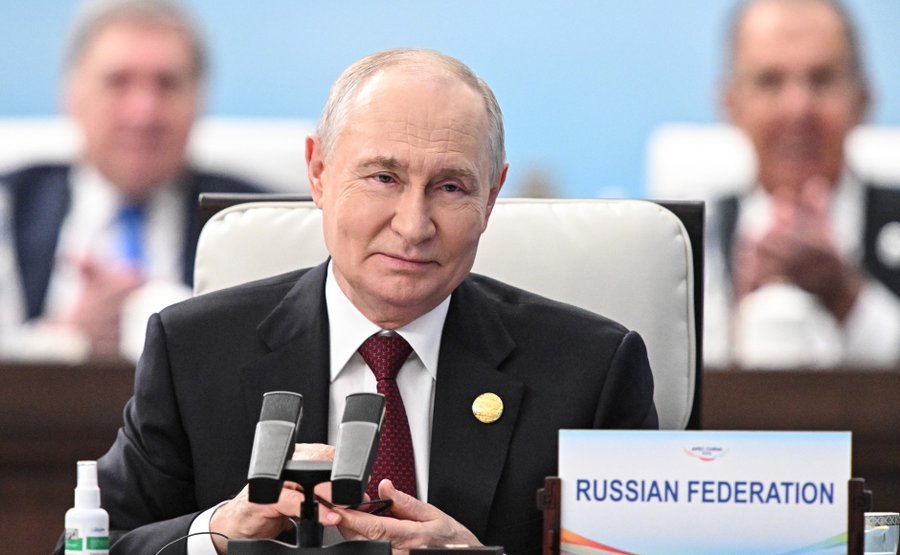
Russian President Vladimir Putin discussed the war in Ukraine with Trump and Chinese President Xi Jinping on the sidelines of the APEC summit in Shenzhen, China. The encounter, described as their first trilateral meeting, has heightened concerns in Kyiv that major powers could discuss a possible settlement without Ukraine having a meaningful role in the process.
Ukrainian President Volodymyr Zelenskyy has insisted that any ceasefire must be accompanied by credible security guarantees to prevent another Russian attack. European leaders maintain that NATO already provides the foundation for the continent's collective security, while Moscow wants a broader arrangement that addresses its objections to the alliance's military presence and expansion.
Russia's 2021 security demands return to the table
Russia's current position draws heavily on proposals it submitted to the United States and NATO in December 2021, just two months before the launch of its full-scale invasion of Ukraine on February 24, 2022.
In draft agreements presented at the time, Moscow demanded that Washington and its allies formally rule out further NATO expansion to Ukraine, Georgia and other countries that were once part of the Soviet Union.
Russia also sought commitments preventing the United States and its NATO allies from deploying weapons or conducting military activities in Ukraine and other former Soviet republics.
Another major demand concerned NATO's military presence in Central and Eastern Europe. Moscow wanted the alliance to refrain from stationing troops in areas where they had not been deployed in 1997, before NATO began incorporating former Soviet bloc countries and ex-Soviet republics.
The Russian proposals also called for restrictions on military activity near national borders. These included a possible freeze on patrols by Russian and US warships and bombers close to each other's territory, as well as measures to reduce the risk of incidents involving Russian and NATO aircraft and naval forces, particularly in the Baltic Sea and Black Sea regions.
Moscow further proposed limiting the scale of military exercises, improving transparency and introducing additional confidence-building measures to reduce the possibility of accidental confrontation.
NATO allies rejected the proposals, regarding several of the demands as unacceptable because they would effectively restrict the alliance's ability to determine its own security arrangements and the choices of sovereign countries seeking membership.
Putin subsequently cited the West's refusal to consider Moscow's security concerns as a principal reason for ordering Russian forces into Ukraine in February 2022. He argued that Russia had been compelled to act to protect its national security. Ukraine and its Western partners have rejected that justification, describing the invasion as an unprovoked act of aggression.
Kremlin sees an opening to expand its demands
Following his discussions with Trump and Xi, Putin again criticised Western governments for failing to take Russia's objections to NATO expansion seriously before the war.
"They just spat at our opinion," he said, reiterating Moscow's position that its security concerns had been ignored.
Putin also dismissed Europe's response to Russia's earlier proposals, describing it as "political diarrhea" and "nonsense". He maintained that Russia did not seek a war with European countries, saying that "everybody understands that we don't strive for a war with Europe".
At the same time, the Russian President said Moscow was prepared to discuss the future of European security with European governments, as suggested by the US administration. He criticised what he called "hysterics in some European capitals" over Washington's proposal.
"We understand that it makes no sense to discuss issues related to security in Europe without the Europeans," Putin said.
He added that Moscow had invited a European delegation to visit Russia and present its negotiating position. The Kremlin would then decide on the date and format of further discussions concerning Ukraine.
Putin said Russia was willing to look for compromises but would not abandon its fundamental security demands. He has also issued a strong warning against the deployment of European troops in Ukraine after the fighting ends, saying Moscow would regard such forces as legitimate targets.
Kremlin foreign affairs adviser Yuri Ushakov said Putin had recalled Russia's December 2021 security proposals during his November 12 meeting with Trump's envoys, Steve Witkoff and Jared Kushner, at the Kremlin.
According to Ushakov, those proposals had envisaged the withdrawal of NATO forces from Central and Eastern Europe. He added that Moscow would now update its position with what he described as "fresh considerations".
The statement suggests that Russia may seek to use the proposed negotiations not merely to address the immediate conflict in Ukraine but also to reopen wider questions about NATO's military posture and Europe's security architecture.
Analysts see possible room for compromise
Although Putin remains firm in his opposition to Ukraine joining NATO and to the deployment of Western troops on Ukrainian territory, some observers believe Russia could show flexibility on other parts of its negotiating position.
Alexei Naumov, a pro-Kremlin political commentator, said Moscow's demands should be viewed as an initial bargaining position that could be adjusted during negotiations.
He argued that there was considerable room for an agreement between maintaining the current security arrangements and accepting all of Russia's demands.
"Between maintaining the current status quo and the full realization of Russia's demands, there is a vast space for compromise: mutual arms limitations, agreements regarding the deployment of military infrastructure, the parameters for a future Ukrainian military, security guarantees, and mechanisms to monitor their implementation," Naumov said in a commentary.
"Russia is currently negotiating from a position of strength, but that does not at all mean there will be no compromises," he added.
Tatiana Stanovaya, an expert at the Carnegie Russia Eurasia Center, said the current diplomatic initiative represented a significant opening for Moscow.
"For the first time since 2022, Moscow sees a concrete opening for negotiations that could address what it calls the root causes' of the war," she said.
Stanovaya cautioned, however, that the Kremlin's expectations for the current round of discussions remained limited.
"The Kremlin thinks the opportunity is worth pursuing, even though its expectations for this round are low," she said. "If the talks fail, Russia is prepared to keep fighting until another opening presents itself."
Russia expert Mark Galeotti, head of the Mayak Intelligence consultancy, suggested that Moscow's extensive list of demands could be a negotiating tactic.
He described it as a "classic attempt to start with a very, very exaggeratedly ambitious list of proposals with the expectation that you get haggled down".
Galeotti has also suggested that Putin could be looking for a way to end the war without having achieved all the territorial gains in Ukraine that he initially sought. A broader diplomatic agreement could potentially offer the Russian President a way to present an outcome as a strategic settlement, even if Moscow has to make concessions.
Ukraine and Europe warn against security negotiations on Moscow's terms
European governments are concerned that Putin could persuade Trump to support an agreement that compromises Ukraine's sovereignty and weakens the wider European security system.
The European Union's top diplomat, Kaja Kallas, has argued that a ceasefire must come before negotiations on broader security arrangements. Her position contrasts with Moscow's preference for discussing the European security framework as part of the process.
"If we start to talk about what Russia is asking regarding the security architecture, we actually walk into the traps that Russia is setting us," Kallas said earlier this month at a meeting of the European Political Community in Dublin.
Zelenskyy has also warned that discussions about a new European security framework before the end of the war could be dangerous. Kyiv fears that Moscow could use such negotiations to undermine NATO, limit Ukraine's future defence options and seek changes to Europe's borders.
The Ukrainian government wants security guarantees to be central to any settlement, arguing that a ceasefire without effective safeguards could leave the country vulnerable to another Russian military offensive.
Kushner sought to reassure European leaders after meeting Zelenskyy and other officials in Berlin on Thursday. He said Trump wanted to reach an agreement with Europe "by his side" and was not seeking to impose a unilateral settlement.
Kushner also said Trump was "open" to providing Ukraine with NATO-like security guarantees after the war. He added that he believed Russia was "comfortable" with the possibility of allies offering such assurances to Kyiv.
According to Kushner, Trump joined the Berlin discussions by telephone following his meeting with Putin.
Stanovaya said Putin wanted European governments to acknowledge that Russia would have to be involved in any future negotiations concerning the continent's security arrangements. She also warned that the process could deepen divisions among Western allies without producing an immediate agreement.
"I expect the process to deepen divisions within Europe, with little prospect of concrete results," she said in a post on X.
The proposed talks therefore present a complex diplomatic challenge. Washington is seeking to explore a wider framework that could support an eventual settlement in Ukraine, while Moscow sees an opportunity to revive demands it made before the invasion. Kyiv and European capitals, meanwhile, are determined to ensure that negotiations do not compromise Ukraine's sovereignty or undermine NATO's role in European security.
Whether the initiative can produce a workable compromise will depend on the willingness of the parties to reconcile Russia's demands with Ukraine's security requirements and Europe's insistence that decisions about the continent's future cannot be made without those directly affected.
Disclaimer: This review is based on the reviewer’s individual perspective. Audience opinions may vary.