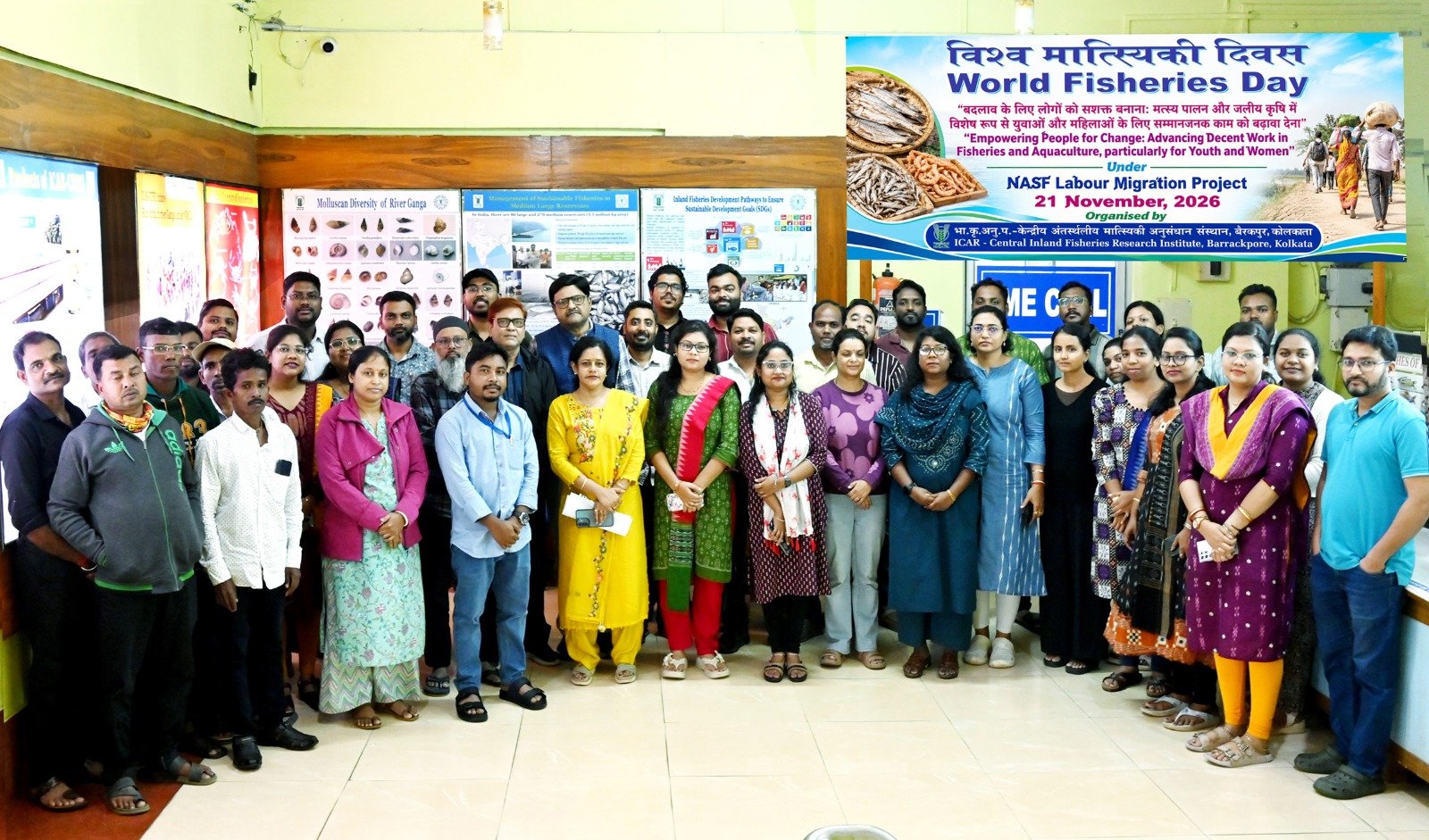
BARRACKPORE, November 2026: Emphasising the importance of inclusive growth, sustainable resource management and livelihood security in the fisheries sector, the ICAR–Central Inland Fisheries Research Institute (ICAR-CIFRI), Barrackpore, observed World Fisheries Day 2026 with the participation of scientists, fishers from the Sundarbans and officials from the Department of Fisheries, Odisha. The programme brought together diverse stakeholders to deliberate on emerging challenges and opportunities in inland fisheries, with particular emphasis on empowering women, youth and small-scale fishing communities.
Addressing the gathering, Dr. Pradip Dey, Director, ICAR-CIFRI, highlighted the vital role of inland fisheries in ensuring food and nutritional security, conserving aquatic biodiversity and sustaining rural livelihoods. He stated, “Empowering communities through knowledge, technology and innovation will help build a resilient and sustainable fisheries sector in India.” He further emphasised the integration of scientific research, responsible resource management and community participation for inclusive fisheries development.
The significance of inland fisheries in India's economy was highlighted, with the country's total fish production reaching approximately 197.75 lakh tonnes in 2024–25 (provisional). Inland fisheries contributed around 147.37 lakh tonnes, accounting for nearly 74.5 per cent of total production. The programme also recognised women's substantial contribution to the sector, with approximately 9.14 lakh women engaged in fisheries on a full-time basis, participating in harvesting, net making, processing, preservation and marketing.
A major highlight of the celebration was a stakeholder interaction under the NASF Labour Migration Project, focusing on labour migration in the fisheries sector, particularly in Odisha and West Bengal. The technical session was chaired by Dr. Hemanta Chowdhury, with Dr. Md. Aftabuddin serving as Co-Chair. Dr. Aparna Roy initiated the discussion by highlighting labour demand and supply dynamics in the fisheries sector.
Participants deliberated on the factors driving migration among fishers and fisheries-dependent communities, its implications for employment and livelihood security, and the challenges faced by migrant fish workers. Special emphasis was placed on creating awareness about government schemes and welfare provisions available to fishers and fish workers in both states. Improved information dissemination, institutional coordination and convergence of welfare schemes were identified as important measures for strengthening social security and livelihood opportunities.
The programme also highlighted ICAR-CIFRI's research achievements, including enclosure culture technologies using diversified high-value indigenous fish species, reservoir fisheries management guidelines and culture-based fisheries interventions. Scientific management practices have enhanced average productivity in selected reservoirs from 20 to 150 kg/ha/year and in wetlands from 600 to 1,600 kg/ha/year. Emphasis was also laid on conserving indigenous fish species, restoring wetlands, protecting natural breeding habitats and promoting climate-resilient fisheries management.
The global theme for World Fisheries Day 2026, “Empowering People for Change: Advancing Decent Work in Fisheries and Aquaculture, particularly for Youth and Women,” underscored the importance of skill development, decent employment and equitable livelihood opportunities. The celebration reaffirmed ICAR-CIFRI's commitment to sustainable and inclusive inland fisheries development through scientific innovation, capacity building and active community participation, contributing towards the vision of Viksit Bharat @2047.