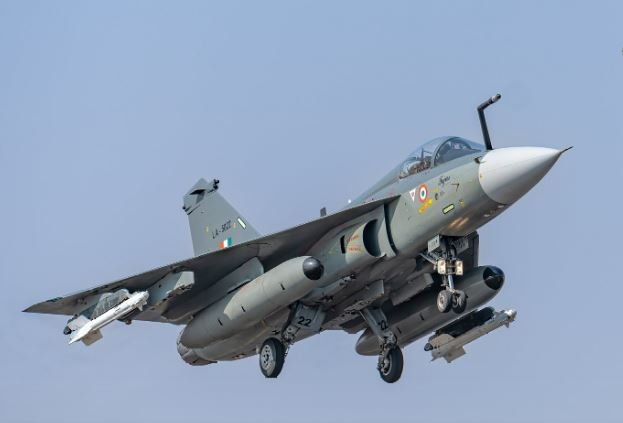
New Delhi, Aug 2026 : India’s indigenous fighter aircraft programme is evolving through a clearly defined technological pathway, moving from the Tejas Mk-1A to the more capable Tejas Mk-2 and ultimately to the Advanced Medium Combat Aircraft (AMCA). The approach is aimed at ensuring that each generation builds on established technologies, systems, expertise and infrastructure rather than beginning development from scratch.
The Tejas Mk-2 is being developed on the foundation created by the Tejas Mk-1A. A significant proportion of technologies, systems and engineering know-how developed for the Mk-1A are expected to provide commonality with the Mk-2. This continuity can help shorten development timelines, reduce technical risks and allow engineers and manufacturers to concentrate resources on areas requiring major technological advancement.
Several core philosophies and systems are being carried forward. The fly-by-wire architecture remains an important element, while the mission-computing environment is expected to retain substantial commonality. The cockpit philosophy also builds on the Mk-1A, including glass displays, Hands-On-Throttle-and-Stick (HOTAS) controls and established human-machine interface systems.
The stores management system and weapons-integration framework provide another area of continuity. The Uttam family of radar systems forms an important part of India’s indigenous sensor development, while electronic warfare software architecture associated with the Defence Avionics Research Establishment and related systems provides a base for further evolution.
Datalink capabilities, software development tools and testing infrastructure are also areas where accumulated experience can be reused. Facilities and methodologies involving Iron Bird, Hardware-in-the-Loop and Software-in-the-Loop testing provide valuable support for aircraft development.
Perhaps equally important is the human expertise accumulated through the Tejas programme. Flight-test teams, certification specialists and engineers have gained experience in designing, integrating, testing and certifying an indigenous fighter. Established certification processes involving the Centre for Military Airworthiness and Certification can further reduce uncertainty in subsequent programmes.
The maturity of composite manufacturing, component suppliers and the broader aerospace vendor ecosystem also represents an important advantage. Years of work on Tejas have helped create an industrial base capable of supporting increasingly complex aircraft programmes.
This approach can be summarised as “Proven. Reused. Accelerated.” Instead of treating every aircraft programme as an independent effort, India is attempting to build a cumulative technology base in which lessons from one generation directly strengthen the next.
The benefits for Tejas Mk-2 are substantial. Greater technology commonality can reduce development time and technical risk while lowering costs and making better use of existing manpower and infrastructure. Operational experience with the Mk-1A also provides valuable feedback for improving the next-generation aircraft.
Tejas Mk-2, however, represents a significant step beyond the Mk-1A. It is being conceived as a medium-weight fighter with a larger airframe, greater fuel capacity, higher payload and more advanced avionics. The aircraft is expected to use the General Electric F414 engine, offering substantially greater thrust than the F404 engine used by the Mk-1A.
The Mk-2 is also expected to incorporate advanced aerodynamic features, including canards, while its larger structure will provide greater scope for fuel, weapons and mission systems. Its payload capacity is expected to exceed six tonnes, compared with roughly three-and-a-half tonnes for the Mk-1A.
The experience gained with the Mk-2 is intended to become another stepping stone towards the AMCA. Engineers can apply lessons from integrating the F414 engine, managing higher power and thermal loads, developing advanced flight-control laws and integrating sophisticated sensors and electronic warfare systems.
AMCA will represent a substantially greater technological leap. The planned fifth-generation fighter is expected to incorporate stealth-oriented shaping, radar-absorbing materials, internal weapons bays and advanced sensor-fusion capabilities. Experience in large-scale system integration gained through the Mk-2 programme can help reduce the risks associated with developing such an advanced platform.
The broader objective is to create an indigenous capability growth cycle. Tejas Mk-1A established and demonstrated the foundation. Tejas Mk-2 is intended to expand that capability through greater range, payload, performance and avionics sophistication. AMCA is envisaged as the next major leap towards advanced stealth combat aviation.
India’s aerospace ecosystem, particularly in Bengaluru, has also matured considerably. Hindustan Aeronautics Limited, the Aeronautical Development Agency, DRDO laboratories and an expanding private-sector supply chain are contributing to the development and manufacture of indigenous aircraft and systems.
Composite production, avionics integration, software development, testing and flight evaluation capabilities have all benefited from the experience accumulated through the Tejas programme. This industrial depth is increasingly important as India moves towards more sophisticated combat aircraft.
The progression also has a strategic dimension. Developing successive aircraft using an expanding base of indigenous technologies can reduce dependence on overseas suppliers and strengthen India’s ability to design, manufacture, upgrade and maintain advanced combat aircraft domestically.
Rather than repeatedly starting with clean-sheet designs, the philosophy is to build capability layer by layer, retaining proven systems while introducing increasingly sophisticated technologies. Such evolutionary development can help preserve institutional knowledge, strengthen the domestic supply chain and reduce avoidable delays.
The journey from Tejas Mk-1A through Mk-2 to AMCA therefore represents more than a sequence of aircraft programmes. It reflects an effort to create a sustainable indigenous fighter-aircraft ecosystem in which technology, infrastructure, manufacturing capability and human expertise continuously feed into the next generation.
The broader vision is aligned with the principles of Atmanirbhar Bharat and Atmanirbhar Defence — designing, developing and manufacturing increasingly advanced combat aircraft within India while creating the technological foundation for future generations of military aviation.
(The content of this article is sourced from a news agency and has not been edited by the Mavericknews30 team.)