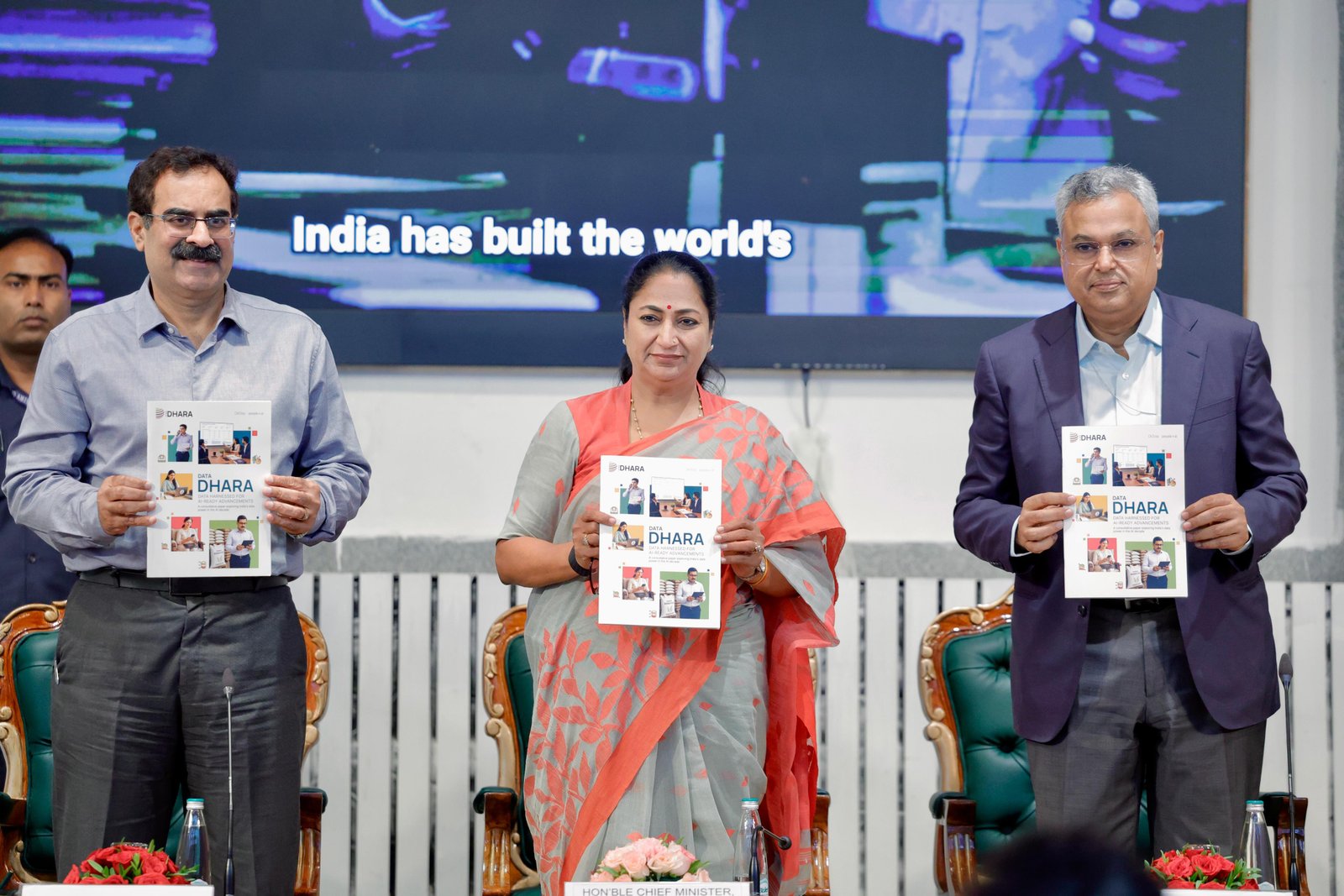
Delhi Government Launches Initiative to Make Administrative Data AI-Ready and Interconnected
‘Data DHARA’ Toolkit and Vision Paper Launched, System to Be Based on Open-Source and Digital Public Infrastructure
For Citizens, There Is Only One Government, So Data Systems Must Also Be Interconnected: Chief Minister Rekha Gupta
New Delhi, August 2026 : The Delhi Government has launched a major initiative to make its administrative data more organised, reliable and ready for use with artificial intelligence. A workshop on ‘Harmonization and Interlinking of Administrative Data for AI-Ready Governance’ was held on Tuesday under the chairmanship of Chief Minister and Planning Minister Smt. Rekha Gupta. All Administrative Secretaries, heads of departments and senior officials of the Delhi Government participated in the workshop. The discussions focused on using data more effectively to strengthen evidence-based decision-making, enable the government to provide services proactively based on people’s needs, and improve public services. Chief Minister Rekha Gupta said the benefits of AI should reach those who need them the most. “Data is the fuel for AI, and it is essential to make data useful for empowering citizens,” she said. EkStep Foundation will work as a knowledge partner to the Delhi Government and share its open frameworks and expertise.
During the workshop, the Delhi Government’s Planning Department and EkStep Foundation also signed an MoU to collaborate in the area of administrative data. Under the agreement, the two organisations will work together to make Delhi’s government data ready for AI use and develop various use cases aimed at improving citizen services with the help of AI. On the occasion, Secretary, Ministry of Statistics and Programme Implementation, Shri Saurabh Garg; Chief Secretary, Delhi, Shri Rajiv Verma; EkStep Foundation Co-founder and CEO Shri Shankar Maruwada, among others, were present.
Important initiative towards making Delhi AI-ready
During the workshop, EkStep Foundation made a presentation on ‘Data DHARA for an AI-Ready Delhi’. The ‘Data DHARA’ toolkit and vision paper were also launched. Data Harnessed for AI-Ready Advancements (DHARA) is an open-source methodology based on digital public infrastructure. It is aimed at helping government departments and institutions prepare their data for AI use. DHARA has been developed as an open, pluggable, interoperable and cloud-deployable toolkit. It can also be used on-premises, as required.
Discussion on important use cases across departments
During the technical session on ‘Data Creating Impact’, several examples were shared of how data can be used to improve public services and help people access government schemes. These included linking civil registration data with schemes such as PMJJBY and PMSBY, using voice AI to provide government services to citizens in their own languages, improving support for investors through investment facilitation, and making information about available incentives easier for them to access. Other examples included improving the delivery of Matru Vandana and Delhi Lakhpati Bitiya schemes, identifying eligible beneficiaries and connecting them with schemes, reducing gaps in enrolment, and helping construction workers access various government schemes.
Focus on making data the foundation for better citizen services
Chief Minister Rekha Gupta said the workshop was not merely a technology initiative, but an important step towards changing the way the government understands problems, takes decisions and delivers services to citizens. Various departments have large amounts of administrative data relating to citizens, beneficiaries, workers, students, health, education, employment and government schemes. The need now is to move from merely collecting data to using it, from maintaining records to generating insights, and from reactive to proactive governance.
‘For citizens, there is only one govt, so data systems must also be interconnected’
She said different government departments have their own data and records, but for citizens there is only one government. Therefore, wherever legally permitted and technically feasible, data should be used securely and appropriately across departments. This will reduce the need to collect the same information repeatedly for the same purpose, improve the delivery of schemes and services to the right people, and spare citizens the inconvenience of providing the same information repeatedly to different departments.
Making data standardised and organised is equally important
Chief Minister Rekha Gupta said merely connecting different databases would not be enough. It is necessary to establish common definitions and standards for data, maintain uniform metadata, improve data quality, enable seamless data sharing between different systems, use the right identification numbers, and clearly define responsibilities at every level. A system needs to be created in which data from government departments can work together easily and effectively. The success of any data initiative should not be measured by how many databases have been connected, but by how much it makes the lives of ordinary citizens easier and better.
‘The right benefit should reach the right person at the right time’
The workshop discussed how data can be used to improve the delivery of schemes such as PMJJBY and PMSBY, Matru Vandana and the Delhi Lakhpati Bitiya scheme. Examples were also presented on identifying eligible beneficiaries, reducing the number of people left out of scheme enrolment, and ensuring that construction workers receive the benefits of government schemes. The Chief Minister said the government should proactively identify eligible people through data and connect them with relevant schemes and services. This will make it easier to ensure that the right people receive the benefits and reduce the possibility of eligible people being left out, the same person receiving benefits repeatedly, or irregularities in the delivery of scheme benefits.
AI will bring new capabilities to governance
Chief Minister Rekha Gupta said artificial intelligence can be used to analyse government data more effectively. It can help identify patterns and irregularities hidden in data, anticipate future needs, improve grievance resolution, enable communication with citizens in different languages and support better decision-making. However, the full benefits of AI cannot be realised if data is fragmented across different places, outdated or inconsistent. Therefore, the Delhi Government’s priority is to build a strong data system in which data is reliable, high-quality and consistent across systems.
Privacy and security are equally important in data use
The Chief Minister said that as the use of data in government increases, so does the responsibility that comes with it. Citizens must have confidence that the information they provide to the government is being used securely and responsibly. This requires protecting people’s privacy and data, ensuring that data is used only for defined purposes, determining who can access the data, ensuring accountability, maintaining data quality, keeping the entire process transparent, and complying with all applicable laws and policies. Delhi needs to develop a data system in which data sharing and use are carried out responsibly, supported by clear rules and sustainable institutional arrangements.
Vision for a connected, intelligent and citizen-centric Delhi
Chief Minister Rekha Gupta said Delhi’s goal is to build a connected, modern and citizen-centric government system in which all departments can coordinate easily and decisions are based on solid facts and data. Citizens should not have to provide the same information repeatedly for different government services.
At the same time, technology should reduce the time officials spend on repetitive tasks, allowing them to focus more on solving problems. The exchange of the MoU and the workshop held today mark the beginning of this journey. The focus now must be on implementing initiatives that deliver the greatest benefits to people and whose outcomes can be clearly measured.