United Nations, October 2026 : India has urged the United Nations Human Rights Council (UNHRC) to maintain sustained attention on the threat of terrorism, describing it as one of the gravest challenges to human rights, particularly the fundamental right to life.
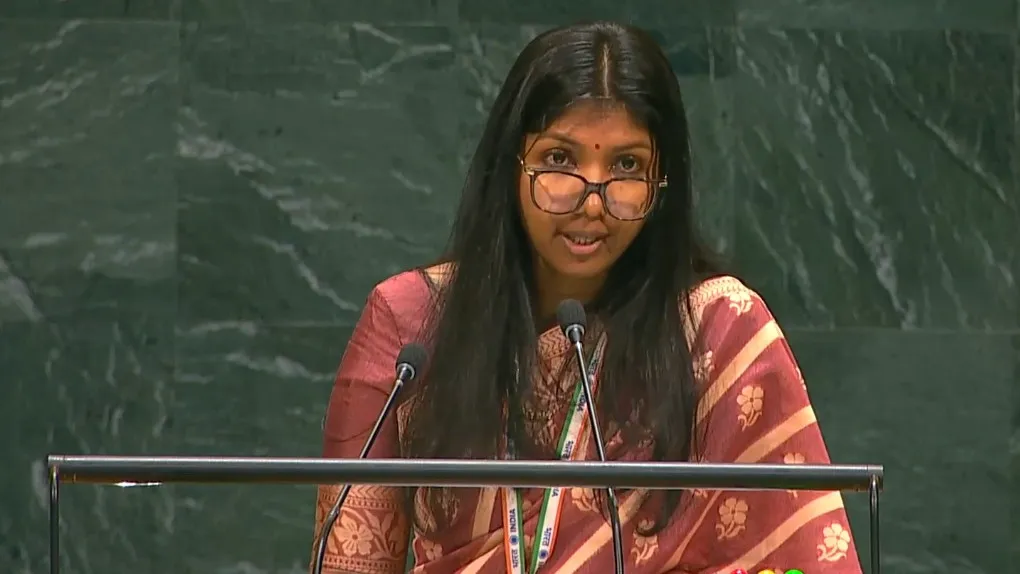
Addressing the UN General Assembly in New York on Friday during a debate on the Human Rights Council's report, Bhavika Mangalanandan, First Secretary at India's Permanent Mission to the United Nations, said terrorism continued to pose a serious threat to the enjoyment of human rights.
"Terrorism remains among the gravest threats to the enjoyment of human rights, above all, the right to life," she said, urging the Council to address the issue with a zero-tolerance approach.
Mangalanandan noted that the Human Rights Council had acknowledged the danger posed by terrorism in its resolution on international cooperation, adopted in July in Geneva. She encouraged the Council to maintain sustained attention on the issue and strengthen collective efforts to combat the menace.
The resolution called upon the international community to take necessary steps to enhance cooperation in preventing and combating terrorism. It also reaffirmed that terrorist acts, methods and practices, in all their forms and manifestations, are aimed at undermining human rights, fundamental freedoms and democracy.
It further stated that terrorism threatens the territorial integrity and security of states and destabilises legitimately constituted governments.
India's intervention also underlined the need to reject attempts to differentiate between various forms of terrorism or justify certain acts based on political considerations. Such distinctions, New Delhi has maintained, weaken the collective international response to the threat.
Apart from raising concerns over terrorism, the Indian diplomat criticised what she described as the politicisation of human rights issues and the application of double standards by the Human Rights Council.
She said the Council's credibility was undermined when human rights were used selectively or for political purposes.
"Human rights are best advanced through dialogue, capacity building and genuine partnerships, and not by politicisation, selectivity or double standards," Mangalanandan said. She added that a consistent approach was essential for the Council to speak with one voice and counter allegations of the weaponisation of human rights.
Emphasising the importance of cooperation and constructive engagement, she expressed reservations about country-specific mandates pursued without the involvement of the concerned government.
"Country-specific mandates pursued without the engagement of the country concerned seldom improve the situation on the ground," she said, warning that such approaches could instead deepen divisions within the Council.
Mangalanandan identified the Universal Periodic Review (UPR) as the appropriate mechanism for assessing human rights situations across countries. The process is based on cooperation, engagement with the concerned member states and equal treatment of all countries.
The UPR is conducted every four to five years and considers reports submitted by individual countries, assessments by UN bodies and experts, and contributions from civil society organisations. Unlike unilateral criticism, the mechanism provides an opportunity for a broader and more inclusive examination of human rights records.
The Indian representative also called for a balanced approach to human rights, stressing that economic, social and cultural rights and the right to development must receive the same attention as civil and political rights.
"All human rights must be treated in a fair and equal manner on the same footing and with the same emphasis," she said.
Highlighting the challenges faced by developing nations, she pointed out that poverty, mounting debt and limited access to finance and technology remained among the most immediate obstacles to the enjoyment of human rights.
She stressed that addressing these challenges required international cooperation rather than coercive measures.
India's intervention thus called for a comprehensive and non-selective approach to human rights, combining sustained international action against terrorism with dialogue, development cooperation and respect for the sovereignty of member states.
(Disclaimer :The content of this article is sourced from a news agency and has not been edited by the Mavericknews30 team.)