Maharashtra to Completely Eliminate Drugs by 2029
Next step under the Nasha Mukt Bharat Abhiyan; comprehensive policy approved
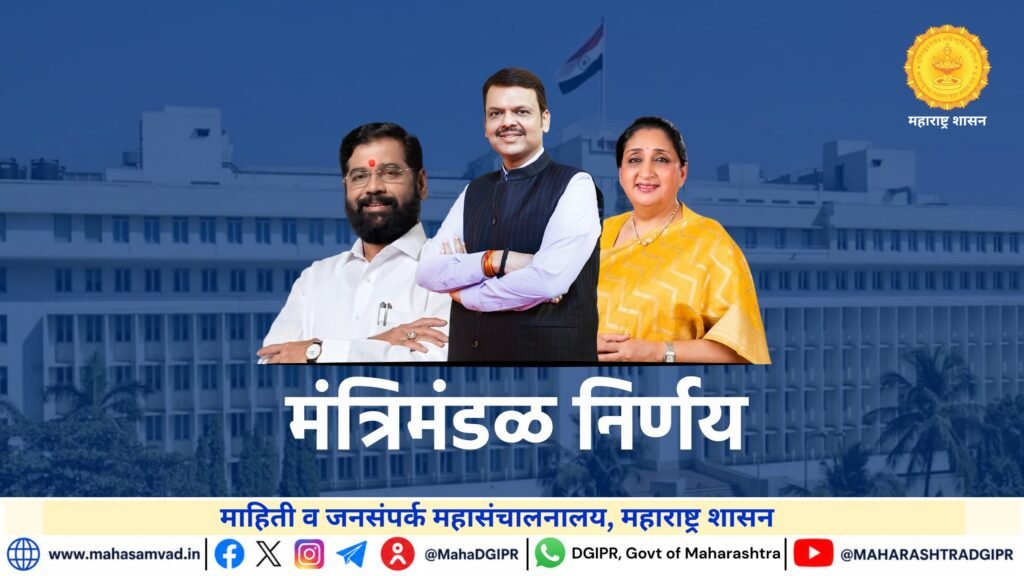
Maharashtra has taken another major step under the Nasha Mukt Bharat Abhiyan. The State Cabinet has approved a comprehensive policy aimed at completely eliminating drugs from Maharashtra by 2029. The Cabinet meeting was chaired by Chief Minister Devendra Fadnavis.
The policy will focus on extensive public awareness and strict action against drugs, with the participation of all government departments. To ensure effective implementation, responsibilities have been assigned from the village level to the district, divisional and Mantralaya levels. Maharashtra is the first state in the country to undertake such a comprehensive campaign, involving multiple departments, to build a drug-free state.
The Central Government has set a target of completely eliminating drugs from the country by 2029 through coordination among various Central and state government departments. Accordingly, the Nasha Mukt Bharat Abhiyan is being implemented effectively at the national level.
To accelerate this initiative and make Maharashtra completely drug-free by 2029, the State Government has formulated a policy based on a “Comprehensive Government Approach.” Under the policy, strict action will be taken against cultivation of crops used for the illegal production of drugs, as well as the production, transportation, sale and consumption of natural and synthetic narcotic substances. A large-scale public awareness campaign will also be conducted.
For successful implementation, all departments will have to coordinate with the Anti-Narcotics Task Force (ANTF). At the Mantralaya level, each department will appoint an officer of the rank of Deputy Secretary as a nodal officer for coordination.
An action plan has been finalised for various departments under the policy. From the academic year 2027, at least one lesson on drug awareness will be included in the school curriculum from Class V onwards. Additional marks will also be awarded for drug-awareness initiatives under Phase III of the Chief Minister’s My School, Beautiful School campaign.
The Higher and Technical Education Department will undertake measures to ensure that all educational institutions maintain drug-free campuses. Additional marks will also be awarded under the Chief Minister’s Samruddha Panchayati Raj Abhiyan and My Village, Healthy Village campaign. Every year on June 26, awards will be announced for the best-performing district in achieving a drug-free Maharashtra. The performance of districts will be assessed for the period from October 2 to April 30.
The policy identifies four pillars for drug control: effective enforcement, sharply reducing the supply of drugs, effectively reducing demand, and de-addiction, treatment and rehabilitation.
The Home, Transport, Ports, and Law and Judiciary departments will be responsible for effective enforcement. The Revenue, Agriculture and Forest departments will be responsible for curbing the supply of drugs. The Food and Drug Administration and Industries departments will take action against illegally manufactured synthetic drugs.
The School Education, Higher and Technical Education, Sports, Rural Development, Public Health, Women and Child Development, Skill Development and Entrepreneurship, and Information and Public Relations departments will work towards reducing demand for drugs. The Social Justice and Special Assistance, Public Health, Medical Education, Urban Development, and Skill, Employment, Entrepreneurship and Innovation departments will be responsible for de-addiction, treatment and rehabilitation.
(Public Works Department)
Solapur Elevated Road Project from Old Pune Naka to Boramani Naka Gets Boost
Traffic to become smoother; project accorded urgent public project status
The State Cabinet has approved the declaration of the four-lane elevated corridor from Old Pune Naka to Boramani Naka on the national highway in Solapur city as an urgent public project. The Cabinet meeting was chaired by Chief Minister Devendra Fadnavis.
The decision will accelerate the project as land belonging to various government departments will be transferred to the National Highways Authority of India (NHAI) without charging any occupancy value.
Chief Minister Fadnavis had directed that the project be completed within the stipulated timeframe. Following this, the urgency of the project and related matters were examined before the proposal was submitted and approved by the Cabinet. The project is expected to improve traffic movement within Solapur city, across the district and on interstate routes.
The elevated road on National Highway 65, passing through Solapur city from Old Pune Naka to Boramani Naka, is important for both local and interstate traffic. To address congestion on the route, the government has approved a four-lane elevated road between Old Pune Naka and Boramani Naka, along with service roads and approach roads wherever required. The project is expected to significantly reduce traffic congestion in Solapur.
Most of the land required for the project is already under the control of various state government departments. Approval has been granted to declare the project an urgent public project so that government land required for this important public infrastructure can be made available to the concerned agency on time. The Cabinet has also approved transferring the land held by various government departments to the National Highways Authority of India without charging any occupancy value.
Project Details
- Length: 9.660 km four-lane elevated road
- Ramps: 6
- Minor bridges: 3
- Cost: ₹1,020.50 crore
Benefits of the Project
The project will reduce traffic congestion in Solapur city and make travel on the national highway safer and faster. It will help save fuel and reduce environmental pollution.
It will also boost industrial, commercial and agricultural development. Traffic movement towards important religious tourism destinations such as Tuljapur, Pandharpur, Akkalkot, Ganagapur and Solapur will become smoother. The project is also expected to support the planned development of Solapur city and provide momentum to the textile and specialised fabric industries.
(Public Health Department)
Healthy Food and Balanced Menus Made Mandatory at Government Meetings and Canteens
The State Cabinet has decided to make it mandatory to provide healthy snacks and meals, along with balanced menus, at government and semi-government meetings, official programmes and canteens. The Cabinet meeting was chaired by Chief Minister Devendra Fadnavis.
Emphasis will be placed on providing government officers and employees with balanced and nutritious food during meetings, programmes and training sessions. Instructions will be issued to all departments to make healthy lifestyles and nutritious eating habits a part of the daily lives of government employees.
Healthy food options will be included when snacks or meals are served at meetings, programmes, training institutions, conferences and canteens. These will include seasonal fruits such as bananas, apples, guavas and papayas; boiled eggs; boiled pulses; poha; idli-sambar; hot milk on demand; sugar-free green tea; ragi bhakri; jowar and bajra bhakri; buttermilk; salads; vegetables; dals and sprouts.
The proportion of oily and highly processed foods in snacks will be reduced, while nutritious local and traditional foods will be promoted. Meals will be planned to include dal, sprouts, leafy vegetables, buttermilk, salads, vegetables and balanced grains as required.
The inclusion of healthy menus will be made mandatory in new catering contracts of the concerned offices. Before implementing the decision, government and semi-government institutions have also been instructed to discuss health-related practices with their employees.
Government and semi-government institutions will undertake awareness programmes among employees regarding healthy lifestyles and nutritious diets and prepare guidelines for providing balanced menus. The guidelines of the Indian Council of Medical Research–National Institute of Nutrition (ICMR-NIN) may be used while finalising healthy menus.
Healthy food items such as fruits, boiled eggs, boiled pulses, poha, idli-sambar, hot milk and green tea have already started being made available at the Mantralaya canteen. This has helped reduce the quantity of oily food served as snacks, while nutritious items such as dal, sprouts, leafy vegetables, buttermilk, salads and pulao are also being included in meals.
(Water Resources Department)
₹5,704-Crore Provision Approved for Kukadi Irrigation Project
Irrigation to benefit 1,44,912 hectares across Pune, Ahilyanagar and Solapur districts
The State Cabinet has granted the fourth revised administrative approval for the Kukadi Irrigation Project in Pune district. Under the approval, a provision of ₹5,704.50 crore has been sanctioned for the project. The Cabinet meeting was chaired by Chief Minister Devendra Fadnavis.
The decision will strengthen irrigation facilities in drought-prone areas of Pune, Ahilyanagar and Solapur districts.
The Kukadi Irrigation Project is a joint project comprising five dams — Yedgaon, Manikdoh, Wadaj, Dimbhe and Pimpalgaon Joge. The five reservoirs have a combined live storage capacity of 30.52 TMC, while the project's water utilisation is 39.36 TMC.
The project will provide irrigation benefits to a total area of 1,44,912 hectares across seven drought-prone talukas: Ambegaon, Junnar and Shirur in Pune district; Parner, Shrigonda and Karjat in Ahilyanagar district; and Karmala in Solapur district.
The project cost has increased due to revisions in schedule rates, acceptance of higher-rate tenders, increased land acquisition costs — particularly because of the new land acquisition law — changes in designs, new or deleted provisions, inadequate provisions and other related expenses.
After scrutiny by the State-Level Technical Committee, the Maharashtra Krishna Valley Development Corporation submitted the proposal for the fourth revised administrative approval. The High-Powered Committee on Construction also examined the proposal and recommended approval of the revised administrative provision of ₹5,704.50 crore.
Of the sanctioned amount, ₹4,946.20 crore will be allocated for the actual works, while ₹758.30 crore will cover related expenses.
Instructions have been issued to complete the project within the scheduled timeframe and within the limits of the revised administrative approval. To reduce the overall project cost, only the land strictly required for the remaining works will be acquired.
The Maharashtra Krishna Valley Development Corporation has been entrusted with ensuring compliance with all points raised in the scrutiny report of the State-Level Technical Advisory Committee and ensuring that no funds are released or additional expenditure incurred beyond the limits of the approved administrative sanction.