Mumbai, Oct 206 : Marathi language is not merely a medium of communication, but a carrier of our rich culture and a witness to our glorious history. With its vast vocabulary, rich literary tradition and heritage of diverse dialects, Marathi will be strengthened as a digital and knowledge language in the 21st century, Chief Minister Devendra Fadnavis said.
Along with increasing the use of Marathi in daily transactions, he appealed for greater use of the language in modern fields such as Artificial Intelligence (AI), digital technology, quantum computing, space technology and biotechnology.
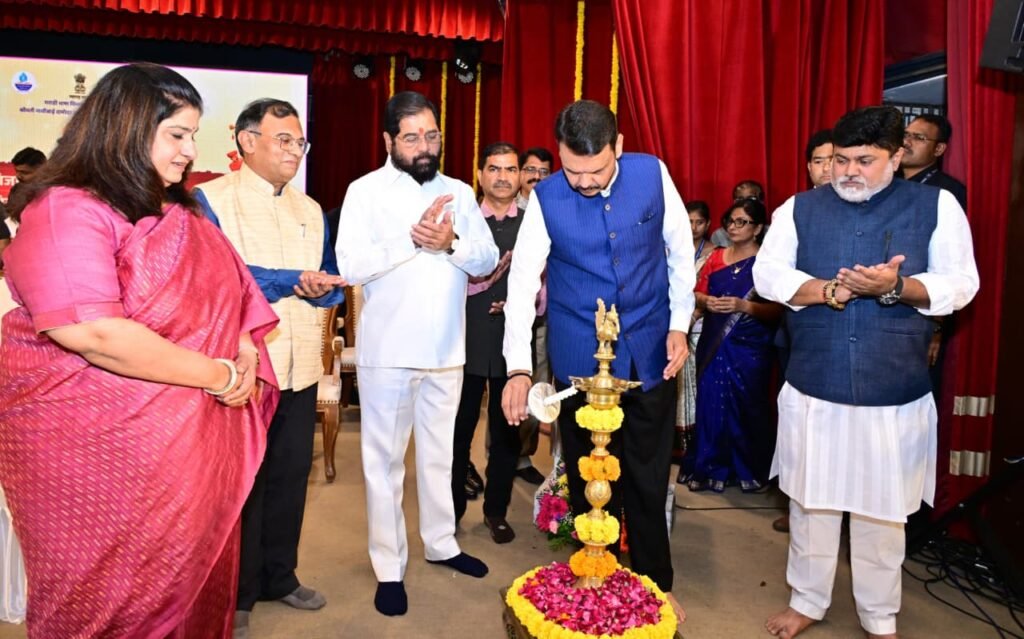
The ‘Classical Marathi Language Week’ and ‘Classical Marathi Language Honour Day’ programmes, organised against the backdrop of Marathi receiving classical language status, were inaugurated with enthusiasm at the Patkar Hall of Shrimati Nathibai Damodar Thackersey Women’s University in Churchgate. Fadnavis was speaking at the special ceremony organised on the occasion.
Deputy Chief Minister Eknath Shinde, Marathi Language and Industries Minister Dr Uday Samant, Mumbai Mayor Ritu Tawde, University Vice-Chancellor Dr Hemlata Bagla, Marathi Language Department Secretary Kiran Kulkarni, along with dignitaries, teachers, students and Marathi language enthusiasts, were present.
Classical Language Status for Marathi a Moment of Pride
Fadnavis said Marathi has always been an ancient and classical language, but receiving official recognition as a classical language from the Central Government was a moment of pride for Marathi speakers.
He noted that under the leadership of Prime Minister Narendra Modi, Marathi receiving classical language status had given Maharashtra’s linguistic and cultural heritage a special and prominent position at the national level.
Fadnavis also recalled that Chhatrapati Shivaji Maharaj had given importance to the mother tongue along with the concept of Swarajya. He made efforts to increase the use of Marathi in administration, thereby giving a new direction to its official use.
Need to Expand Marathi Vocabulary
Fadnavis said Marathi ranks 13th among the most widely spoken languages in the world and described it as a global language. He said the Marathi encyclopaedia and Shabdaratanakar created in the 20th century contained between 11 lakh and 13 lakh words.
In comparison, he said the Oxford Dictionary contains around six lakh words, while languages such as Mandarin, Spanish and French have approximately three to three-and-a-half lakh words. The Marathi dictionary published by the state government currently contains around three lakh words.
He stressed the need to prepare subsequent editions of the dictionary and work towards expanding Marathi’s vocabulary to 13 lakh words.
Referring to the rich vocabulary of Marathi, Fadnavis highlighted the importance of the tradition of Marathi encyclopaedias and dictionaries. Millions of Marathi words have been recorded in various reference works, reflecting the language’s rich linguistic heritage.
He said this linguistic wealth should not remain merely a matter of pride but should be effectively used in modern knowledge creation. If concepts related to science, technology, the economy, education and research become available in Marathi, the language will truly become a knowledge language, he said.
Connecting Marathi with the New Era Through ‘Marathi AI’
Fadnavis said communication methods were changing rapidly because of digital technology. In such circumstances, it was necessary to connect Marathi with new technologies rather than restrict it to traditional usage.
He said effective use of Marathi in Artificial Intelligence through ‘Marathi AI’, availability of information and knowledge content in Marathi on digital platforms, and creation of quality Marathi content in large numbers on OTT platforms and social media were necessary.
He also expressed confidence that making knowledge content available in Marathi in advanced fields such as quantum computing, space technology and biotechnology would provide the new generation with an opportunity to acquire modern knowledge in its mother tongue.
Need to Preserve the Richness of Dialects
Fadnavis said the dialects spoken in different parts of Maharashtra were an invaluable treasure of Marathi alongside standard Marathi. Dialects such as Konkani, Varhadi, Khandeshi-Ahirani, Malvani, Dangi and Zhadiboli contain local culture, folk traditions and experiences of life.
He stressed the need to preserve the literature, folk traditions and linguistic characteristics of these dialects.
He also made a special mention of Marathi theatre culture. Despite having limited modern technological resources, several generations kept the rich tradition of Marathi theatre alive. Artists gave Marathi theatre a distinct identity through their acting, writing and experimentation, he said.
Marathi Conservation Through Everyday Use
Fadnavis said preservation and promotion of Marathi should not be limited to government initiatives and every Marathi speaker should contribute through everyday usage.
The use of Marathi should increase in the home, education, administration, business, technology and social media. He appealed for a collective effort to make Marathi a capable knowledge language of the future by combining pride in tradition with modern technology.
Next World Marathi Literary Conference to Be Held in London: Eknath Shinde
Deputy Chief Minister Eknath Shinde said Marathi is not merely Maharashtra’s identity but its self-respect. Marathi, enriched by the traditions of Sant Dnyaneshwar and Chhatrapati Shivaji Maharaj, has now travelled across the seven seas and is gaining global recognition.
He said the state government was committed to expanding Marathi globally. Marathi usage should also be increased in modern areas such as the digital world, social media, podcasts, gaming and coding to connect the new generation with the language.
Shinde said there was a resolve to promote and expand Marathi in more than 50 countries. A ‘Chhatrapati Shivaji Maharaj Global Marathi Centre’ would be established in London, and the next World Marathi Literary Conference would also be organised there.
Around 70,000 to 80,000 Marathi people reside in London, where initiatives such as Marathi education, courses and certificate examinations are being conducted through the Maharashtra Mandal. Work is also underway towards establishing the global Marathi centre, and a Maharashtra Mandal building has been purchased for the purpose.
Shinde appealed for a new culture of gifting Marathi books instead of bouquets on birthdays, felicitation ceremonies and other occasions. He said initiatives such as the Marathi Language Policy, ‘Village of Books’ and ‘Village of Poetry’ were being implemented to promote Marathi and reading culture.
Global Marathi Centre, 100 Dialect Dictionaries Planned: Uday Samant
Industries and Marathi Language Minister Uday Samant said the state government was committed to preserving, promoting and expanding Marathi language and culture globally.
He said several ambitious initiatives had been undertaken, including a Centre of Excellence for Marathi at Deccan University in Pune, a ‘Marathi Global Centre’ named after Chhatrapati Shivaji Maharaj in London, 100 dictionaries covering different dialects of the state and nine ‘Marathi Skill Development Centres’.
To strengthen communication with Marathi people living abroad, several initiatives were being undertaken. Samant said a ‘Namo Samvad’ programme had been launched in 75 countries on the occasion of Prime Minister Narendra Modi’s birthday, while online training arrangements were also being made for Marathi people living abroad.
He said the number of international Marathi forums had reached 52 and the target was to increase it to 75 soon.
Samant added that work was progressing rapidly on a ‘Literature Museum’ and a modern ‘Marathi Language Bhavan’, taking into account the long-standing demands of writers. The objective was to preserve Marathi’s literary heritage, document the contributions of writers and create modern centres connecting citizens with Marathi literature and culture.
Focus on Research and Digitisation of Classical Marathi: Kiran Kulkarni
Marathi Language Department Secretary Kiran Kulkarni said the history of Marathi did not begin only during the periods of Dnyaneshwar Maharaj or Chakradhar Swami, but had a rich tradition dating back around 2,500 years to the Gatha Saptashati.
He said the Marathi Language Department was committed to researching and preserving this long linguistic heritage and transferring it to the new generation through modern technology.
Following Marathi’s recognition as a classical language, work had been underway for the past two years to explain the meaning of its classical status, linguistic tradition and knowledge wealth to the public. This year, particular emphasis was being placed on promoting and preserving Marathi with young people at the centre.
Kulkarni said the Vishwakosh initiative, which began under the guidance of Tarkateerth Lakshmanshastri Joshi, was now being connected with modern technology. Work was progressing rapidly to make the knowledge contained in the encyclopaedia available to the public in digital form. From this month, the Vishwakosh would be made fully available digitally through a portal.
At the beginning of the programme, dignitaries were welcomed by presenting them with books. The book ‘Marathiche Kaautuk Part-2’ was also released, followed by a cultural programme based on the theme ‘Classical Marathi, Proud Marathi’.