New Global Opportunities for Gujarat’s Fishermen in High Seas and Tuna Fishing:- Union Minister Shri Rajiv Ranjan Singh
Deliberations Held to Ensure Holistic Upliftment of Coastal Farmers and Strengthen the Deep-Sea Fishing Ecosystem
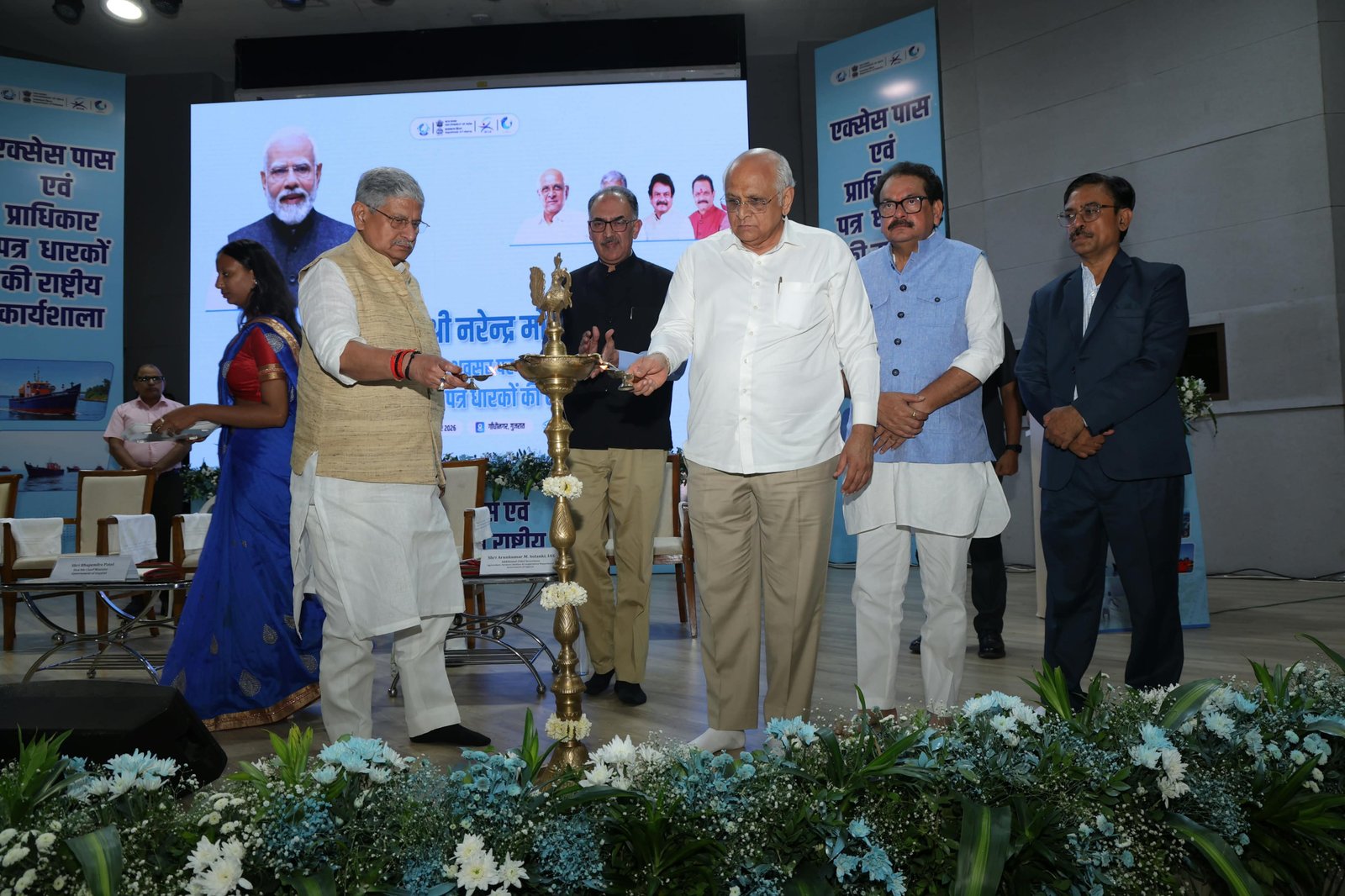
Gandhinagar, September 2026: The Department of Fisheries, Government of India, organised a National Workshop on ‘Promoting Deep-Sea Fishing and Interaction with Access Pass-LoA Holders’ at the National Forensic Sciences University (NFSU), Gandhinagar, in the presence of Chief Minister Shri Bhupendra Patel, as part of Prime Minister Shri Narendra Modi’s birthday celebrations. Union Minister Shri Rajiv Ranjan Singh and Union Minister of State Prof. S. P. Singh Baghel graced the event.
The workshop aimed to encourage coastal farmers to make better and maximum use of high-value fishery resources in India’s Exclusive Economic Zone (EEZ) and the high seas. It also focused on understanding the challenges faced by fishermen on the ground and finding suitable policy solutions.
Chief Minister
Speaking on this occasion, Chief Minister Shri Bhupendra Patel said that, under the guidance of the Prime Minister, Gujarat, which has the longest coastline in the country, must make the most of the opportunities in fisheries and the fisheries sector. Referring to the training workshop organised for this purpose, he said that the Central Government is ready to arrange further training in Delhi. At the same time, the Gujarat Government will consider providing travel tickets for trainees from Gujarat.
CM urged coastal farmers to make the most of the state’s rich marine resources. Referring to the natural food chain and their professional responsibilities, he stressed the importance of receiving proper training in ‘Deep-Sea Fishing’.
Discussing infrastructure development in the fisheries sector, CM stated that if local people come forward to operate on a cooperative basis, the Government is ready to provide cold storage facilities and the required land. He urged cooperative societies and their leaders to come forward and make maximum use of these schemes.
The Prime Minister’s key objective has been to bring every section of society and every sector, including people at the grassroots, into the mainstream of development. Accordingly, continuous efforts are being made for the holistic development of all sectors, including fisheries and tribal areas.
CM said that Gujarat has the country’s longest coastline of 2,380 kilometres. He added that with proper planning and vigilance, Gujarat can become a leading state in the fisheries sector. The Central Government is extending full support to achieve this goal.
CM further said that progress can be achieved by following the Prime Minister’s guiding principle of ‘Sauno Saath, Sauno Vikas, Sauno Vishwas and Sauno Prayas’. He emphasised that building a ‘Viksit Gujarat’ is essential to achieving the goal of a ‘Viksit Bharat’ by 2047 and called for collective efforts to achieve this vision.
Union Minister for Fisheries Shri Rajiv Ranjan Singh said that Gujarat is the ‘Karmabhoomi’ of Prime Minister Shri Narendra Modi. He said that the continuous efforts of the Central Government under the Prime Minister’s guidance have led to significant growth in the fisheries sector. India’s fish production increased from 95.7 lakh tonnes in 2013-14 to 197.75 lakh tonnes in 2024-25, a growth of 106 per cent. Fish exports also rose from Rs. 30,213 crore in 2013-14 to Rs. 62,408 crore in 2024-25 and reached a record Rs. 73,890 crore in 2025-26. He said this growth has opened new opportunities for coastal states like Gujarat to expand their presence in global markets.
He further stated that more than 4,000 Access Passes have been issued to Gujarat, allowing the state’s fishermen to expand fishing activities in the EEZ from 12 to 200 nautical miles. Of the 14 Letters of Authorization issued for high-seas fishing, three have been issued to Gujarat, creating opportunities to fish beyond 200 nautical miles. He said Gujarat has great potential for high-value fish such as tuna and stressed the need to further strengthen modern processing, cold chains, packaging, value addition, and branding to take Gujarat’s fishery products to global markets.
Minister Shri Rajiv Ranjan Singh further added that the Government of India is providing concessional financial assistance and 3 per cent interest subvention under the Fisheries Infrastructure Development Fund (FIDF) for infrastructure development in the fisheries sector. Additionally, the fee for a Letter of Authorization for High-Seas Fishing for cooperative societies has been reduced from Rs. 25,000 to Rs. 5,000. Considering Gujarat’s extensive maritime boundary and the capabilities of its fishermen, it is necessary to promote Deep-Sea and High-Seas Fishing along with developing modern infrastructure. Providing fishermen with training in modern fishing methods, handling and processing of high-value fish such as tuna, cold chain, packaging, and value addition can create new opportunities to increase their income. The Minister added that the Central Government is ready to provide facilities such as accommodation and food free of cost for this training.
Union Minister of State for Fisheries Prof. S. P. Singh Baghel said that the fisheries sector entered a new phase when the Prime Minister gave the Department of Fisheries a separate identity by separating it from the Department of Agriculture. He said that, like the Green Revolution transformed agriculture and the White Revolution strengthened dairy cooperatives and animal husbandry, the Blue Revolution is creating new opportunities for fishermen across the country. He added that the Blue Revolution will now contribute to the prosperity of fishing families. Through the concept of the ‘Blue Economy’, the Prime Minister has also given the country a new perspective on economic development.
Under the Prime Minister’s leadership, the Pradhan Mantri Matsya Sampada Yojana was launched, along with the highest-ever fisheries sector budget of Rs. 20,500 crore since Independence. These initiatives have given a major boost to the development of the fisheries sector across the country. Fish production has increased to 197.75 lakh tonnes, while productivity has risen from 3 tonnes to 4.77 tonnes per hectare. This has opened new opportunities for fishermen and strengthened the path towards their prosperity.
In his welcome address, Secretary of the Department of Fisheries, Government of India, Dr. Abhilaksh Likhi said that the deliberations across five technical sessions held today will help strengthen capacity building and training for fishermen, enabling them to expand their activities from 60–70 nautical miles to the 200-nautical-mile EEZ and the high seas. He stressed the need to strengthen financial support through NABARD, commercial banks and government schemes, while empowering cooperatives, FFPOs and women’s self-help groups through financial and training assistance. He added that the suggestions emerging from the discussions would be incorporated into the policy framework and followed up with necessary action.
At the conclusion of the programme, Additional Chief Secretary of the State Fisheries Department Shri Arun Kumar Solanki delivered the vote of thanks.
On the occasion, an inspiring short film showcasing the development and vast potential of deep-sea fishing was also screened for the gathering.
During the event, the Chief Minister and other dignitaries interacted directly with Access Pass and LoA holders. Coastal farmers enthusiastically shared their experiences, needs, and suggestions during the interaction.
Fishermen from Gujarat and across the country, senior officials from leading organisations, and officers and employees of the Fisheries Department attended the National Workshop.