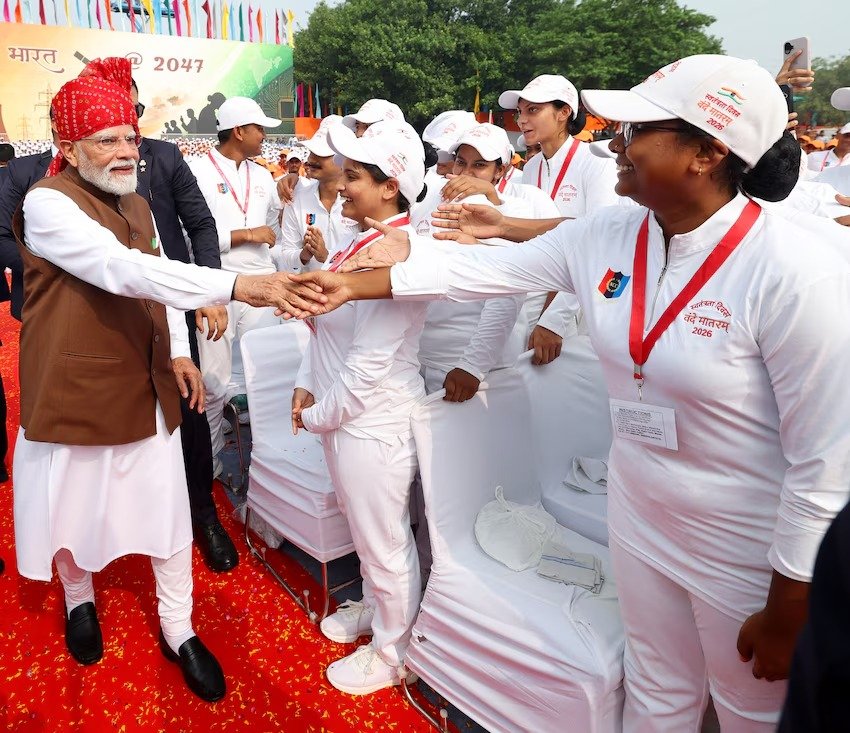
New Delhi, Aug 2026 : Prime Minister Narendra Modi on Saturday announced a series of major initiatives aimed at transforming India’s youth, expanding access to education, strengthening sports, modernising civil defence, building semiconductor capabilities and accelerating nuclear power generation, as he addressed the nation from the ramparts of the Red Fort on the 80th Independence Day.
In a wide-ranging Independence Day address, Modi placed youth empowerment, technological advancement and strategic self-reliance at the centre of India’s development journey. Among the key announcements were free online coaching for competitive examinations, a nationwide sports talent identification programme for children, a modern volunteer-based civil defence network, an ambitious Artificial Intelligence skilling programme for one crore youngsters and further expansion of semiconductor manufacturing.
The Prime Minister said the government would establish a nationwide digital platform offering free online coaching for students preparing for various competitive examinations. He said the initiative was intended to ease the financial burden on families and make quality preparation accessible to students irrespective of their economic background.
"Coaching classes burden the poor and the middle class. We will provide free online coaching for various exams," Modi said.
He highlighted the social pressure surrounding private coaching, noting that many parents feel compelled to send their children to coaching institutes even when the expense places a strain on household finances.
"Every parent feels that if they do not send their child to a coaching class, they are not a prestigious family," he said.
The Prime Minister said the proposed system would allow families to save substantial amounts of money while enabling parents to remain closer to their children.
"I assure these families that they can save thousands of crores of rupees spent on coaching, be close to their children, and care for them," Modi said.
The initiative, he explained, would combine India’s digital public infrastructure with the country’s pool of teachers, educators and other academic resources. The objective would be to create a comprehensive national network capable of delivering free examination preparation to young people across the country.
Modern Civil Defence Network
Modi also announced plans to strengthen India’s civil defence capabilities in response to emerging security threats, natural disasters and other contemporary emergencies.
He said the government would build a large and modern volunteer network equipped with contemporary training and systems so that citizens could be better prepared to respond during crises.
"I announce today from the Red Fort that we will establish a vibrant Civil Defence network in the coming days. We will familiarise them with modern systems," he said.
The proposed network will focus on preparing volunteers to deal with modern-day challenges and emergencies, while improving response capabilities and public preparedness. The Prime Minister said the force would be designed to help protect citizens and strengthen the country’s ability to respond effectively during crises.
Nationwide Sports Talent Hunt
Sports also received significant attention in Modi’s address, with the Prime Minister highlighting India’s improving performance at international competitions and its growing sporting infrastructure.
He pointed to initiatives such as the Target Olympic Podium Scheme, Khelo India Games, University Games, Beach Games and Winter Games, along with improvements in sports training, sports medicine and sports nutrition.
"India is making space for itself in the world of sports. We hear our national anthem frequently and see our Tricolour going up very often," Modi said.
However, he acknowledged that India still has considerable ground to cover in terms of participation across Olympic disciplines. While the country has improved its overall performance, Indian athletes are still unable to qualify in a large number of events.
"There are about 40 disciplines in the Olympics, with nearly 350 events. It is sad that we are not even able to compete in at least two-thirds of these events because we are not even able to qualify," he said.
With India aspiring to host the 2036 Olympic Games and the Commonwealth Games in 2030, Modi said the country needed to significantly widen its sporting talent pool.
He announced a nationwide talent hunt for children aged between five and 15 years. The programme will seek to identify promising athletes from every part of the country and provide selected youngsters with specialised training.
"We have decided that in 2036, we should have participation in at least three-fourths of events," Modi said.
The initiative is intended to create a stronger pipeline of athletes and ensure that talent from smaller towns, rural areas and different regions gets an opportunity to reach the highest levels of international sport.
Semiconductor Push
The Prime Minister also underlined the strategic importance of semiconductor manufacturing, describing chips as indispensable to almost every aspect of the modern economy.
He said semiconductors were critical for electronic products, medical equipment, automobiles, transportation systems and other technologies, making domestic manufacturing capacity essential for India’s economic and national security.
"In today's digital world and technological landscape, we understand the immense importance of chips," Modi said.
He said India had already taken significant steps towards becoming self-reliant in semiconductor production, with three major semiconductor plants established and production reportedly beginning for export.
"India has moved towards self-reliance in this sector; three major semiconductor plants have already been established," he said.
Modi said several more facilities were expected to become operational in the coming years. He indicated that five to eight additional semiconductor plants were expected to commence operations over the next seven to eight years, significantly expanding India’s domestic manufacturing ecosystem.
The semiconductor push is expected to strengthen India’s position in global technology supply chains while reducing dependence on overseas sources for critical components.
Nuclear Power and Energy Security
Energy security formed another important component of the Prime Minister’s long-term vision. Modi announced plans to commission and operationalise five new nuclear reactors over the next six to seven years, underlining the importance of nuclear energy in meeting India’s growing electricity requirements.
He set an ambitious target of achieving 100 gigawatts of nuclear power capacity by 2047, linking the expansion of nuclear energy with India’s broader objective of becoming a developed economy.
The Prime Minister also referred to India’s progress in Fast Breeder Nuclear Technology, describing the achievement as a significant milestone in the country’s efforts towards greater self-reliance in nuclear fuel.
"This year, India has achieved mastery in Fast Breeder Nuclear Technology, marking a crucial milestone," he said.
He argued that technological capabilities in nuclear energy would be essential for building a secure and sustainable energy base capable of supporting India’s industrial and economic expansion over the coming decades.
AI Skills for One Crore Youth
Artificial Intelligence emerged as one of the most prominent themes of the Prime Minister’s youth-focused announcements.
Modi announced that the government would provide AI skill training to one crore young people over the next year, with the objective of creating a workforce capable of competing and leading in the rapidly evolving global AI ecosystem.
"We have resolved that in the coming one year, we will work to provide AI skill training to 1 crore youth, so that the youth of our nation possess the capability to lead the world in the domain of AI as well," he said.
The Prime Minister linked the initiative to India’s growing digital economy and expanding technology sector. He said the country had already witnessed a significant rise in entrepreneurship, with more than 2.5 lakh startups operating across India and young entrepreneurs contributing substantially to employment generation.
Referring to India’s recent AI Summit, Modi said the country had demonstrated its growing interest and capabilities in the emerging technology. The proposed training programme, he said, would help ensure that Indian youth were equipped with skills required by the industries of the future.
Ambitious Economic Goals
Beyond the immediate announcements, Modi laid out a broader set of national ambitions. He said India should aim to have 50 companies among the Fortune 500, an Indian bank among the world’s five largest banks and a nuclear power capacity of 100 gigawatts by 2047.
These goals, together with semiconductor expansion, AI skilling, sports development and modern civil defence, form part of the larger vision of transforming India into a developed and self-reliant nation.
The Prime Minister’s Independence Day address therefore combined immediate policy announcements with long-term strategic objectives. From ensuring affordable access to competitive-exam preparation and identifying sporting talent at a young age to training one crore youth in AI and expanding India’s semiconductor and nuclear capabilities, the initiatives reflected an emphasis on building capabilities for the next generation.
Modi’s message was clear: India’s future growth will depend not only on economic expansion but also on its ability to develop skilled young citizens, create strategic technological capabilities, strengthen national preparedness and secure its energy needs.
With 2047 as the overarching deadline for the Viksit Bharat vision, the Prime Minister sought to place youth, technology, innovation, sports and self-reliance at the heart of India’s next phase of national development.