Chief Minister inaugurates Vishwakarma Swarozgar and Swadeshi Mela-2026, emphasizes making artisans from 25 trades self-reliant
CM says artisans were once entrepreneurs, but were forced to become laborers due to being kept away from markets, banks, and technology
Government now providing training, honorarium, toolkits, and interest-free, collateral-free loans: Chief Minister
Uttar Pradesh was not BIMARU; rather, the mindset of the politicians who governed it was BIMARU: CM
Lucknow, September 2026 : Chief Minister Yogi Adityanath on Thursday inaugurated the Exhibition and Margin Money Loan Portal at the Vishwakarma Swarozgar Evam Swadeshi Mela-2026, organized at Indira Gandhi Pratishthan. On the occasion, targeting previous governments, the Chief Minister remarked, “When governments had no time beyond organizing festivals in Saifai, bringing dancers from Mumbai, and celebrating birthdays with a Birmingham buggy, how could they find time to think about artisans? At that time, there was no time even to think about Swadeshi and self-reliance. Our government worked to honor the skills of traditional artisans and connect them with market requirements. In 2018, on the occasion of Uttar Pradesh Diwas, the One District One Product (ODOP) scheme was implemented, and in 2019, the Vishwakarma Shram Samman Yojana was launched.”
The Chief Minister stated, “The occasion of Bhagwan Vishwakarma Jayanti and Prime Minister Narendra Modi’s birthday is extremely significant. This program, dedicated to honoring artisans and handicraft workers, is moving forward under the inspiration of Prime Minister Narendra Modi, the architect of New India. Prime Minister Narendra Modi has guided us in advancing Vishwakarma-related schemes. Since 2019, through the Vishwakarma Shram Samman Yojana, traditional artisans and handicraft workers in Uttar Pradesh have received training, toolkits, and support for self-employment. Over the past seven to eight years, more than 6 lakh handicraft workers and artisans have been provided toolkits and training and have been guided towards self-reliance.”
Referring to the craftsmanship and tradition of Bhagwan Vishwakarma, the Chief Minister observed, “Through his extraordinary craftsmanship, Bhagwan Vishwakarma contributed to the welfare of society. Bhagwan Shiva’s Trishul, Indra’s Vajra and Shri Krishna’s Sudarshan Chakra are also examples associated with the craftsmanship of Bhagwan Vishwakarma. There is hardly any industry or craft sector where the tradition of Vishwakarma worship has not existed.”
Referring to an episode from the Ramayana, he noted, “When Bhagwan Ram had to march towards Lanka, Nal and Neel, who constructed the bridge across the sea, are regarded as the spiritual sons of Bhagwan Vishwakarma. Completing a bridge across a hundred-yojana sea without pillars in just a few days reflects the remarkable craftsmanship and artistry of that era. Today, our artisans and handicraft workers stand before society as those very spiritual representatives of Bhagwan Vishwakarma.”
The Chief Minister stated, “India was developed when its artisans were entrepreneurs and its handicraft workers were self-reliant. Previous governments deprived artisans of facilities by citing poverty and lack of resources. They possessed skill and craftsmanship, but markets were kept away from them. They were excluded from the banking system and were not given opportunities to advance in line with changing demands of design and technology.”
He added, “As a result, artisans who were once entrepreneurs were forced to become laborers and live in distress. When I assumed the responsibility of Chief Minister in 2017, I was concerned about the condition of the state's artisans. At that time, artisans and handicraft workers were disappointed, frustrated, and migrating. The very artisans whose labor created prosperity and employment in the state were forced to leave because of alleged disease, corruption, and anarchy. The situation was such that instead of working for the welfare of artisans, people were engaged in extorting and exploiting them.”
The Chief Minister stated, “The government understood that people engaged in traditional occupations such as carpentry, tailoring, pottery, blacksmithing, barbering, masonry, goldsmithing, basket weaving, sweet making, cobbling and laundry work support their families through daily labor. If they are sent for training, how will their families meet their day-to-day needs during the training period?”
He further said, “Therefore, instead of merely providing training, the government arranged for an honorarium during training, a toolkit upon completion of training, and linkage with banks thereafter. Under the scheme, participants receive 10 days of free training and an honorarium of ₹5,000 during the training period. After completing the training, participants receive toolkits worth up to ₹15,000. The objective is to develop traditional skills in accordance with the needs of today’s market and society.”
The Chief Minister informed that 16 trades were included in the first phase of the scheme. These comprised 11 traditional trades: carpenter, tailor, potter, blacksmith, barber, mason, goldsmith, basket weaver, confectioner, cobbler and washerman. The government has now added five more traditional trades, including sculptor, milkman, garland-making gardener, bhadbhuja and fisherman.
He stated that those engaged in traditional occupations that have sustained society for generations did not receive adequate support for a long time. The government has now decided to stand with such people and help them progress.
He said, “In addition, considering the interests of youth and present-day requirements, trades such as mobile repair, automobile repair, repair of electronic items, repair of electrical equipment, plumbing, computer repair, solar installation, digital photography, and beauty parlor services have also been included. A young person can choose any trade according to their interest. The fundamental objective of these 25 trades is that artisans and handicraft workers should not remain laborers, but become entrepreneurs.”
The Chief Minister stated, “In the process of making an artisan an entrepreneur, linking them with banks along with training and toolkits is equally important. Under the CM Yuva Udyami Yojana, youth are being provided interest-free and collateral-free loans up to ₹5 lakh, while for artisans the limit has been increased to ₹10 lakh.”
He added, saying there is also a provision for 10 to 15 percent margin money along with interest-free and collateral-free loans. The government stands firmly with artisans. They do not need to provide loan guarantees, and the government will bear the interest burden. Banks should provide loans to artisans, and the government will take responsibility for the interest.
The Chief Minister said toolkit distribution programs are being organized in every district from September 25 to 29. Through these programs, artisans are being provided loans along with toolkits.
He stated, “Some artisans are being provided loans of ₹8 lakh, some ₹2 lakh, and some ₹1 lakh. Bank officials are also participating in these programs and are linking artisans with bank loans on the spot. The objective is to make artisans self-reliant.”
The Chief Minister stated that the policy of promoting artisans, handicraft workers and entrepreneurs is now visible in the state’s economy as well. “Uttar Pradesh now has 96 lakh Micro, Small and Medium Enterprises (MSME) units, providing employment to about 3 crore 25 lakh people.”
He added, “Before 2017, Uttar Pradesh was referred to as a BIMARU state despite having the largest population, the most fertile land, adequate water resources and the youngest workforce. Today, Uttar Pradesh is no longer a BIMARU state; it is moving forward as the growth engine of the national economy. Whenever India’s major economies are discussed, Uttar Pradesh is also counted among them.”
He remarked, “Uttar Pradesh was not BIMARU. The mindset of the politicians who governed it was BIMARU, and they failed to respect handicrafts and artisans.”
The Chief Minister stated, “This is part of the government’s efforts to express gratitude towards Bhagwan Vishwakarma. In this sequence, the Uttar Pradesh Trade Show is being organized at the India Expo Center, Greater Noida, from September 25 to 29.”
He said, “At the Trade Show, products prepared by entrepreneurs, artisans and handicraft workers of Uttar Pradesh will be showcased. More than 2,500 exhibitors and over 650 foreign buyers will participate. I believe the Trade Show can generate a turnover of ₹12,000 crore to ₹15,000 crore. The money generated through orders and sales here will directly reach the artisans, handicraft workers and entrepreneurs of the state. This will increase artisans’ incomes and accelerate the development of the state.”
On the occasion, Minister of Micro, Small and Medium Enterprises Department of the Uttar Pradesh Government Bhupendra Chaudhary, Commissioner of Infrastructure and Industrial Development Deepak Kumar, Principal Secretary, MSME Department Shashi Bhushan Lal Sushil, SLBC Convener Shailendra Kumar Singh, Commissioner and Director of Industries Vijendra Pandian, along with artisans and handicraft workers, were present.
CM Distributes toolkits to beneficiaries of Vishwakarma Shram Samman Yojana
The Chief Minister distributed toolkits to beneficiaries from various districts under the Vishwakarma Shram Samman Yojana. Recipients included Shravan Kumar and Ram Teerath from Ayodhya; Ram Jaiswal and Vandana from Barabanki; Ranjeet from Unnao; Baburam from Hardoi; Shivsevak and Avadhesh from Kanpur; Shahid Khan from Raebareli; Vijaypal from Etawah; and Manish from Lucknow.
Cheques distributed to beneficiaries for self-employment
The Chief Minister also distributed cheques to beneficiaries of the Vishwakarma Shram Samman Yojana for self-employment. Among those receiving cheques were Prakash Deen Sahu of Lucknow, who received ₹8 lakh, Rahul Kumar, who received ₹1 lakh, and Mohammad Mustaq, who received ₹2 lakh.
Similarly, Ram Babu of Unnao received ₹1.50 lakh, and Anand Kumar received ₹1 lakh. An MoU with corporate training institutes and the launch of the Margin Money Loan Portal of VSSY 2.0 were also announced on the occasion.
Vishwakarma Shram Samman Yojana 2.0 will provide traditional artisans with modern technology, training and financial support: Bhupendra Chaudhary
Addressing the program, MSME Minister Bhupendra Chaudhary stated, “Under the leadership of Chief Minister Yogi Adityanath, the State Government has implemented several schemes for the all-round upliftment of artisans and handicraft workers. Vishwakarma Shram Samman Yojana and artisan-centric initiatives such as ODOP are being discussed across the country.”
He stated, “In recent years, more than 6 lakh handicraft workers and artisans have benefited through these schemes. This has improved their skills and product quality while also providing them access to new markets. Under Vishwakarma Shram Samman Yojana 2.0, the scope of the scheme has been expanded to include both traditional and modern occupations.”
He added, “Along with providing free training and toolkits, emphasis is also being placed on better packaging, branding and linking artisans’ products with e-commerce platforms.”
The scheme provided assistance to beneficiaries during the program, and the Margin Money Loan Portal of VSSY 2.0 was launched. He informed that under the PLEDGE scheme, more than 205.8 acres of land have been approved in 14 districts and 668 plots have been made available.
125 stalls set up at the Exhibition
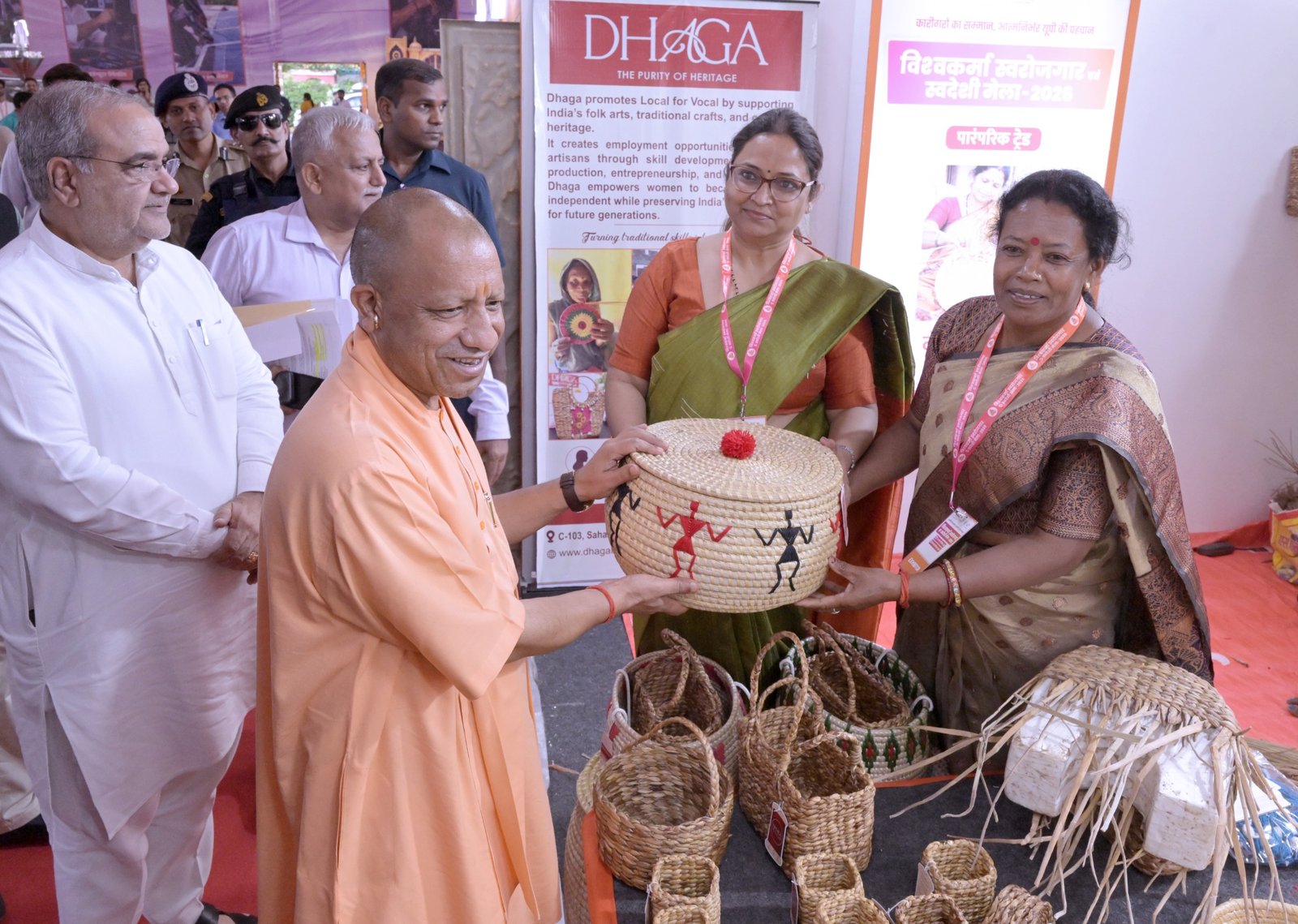
The Exhibition, based on Vishwakarma Swarozgar Evam Swadeshi Mela-2026, will be held from September 17 to 19, 2026. A total of 125 stalls related to ODOP, ODOC, Vishwakarma Shram Samman Yojana, Prime Minister Rozgar Srijan Program, Chief Minister Yuva Udyami Vikas Abhiyan, MSME, Sector Skill Council, franchise brands, and banks have been set up. At the Exhibition, artisans and entrepreneurs associated with 25 trades are being guided on business expansion, technological upgradation, market demand, quality product manufacturing, packaging, and marketing. MoUs have also been signed with corporate training institutes.