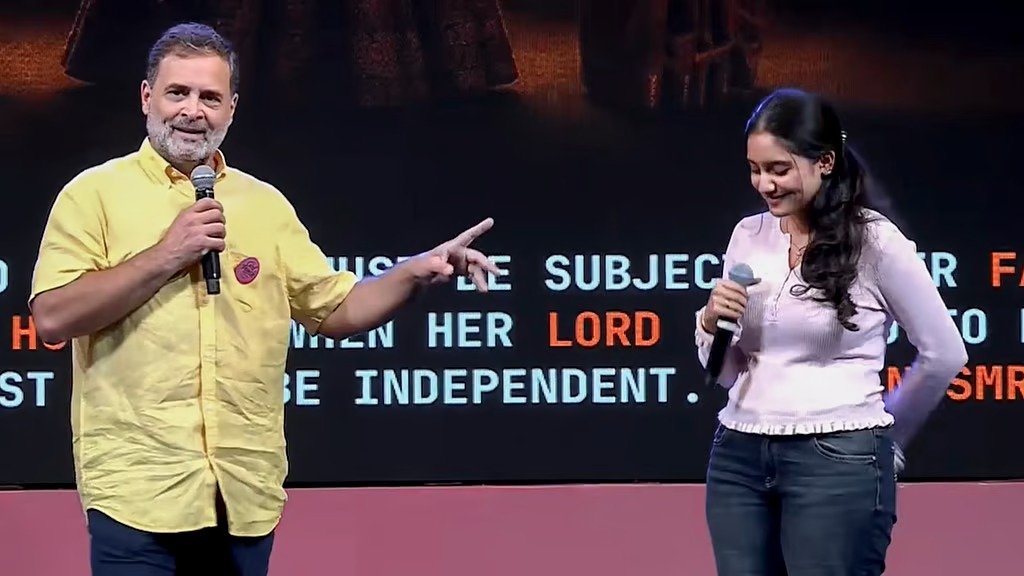
Pune, Aug 2026 : Congress MP and Leader of Opposition in the Lok Sabha Rahul Gandhi on Saturday described women as the country’s greatest strength and launched a sharp critique of patriarchal social structures, saying that keeping women dependent and confined to traditional roles reflected what he termed the “Manusmriti mindset”.
Addressing the “Chhatron Ki Goonj” programme at the Shri Shivaji Preparatory Military School College Ground in Pune, Gandhi told a gathering dominated by young women that women belonged to no one but themselves and urged them to break free from social restrictions.
“Women do not belong to any man; you belong only to yourselves,” Gandhi said, encouraging young women to “break the cage” and assert their independence.
Gandhi said the event was not intended as a conventional political programme. Instead, he sought to interact directly with the younger generation and understand their views on education, discrimination, safety, social change and their expectations for the future.
Several students took part in the discussion and joined Gandhi on stage to share their personal experiences and challenges. The interactive format allowed participants to raise questions and discuss issues affecting young people.
Beginning his address, Gandhi highlighted India’s large youth population as one of the country’s greatest assets. He subsequently turned his focus to women, arguing that the nation’s real strength lay in the ideas, aspirations and dreams of its approximately 70 crore women.
While the economy and the military are often described as the pillars of national strength, Gandhi said he considered women to be a far greater source of strength for India. He also spoke about qualities such as sensitivity, empathy and gentleness, which he said women bring to society.
Criticising traditional social frameworks, Gandhi said women had historically been restricted to narrowly defined identities such as daughter, wife or mother. He argued that such limitations prevented women from fully realising their potential in education, employment, entrepreneurship and other areas.
He cited several statistics while highlighting concerns over women’s safety and social status. According to figures mentioned by Gandhi, around 4.5 lakh girls face female foeticide every year, while a large proportion of women experience harassment and physical violence.
He also pointed to the impact of insecurity on women’s education and economic participation. Gandhi said many women either leave or reject employment and higher education opportunities because of concerns over violence and safety.
He further highlighted the burden of marriage and domestic responsibilities, which he said contributes to women dropping out of education and employment. He also referred to the difficulties faced by young women in travelling outside their homes independently because of safety concerns.
Economic inequality was another issue raised during the interaction. Gandhi said only a small proportion of women independently own property, arguing that economic dependence remains one of the major barriers to genuine empowerment.
The Congress leader also criticised what he described as systemic discrimination against girls in the education sector. He urged young people to challenge social conventions that restrict women’s choices and opportunities.
The discussion also touched upon the idea of the “Aadarsh Nari”, or ideal woman, and how traditional expectations surrounding women are changing. Gandhi said society needed to recognise women as individuals with independent aspirations rather than judging them primarily through conventional roles.
The event remained largely focused on dialogue rather than political rhetoric, with Gandhi repeatedly engaging with the concerns and aspirations of Gen Z participants.
The interaction covered education, youth development, social change, gender equality and contemporary challenges confronting young people. Gandhi’s emphasis throughout the programme was on encouraging the younger generation, particularly women, to question restrictive social norms and pursue their ambitions without being defined by traditional expectations.