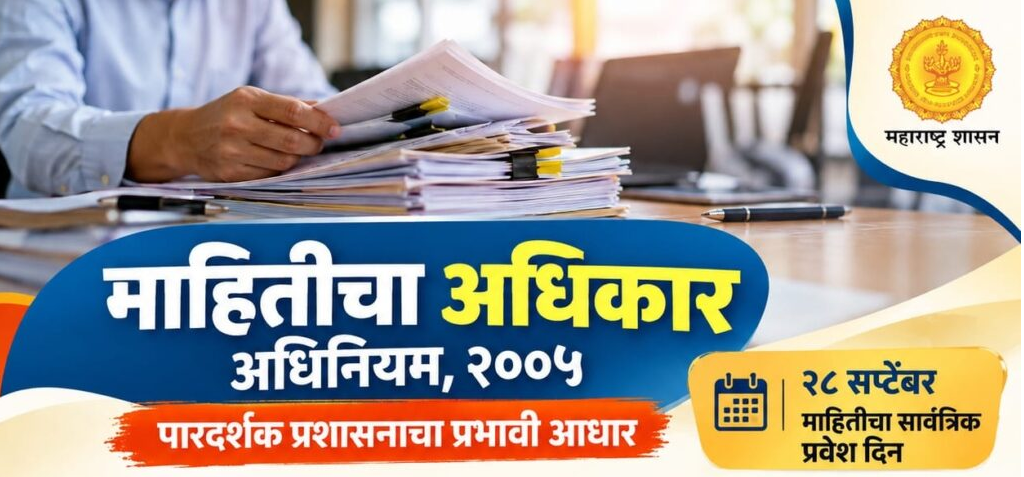
September 28 is observed across the world as the International Day for Universal Access to Information. Access to information is not merely a matter of administrative convenience; it is an important foundation for citizens’ participation in democracy, government accountability and transparency. This awareness was strengthened in India through the Right to Information Act, 2005. The law has now entered its 21st year. It has instilled greater discipline in maintaining transparency in administration and preserving official records properly. At the same time, the Act has helped reinforce at every level of administration the understanding that the government is accountable to ordinary citizens.
Significance of September 28
To underline the importance of universal access to information, the UNESCO General Conference declared September 28 as the International Day for Universal Access to Information in 2015. Subsequently, in October 2019, the 74th United Nations General Assembly also accorded international recognition to the day. UNESCO has emphasised that equal and universal access to information is essential for informed decision-making, democracy, inclusiveness and accountable institutions.
Global journey of the Right to Information
The concept of the right to information first took legal form in modern times in Sweden on December 2, 1766. Sweden’s Freedom of the Press Ordinance is regarded as the world’s first law guaranteeing access to public information.
In India, however, the journey towards this right has been closely linked to social movements, democratic values and demands for greater transparency in administration.
From ‘Hamara Paisa, Hamara Hisaab’ to the Right to Information
The movement led by the Mazdoor Kisan Shakti Sangathan (MKSS) in Rajasthan gave broad public support to the Right to Information movement in India. Activists including Aruna Roy, Nikhil Dey and Shankar Singh demanded that records of expenditure on development works in villages, wage details and government records be made available to the public.
‘Our money, our accounts’ became the central idea of the movement. It emerged from the simple question that if public labour and money were being used for government works, citizens should have the right to know how that money was being spent.
The experience of this movement led to the formation of the National Campaign for People’s Right to Information (NCPRI) in 1996. Aruna Roy and Nikhil Dey, along with several social activists, legal experts, journalists and civil society members, continued to campaign for the Right to Information at the national level.
In Maharashtra too, the demand for the Right to Information received support from social movements. Agitations led by Anna Hazare for transparent administration helped bring the demand for the right to information into public discourse. Maharashtra took an important step in 2002 by introducing its own Right to Information law. The law received presidential assent on August 10, 2002.
2005: A decisive step towards a nationwide law
The Central government had earlier enacted the Freedom of Information Act, 2002. However, recognising the need for a more effective, participatory and meaningful right to information, the process of replacing it with a new law was initiated.
The Right to Information Bill was introduced in the Lok Sabha on December 23, 2004. Both Houses of Parliament passed it in May 2005. Presidential assent was received on June 15, 2005, the Act was published in the Gazette on June 21, 2005, and it came fully into force on October 12, 2005.
Thus, in September 2026, the nationwide Right to Information law completed 20 years and entered its 21st year. In Maharashtra too, the Central Act has been implemented since October 12, 2005. Before that, the state had its own 2002 law.
An effective tool in the hands of citizens
The Right to Information Act gives citizens a legal right to seek information concerning records, documents, orders, reports, agreements and other records held by public authorities. An applicant is not required to provide a reason for seeking the information.
Generally, information has to be provided within 30 days, while information concerning the life or liberty of a person is required to be provided within 48 hours. If information is not provided, the Act provides for a first appeal followed by a second appeal or complaint.
Where the provisions of the Act are violated in denying information, the concerned Public Information Officer can be penalised at the rate of Rs 250 per day, subject to a maximum penalty of Rs 25,000.
The law therefore gives citizens an opportunity not only to ask, “What is the government doing?” but also to know, “On the basis of which records did the government take this decision?”
Changes in administration
The Right to Information has affected administrative functioning in two major ways. The first is accountability — the need to properly maintain decisions, orders and official records has increased. The second is proactive disclosure of information.
Under Section 4 of the Act, public authorities are expected to proactively disclose a range of information. The Maharashtra State Information Commission has also consistently emphasised effective implementation of Section 4, keeping information updated on websites and digitising official records.
Today, e-governance, online applications, digital records, disclosure of 17 categories of information on websites and online appeals have made access to information easier.
The Maharashtra government’s online RTI portal also enables citizens to file RTI applications and first appeals online.
Important changes in the law
At the Central level, the RTI Rules, 2012 were introduced. Subsequently, an important amendment was made to the Act in 2019, under which the tenure, salaries, allowances and service conditions of the Central and State Information Commissioners were to be determined through rules framed by the Central government.
Maharashtra has now taken another step towards updating its framework, with the Maharashtra Right to Information Rules, 2026 being notified on July 7, 2026. The official online RTI system also carries the relevant record.
Maharashtra State Information Commission
The Maharashtra State Information Commission was established on October 12, 2005. The Commission comprises the State Chief Information Commissioner and State Information Commissioners.
According to the information provided, Rahul Bhalchandra Pandey is currently the State Chief Information Commissioner. At the divisional level, Dr Pradeep Vyas is handling the Brihanmumbai jurisdiction; Makarand Madhusudan Ranade is responsible for Pune and Chhatrapati Sambhajinagar; Prakash Shamrao Indalkar for Nashik and Konkan; Ravindra Hanumantrao Thakare for Amravati; and Gajanan Shridhar Nimdev for Nagpur.
The state government has appointed experienced officials to these positions, which has helped reduce the pendency of cases before the Commission, the article states.
The Commission thus has a hearing mechanism covering seven divisional jurisdictions, along with its headquarters in Mumbai. Monthly disposal reports, decisions and hearing schedules are also published on the Commission’s website.
Debate over use and misuse
Bharat Ratna Dr B.R. Ambedkar, while addressing the Constituent Assembly on the effective implementation of the Constitution, had emphasised the importance of how the Constitution was used and implemented.
The same principle is relevant to the Right to Information Act, which needs to be used more actively to promote transparent public administration. The Right to Information is an effective citizen tool in a democracy, but its use must also remain consistent with the purpose of the law.
Requests for personal information that have no connection with wider public interest, or demands for the creation of new information that does not already exist with a public authority, do not fall within the framework of the Act.
Therefore, citizens also have a responsibility to seek factual, precise and public-interest-related information while exercising the right. At the same time, public authorities are expected to provide eligible information within the prescribed time without unduly expanding the exemptions provided under the law.
Special initiative this year
In 2026, Maharashtra has undertaken an initiative to observe Right to Information Day through wider public awareness programmes.
Question-and-answer competitions, painting, essay and elocution competitions, as well as seminars and lecture series on the Right to Information are being organised in schools, colleges, universities and other educational institutions.
The initiative seeks to convey to the younger generation that the Right to Information is not merely a law for filing applications, but also an instrument of civic education that strengthens awareness of democratic values.
Towards transparent governance
The Right to Information is not about creating a wall of distrust between the government and citizens; rather, it can help strengthen the foundation of trust. When information is available, questions become more precise, the administration is required to clearly record the basis for its decisions, and citizen participation in governance increases.
Over the past two decades, the Right to Information has placed an important tool in the hands of ordinary citizens to seek information about government functioning. When used responsibly, it can open not merely the door to an individual file but also a wider window into transparency in administration.
The law recognises the democratic principle that power ultimately comes from the people and that the administration is expected to work for them. Making information about government functioning available to citizens is therefore a natural requirement of democracy. The Right to Information Act has given this requirement legal backing.
By strengthening the three pillars of transparency, accountability and citizen participation, the Right to Information continues to play an important role in making governance more effective, responsive and citizen-oriented.
September 28 is therefore not merely a day to be observed as Right to Information Day. It is an occasion to reaffirm the democratic commitment that information concerning government functioning should, within the framework of the law, be made accessible to citizens rather than unnecessarily kept from them. Transparent administration remains a key hallmark of good governance.