Haridwar, November 2026: Rashtriya Swayamsevak Sangh (RSS) chief Mohan Bhagwat on Saturday emphasised the importance of organisational discipline, service and dedication, saying that running an organisation with discipline for a century was a great spiritual endeavour. He observed that completing 100 years is not easy for any organisation, but preserving its objectives, principles and discipline throughout such a long journey is an even greater challenge.
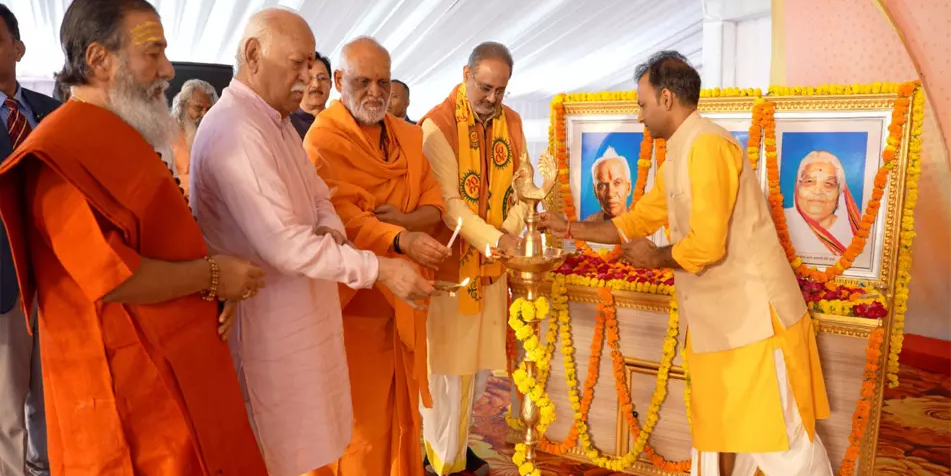
Bhagwat was addressing the birth centenary celebrations of Mata Bhagwati Devi Sharma at Shantikunj in Haridwar. During his address, he also spoke about Sanatan culture, nation-building, social service and the responsibilities of organisations working for social transformation.
A Century of Organisational Discipline Is a Major Achievement
Bhagwat said the real strength of an organisation lies in the discipline, dedication and sustained efforts of its workers. Organisations face several challenges during their long journeys, including periods of neglect and difficult circumstances. However, those that remain committed to their objectives despite such challenges gradually earn the trust and acceptance of society.
He stressed that service and dedication are essential for an organisation to establish its identity and gain social recognition. An organisation's success, he said, should not be measured merely by its expansion, but also by the nature of its activities and the impact they create in society.
Referring to the work of the RSS and the Gayatri Parivar, Bhagwat described their efforts as being connected with a higher, divine purpose. He said sustained efforts, determination and commitment were necessary to carry forward such work.
No Need to Be Anxious About Sanatan Dharma
Speaking about Sanatan Dharma and Indian culture, Bhagwat said there was no reason to harbour doubts or anxiety about the future of Sanatan traditions.
He observed that the world was facing several challenges and that many people were looking towards India with hope for solutions. According to him, Indian culture and Sanatan philosophy have the capacity to offer direction to humanity.
He highlighted the importance traditionally given to service, sacrifice, dedication and collective welfare in Indian thought. Organisations involved in nation-building and social development, he said, should continue their work while drawing inspiration from these values.
Bhagwat urged workers to discharge their responsibilities with complete sincerity and commitment. He said efforts towards social transformation should be guided by a strong sense of duty and concern for the larger community.
Lord Hanuman as an Ideal for Dedicated Workers
Bhagwat cited Lord Hanuman as an example for people engaged in service-oriented activities, describing him as an ideal of selfless service and dedication.
He said that just as Hanuman devoted himself to carrying out the work of Lord Ram, those involved in social service should remain firmly committed to their objectives.
To achieve a larger purpose, he said, individuals must rise above personal interests and work with a spirit of cooperation. Discipline and mutual support among organisational workers are equally important.
Emphasising that service is a significant instrument of social development, Bhagwat called upon workers to continue initiatives that promote Sanatan culture and strengthen social awareness.
Commemorative Stamp Released in Memory of Mata Bhagwati Devi Sharma
A special commemorative postage stamp honouring Mata Bhagwati Devi Sharma was released during the birth centenary celebrations in Haridwar.
Bhagwat, Jagadguru Swami Rajrajeshwarashram and Gayatri Parivar's youth head, Dr Chinmay Pandya, were among the dignitaries present on the occasion.
Speakers remembered Mata Bhagwati Devi Sharma's life, her service activities and her contribution to society. They described her life as an example of sacrifice, spiritual discipline, compassion and social awareness.
The celebrations began with the chanting of Vedic hymns, a ceremonial band performance and the blowing of conch shells. Three sacred urns associated with the life and work of Gayatri Parivar founder Pandit Shriram Sharma Acharya were brought to the venue. These represented Awalkheda, his birthplace; Mathura, his place of spiritual penance; and Haridwar, his place of work. The urns were welcomed with an auspicious Mangal Aarti.
Gayatri Parivar Members from Around 40 Countries Attend
Members of the Gayatri Parivar from India and approximately 40 other countries participated in the birth centenary celebrations. The programme featured discussions on spiritual, social and cultural themes.
Dr Chinmay Pandya, who led the delegation at the celebrations, spoke about Mata Bhagwati Devi Sharma's life and contributions. He said her entire life was devoted to spiritual discipline, sacrifice, devotion and the cause of social development.
Pandya described 2026 as a year of special spiritual significance and also recalled the thoughts and philosophy of Maharishi Aurobindo.
Saints attending the programme highlighted the importance of character, service and ethical values in running organisations. Swami Rajrajeshwarashram said that an institution's true identity was determined not merely by its buildings and resources, but by the character and dedication of the people associated with it.
Mohan Bhagwat Meets Shaildidi at Shantikunj
During his visit to Haridwar, Bhagwat also met Shaildidi, the head of Shantikunj. They discussed various social, cultural and spiritual issues.
Bhagwat visited the Siddh Akhand Deep at Shantikunj and offered prayers for universal brotherhood and the welfare of all. He also paid his respects at the Charan Padukas of Pandit Shriram Sharma Acharya and Mata Bhagwati Devi Sharma.
Shaildidi welcomed him with an auspicious ceremonial tilak. Bhagwat was presented with a stole bearing the Gayatri Mantra, literature from the Yug Nirman movement and a commemorative memento.
The celebrations brought together spiritual leaders and members of the Gayatri Parivar from across the country and abroad to remember Mata Bhagwati Devi Sharma's contributions. Bhagwat's address centred on the values of discipline, service and dedication, reiterating that remaining committed to an organisation's objectives over a century-long journey is, in itself, a significant spiritual endeavour.