London, September 2026 : Rashtriya Swayamsevak Sangh (RSS) chief Mohan Bhagwat has rejected allegations that “intense hatred” forms the basis of the organisation’s activities, asserting instead that its work is rooted in what he described as “Shuddha Saatvika Prem”, or pure and noble love.
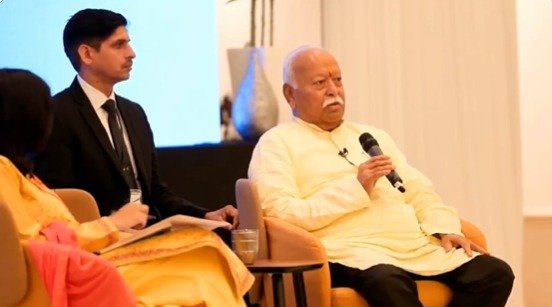
Speaking at a civilisational dialogue in London on Sunday as part of the RSS’s centenary outreach programme, Bhagwat said the concept of “apnapan”, or a sense of oneness, belonging and interconnectedness, lies at the core of Hindu thought as well as the organisation’s approach to society.
Bhagwat said the idea of belonging should not be confined to an individual or a particular group. According to him, it extends from the individual to the family, community, society and humanity as a whole. He also highlighted what he described as the Hindu civilisational understanding of the close relationship between human beings and nature.
“I heard some people say, intense hatred is the basis of our work. It is just the reverse. ‘Shuddha Saatvika Prem’, that is the basis of our work,” Bhagwat said.
Elaborating on the RSS’s philosophy, he said the organisation had consistently emphasised pure and noble love as the foundation of its activities. He maintained that the principle had remained unchanged throughout the RSS’s 100-year history and continued to be reflected in the conduct of its volunteers, known as swayamsevaks.
Bhagwat referred to a song traditionally sung within the RSS to reinforce his point. The song contains the line, “Shuddha saatvika prem apne karya ka aadhaar hai,” which translates to “Pure, noble love is the foundation of our work.”
“We sing a song in Sangh; we say: ‘Shuddha saatvika prem apne karya ka aadhaar hai.’ I heard some people say intense hatred is the basis of our work. It is just the reverse. Shuddha saatvika prem, that is the basis of our work,” he said.
“And that has not worn out even in 100 years. You will find the same shuddha saatvika love in the behaviour of swayamsevaks, in the atmosphere of the Sangh,” the RSS chief added.
During the interaction, Bhagwat was also asked what Hindu civilisation could offer the world at a time when countries are facing armed conflicts as well as economic, technological and social challenges. Responding to the question, he said Hindu thought is fundamentally based on the belief that existence is ultimately one, despite the visible diversity of people, cultures and ways of life.
“Existence is really one. It appears to be diverse. Diversities are natural. So we have to accept them; we have to respect them,” he said.
Bhagwat argued that diversity should be understood as different expressions of an underlying unity rather than as a reason for conflict or separation. He said human beings must engage with diversity because it is an inherent part of nature, while recognising that different forms of existence remain interconnected.
“One has to become many; therefore, many are respected. So deal with many, because it is practical; you have to go through nature. But when dealing with them, you should not look at them as something separate. We are one. All is one,” he said.
He contrasted this approach with an outlook based primarily on rivalry and competition, where one person or group seeks to gain something at another’s expense. Bhagwat suggested that a more cooperative approach would recognise that different people can have common needs and should be able to fulfil them together.
He also discussed the Hindu understanding of diversity and coexistence, arguing that differences in beliefs, lifestyles and practices should not automatically result in separation.
“Hindu is different... Because your way is different, we need not be separate. We can go together, we can work together, we can live together. And we should live together. That is Hindu,” Bhagwat said.
The RSS chief also drew a distinction between the terms “Nation” and “Rashtra”, saying that they should not be considered direct translations of each other. He explained that the modern concept of a nation is often associated with a nation-state formed around factors such as common language, religious identity or a particular system of governance.
“Nation is not a translation of the word Rashtra. Rashtra is a different concept. Nation means nation-state,” he said.
Bhagwat also addressed the relationship between Hindus living in Britain and their connection with India. He said Hindu thought does not require people to abandon their responsibilities or loyalties towards the country where they live, work and contribute to society.
“If British Hindus are ‘Achcha Pakka Sachcha Hindus’, there will never be a conflict between British and Bharat interests,” he said.
He added that if a situation arose in which the interests of Britain and India came into conflict, Hindus living in Britain would be expected to remain committed to their country of residence and responsibility.
“Your Karmabhoomi is where your loyalties lie... Hindutva never asks you to betray your Karmabhoomi,” Bhagwat said, referring to the concept of Karmabhoomi, or the land where an individual performs their duties and work.
Bhagwat’s remarks came as the RSS continues its centenary-year outreach, with the organisation seeking to present its philosophical and social worldview through interactions and dialogues in India and abroad.