Washington, Aug 2026: US President Donald Trump has warned Iran that Washington could impose “very Draconian sanctions” on Tehran while claiming that the strategic Strait of Hormuz may no longer be as important to global energy markets as it was in the past.
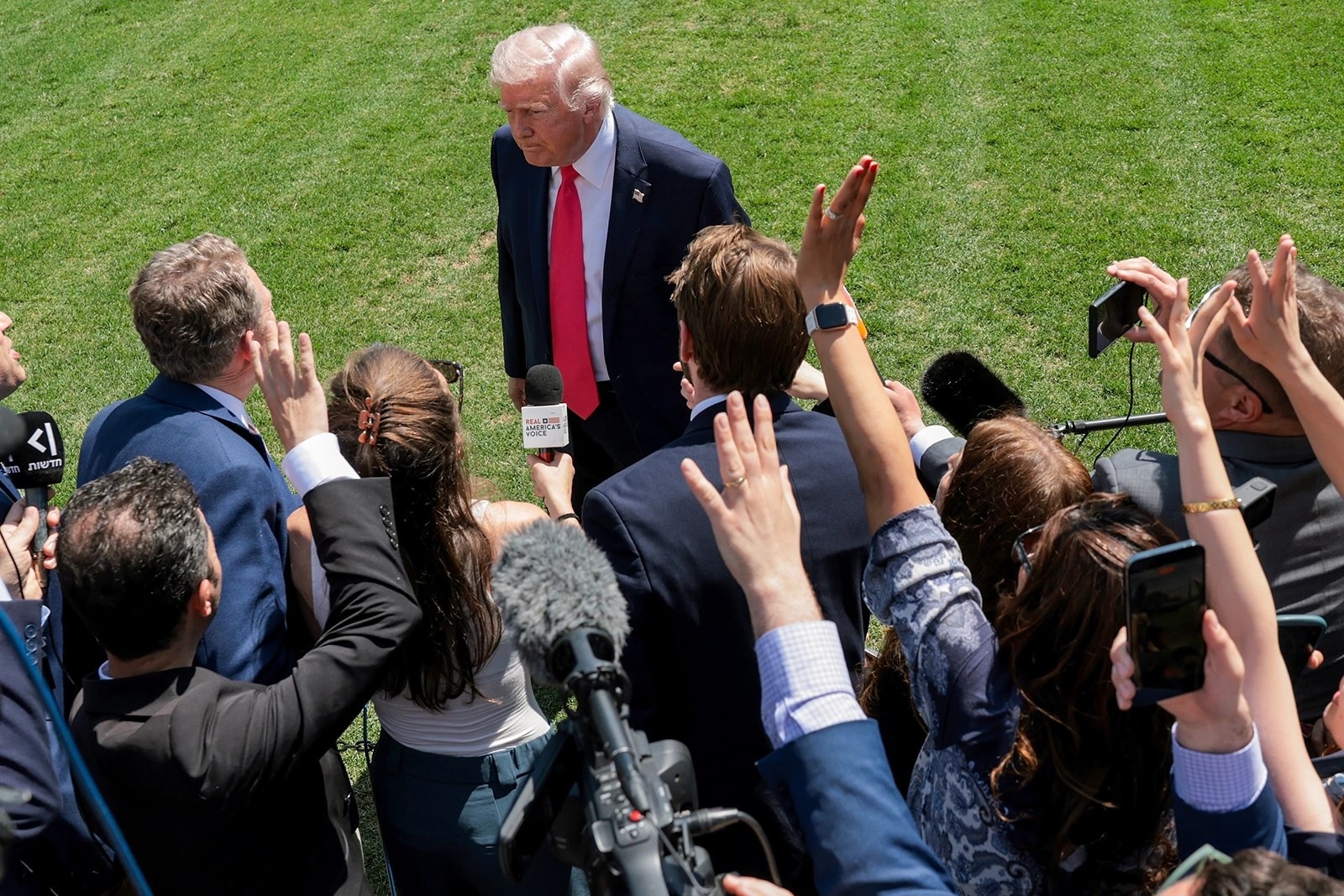
Speaking at the White House, Trump said his administration had several options available to increase pressure on Iran, but stopped short of detailing any specific new measures.
“We have things that we could sanction. We have very Draconian sanctions, and we'll see what happens,” Trump said when asked about the possibility of further economic restrictions on Tehran.
Trump also claimed that the Strait of Hormuz, a crucial maritime passage connecting the Persian Gulf with the Arabian Sea, remained open and that a significant number of vessels were continuing to transit through the waterway.
“Right now, the Strait is open; we've got a lot of boats coming through, people aren't reporting that,” he said. Trump added that traffic could decline in the future but maintained that shipping activity was continuing.
The US President also defended the effectiveness of the American naval blockade on Iran, claiming that no vessels had been able to enter Iranian waters as a result of the operation. He did not provide figures or independent evidence to support the claim.
“The naval blockade has been extremely effective,” Trump said. “No boats have gotten into Iran, but they are getting in for other places.”
Trump suggested that there had been temporary pauses in the US strategy under an earlier understanding but accused Tehran of failing to honour its commitments.
“The deal didn't terminate -- you know, the deal didn't turn out to be what they said,” he said, alleging that Iran had made commitments but subsequently acted differently.
The President presented the situation as a choice between reaching an agreement with Iran that could bring down global oil prices and continuing with the current US strategy of applying pressure on Tehran.
“It'll either be extremely good, and oil prices are going to drop like a rock, or we'll continue to do exactly what we're doing,” Trump said.
He also sought to dismiss concerns that the crisis surrounding the Strait of Hormuz could trigger a dramatic increase in global crude prices. Trump said predictions of oil reaching $350 a barrel had not materialised and claimed prices were currently around $84-$85 a barrel.
“You know, they were talking about $350 a barrel, and it's today $84 or $85. And we are getting a lot of oil out,” he said.
Trump attributed the relatively stable energy market partly to increased US oil production and the development of alternative supply routes. He pointed to energy resources in Texas, Alaska and Louisiana, as well as what he described as a record number of new pipelines being constructed across the country.
According to Trump, these developments have reduced the world's dependence on the Strait of Hormuz and could eventually diminish its strategic importance.
“So, I think the Hormuz Strait is not going to be quite as important as it was in the past,” he said.
The remarks came amid continuing tensions between Washington and Tehran and uncertainty over efforts to end the confrontation. Trump has repeatedly indicated that the US could impose additional economic and financial pressure on Iran if Tehran does not agree to Washington's demands.
His comments were made during a White House meeting with senior figures from the technology, cryptocurrency and financial sectors. Trump was also asked about earlier remarks by the US Treasury Secretary suggesting that the administration could announce some of its most significant sanctions against Iran during the week.
The latest statements underscore Washington's continued reliance on economic pressure while the Trump administration argues that growing US energy production and alternative supply networks can reduce the impact of disruptions around one of the world's most important energy corridors.
(Disclaimer :The content of this article is sourced from a news agency and has not been edited by the Mavericknews30 team.)