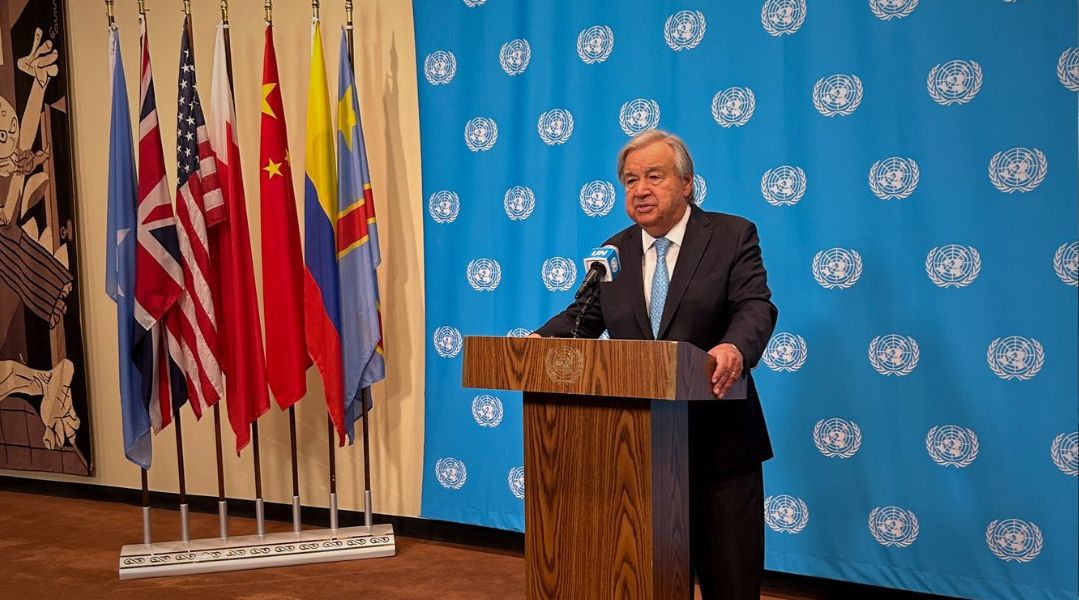
United Nations, Aug 2026 : United Nations Secretary-General Antonio Guterres has urged the United States and Iran to resume meaningful negotiations and pursue a diplomatic solution to their six-month-long conflict, warning of the severe humanitarian and economic consequences of continued hostilities.
UN spokesman Stephane Dujarric, responding to questions about the stalled negotiations, said the prolonged conflict represented a deeply concerning milestone and reiterated the UN’s position that diplomacy remains the only viable path towards ending the crisis.
“This is a sad marker of six months of this ongoing conflict,” Dujarric said. “We again stress that the only solution to this is a diplomatic solution. And we urge both the United States and the Islamic Republic of Iran to engage in meaningful negotiations.”
Dujarric said the United Nations continues to support mediation efforts by Qatar, Pakistan, Egypt, Saudi Arabia and Kuwait. According to the spokesman, Guterres has remained in close contact with the countries involved in diplomatic efforts aimed at bringing the two sides back to the negotiating table.
The UN chief remains particularly concerned about the conflict’s widening humanitarian and economic impact. Dujarric highlighted disruptions to global food supplies, restrictions affecting the delivery of humanitarian goods and limited access to fertilisers, along with rising energy prices.
He warned that the consequences of the conflict extend far beyond the immediate region, potentially affecting global markets and vulnerable populations that depend on stable supplies of food, fuel and other essential commodities.
Guterres’ personal envoy for the conflict, Jean Arnault, also remains available to assist the parties and mediators in their efforts to find a durable settlement, Dujarric said.
The conflict began on February 28, when the United States and Israel launched military attacks against Iran. Tehran responded with attacks targeting Israel and US military bases in the Gulf, triggering a major escalation across the region.
One of the most significant consequences has been disruption around the Strait of Hormuz, a crucial maritime chokepoint through which a substantial share of global energy supplies passes. The waterway was largely blocked during the conflict, severely affecting the movement of oil and other commodities.
The disruption has raised concerns about energy security and contributed to pressure on international markets, while also complicating the movement of essential goods.
Earlier, on June 18, the United States and Iran signed a memorandum of understanding under which the two countries were expected to begin negotiations within 60 days with the objective of reaching a final agreement.
However, the planned diplomatic process has since been thrown into uncertainty amid renewed tensions and military escalation.
The United Nations is now calling on both Washington and Tehran to return to negotiations and use diplomatic channels to prevent further escalation. Guterres has also maintained that sustained international mediation could help create the conditions required for a durable resolution to the conflict.
The UN’s renewed appeal comes as the humanitarian and economic costs continue to mount, increasing pressure on the international community to revive diplomacy and prevent further regional destabilisation.