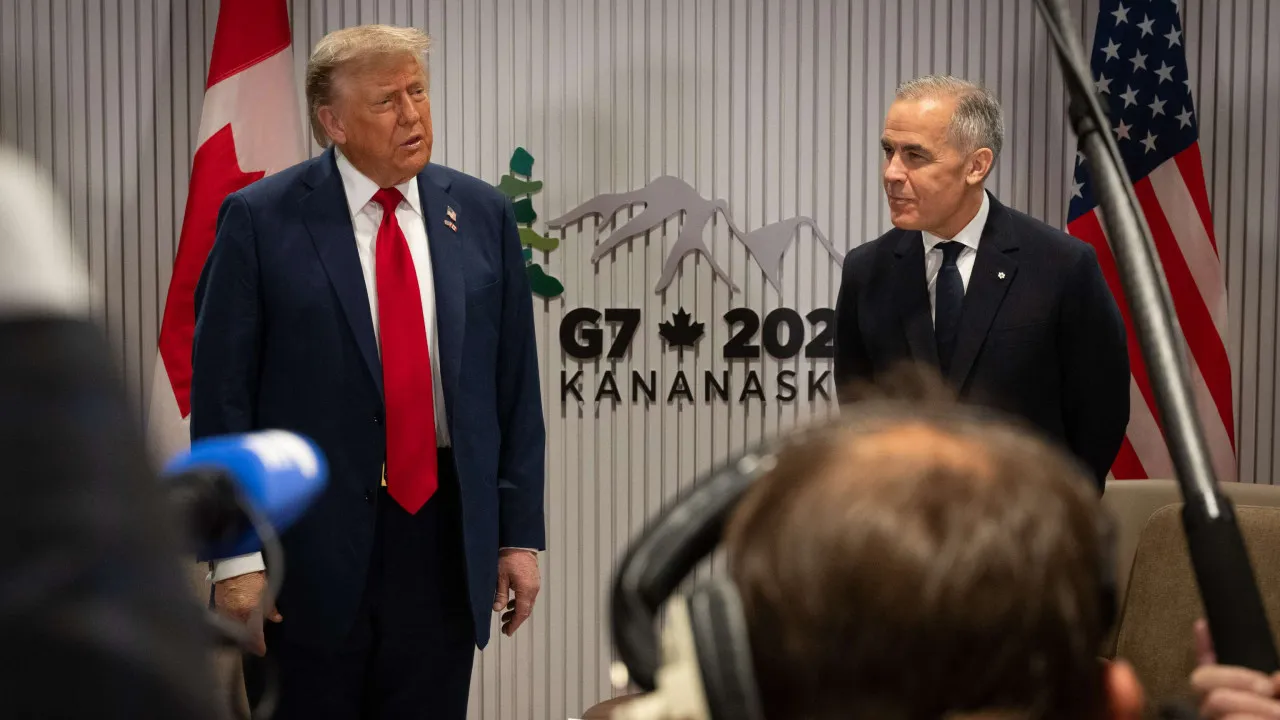
Washington, Aug 2026 : Trade tensions between the United States and Canada intensified sharply on Saturday after last-minute negotiations collapsed, with Washington moving ahead with 50 per cent tariffs on billions of dollars worth of Canadian goods and Ottawa announcing plans for matching retaliatory duties.
Canadian Prime Minister Mark Carney suspended trade negotiations with the United States and instructed his negotiating team to return to Ottawa after accusing Washington of making significant changes to its proposed terms at the final stage of discussions.
“Last-minute changes in the U.S. proposed terms were unfair, uneconomic, and called into question the reliability of any deal,” Carney said.
He said the United States planned to impose a 50 per cent tariff on roughly $28 billion worth of Canadian goods from midnight. Canada, he added, would respond with equivalent tariffs to protect Canadian workers and businesses.
The breakdown marked a major setback to efforts to stabilise economic ties between the two neighbouring countries, whose economies remain deeply interconnected through trade and integrated supply chains.
The Office of the US Trade Representative, however, placed responsibility for the collapse on Canada. It said Ottawa had declined to finalise an agreement based on terms that had reportedly been negotiated earlier in the week.
“Despite the US offer to Canada to receive the best treatment of any major exporter to our market, new demands and walk backs of other commitments by Canada have upended the careful balance reached in the past days,” the US Trade Representative said.
According to Washington, its proposed package included substantial tariff reductions covering key Canadian exports such as steel, aluminium, automobiles and lumber. The proposal also envisaged greater cooperation between the two countries on export controls, transshipment, digital trade, critical minerals and goods manufactured using forced labour.
The US offer further included supply-chain coordination in the aerospace sector and plans to begin formal discussions on the United States-Mexico-Canada Agreement, or USMCA, which governs much of North American trade.
“This is a missed opportunity for Canada to partner with the United States, which is the fastest growing economy in the G7,” the US Trade Representative said.
Carney said Canada had entered negotiations seeking tariff-free access for most Canadian businesses, greater predictability in bilateral trade and lower US tariffs on strategically important sectors. Ottawa also wanted safeguards for small and medium-sized enterprises while preserving Canada’s economic independence and flexibility.
“We have recognised from the beginning that America has changed, and that we will not return to our old relationship,” Carney said.
He stressed that Canada was seeking the best possible agreement rather than accepting a deal simply to meet a deadline.
“Throughout, our goal has been to secure the best deal for Canadians, never a deal at any price or on any deadline,” the Prime Minister said.
Carney also announced that his government would unveil additional measures to support Canadian workers and businesses in the coming days. The new assistance would build on nearly $25 billion in support already provided by Ottawa over the past 18 months to cushion the impact of trade disruptions.
The latest escalation has also drawn criticism within the United States. US Senator Peter Welch, a Vermont Democrat and member of the Senate Finance Committee, urged President Donald Trump to reconsider the tariffs.
“These new 50% tariffs on Canadian goods are a continuation of the president’s chaotic economic policies, and a slap in the face to businesses and farmers in Vermont and northern border states across America,” Welch said.
Welch is the lead sponsor of legislation aimed at providing tariff exemptions for certain American-owned small businesses affected by Canadian trade measures. He also backs the bipartisan Trade Review Act, which seeks to restore a greater role for Congress in shaping US trade policy.
The latest confrontation comes after months of worsening US-Canada trade relations. Earlier American tariffs on automobiles, metals and forest products had already prompted retaliatory measures from Ottawa.
Trump’s repeated comments suggesting that Canada could eventually become the 51st US state have further fuelled public anger in Canada and intensified calls for reducing the country's economic dependence on its southern neighbour.
With both governments now preparing fresh tariff measures, businesses on both sides of the border face renewed uncertainty over costs, supply chains, investment and access to their largest neighbouring market.
(Disclaimer :The content of this article is sourced from a news agency and has not been edited by the Mavericknews30 team.)