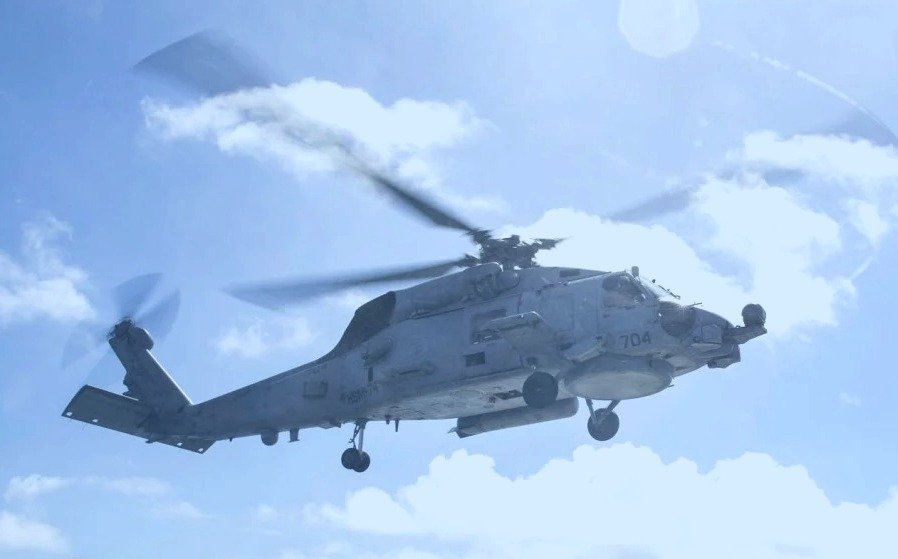
Washington DC; August 2026: On Friday (August 21, 2026), the US DOW has announced that Navy is rebuilding the MH-60 Sea Hawk’s digital architecture vide TALON prototype effort to keep the helicopter combat-relevant through 2050, in collaboration with the Royal Australian Navy. The shift to an open avionics foundation is intended to let MH-60R and MH-60S crews field new sensors, weapons and mission software faster as threats evolve, without waiting for major aircraft redesigns.
Rather than replacing one of naval aviation's most heavily used helicopter families, the Navy is preparing to rebuild the digital foundation beneath its avionics and mission systems. The initiative could transform the Sea Hawk from a mature platform facing electronics obsolescence into an aircraft able to absorb new technology far more rapidly. According to theDepartment of War, the modernisation is being pursued jointly with the Royal Australian Navy under the MH-60 Tailorable Architecture Leveraging Open Systems, popularly known as TALON, prototype project.
The importance of the program stems from the extraordinary breadth of missions performed by the 02 principal Sea Hawk variants. The MH-60R Romeo is the Navy's primary helicopter for anti-submarine warfare and surface warfare, while also supporting electromagnetic warfare, command and control, intelligence, surveillance, reconnaissance and other missions. The MH-60S Sierra provides anti-surface warfare, combat support, special-operations support, personnel recovery, search and rescue, logistics, humanitarian assistance and airborne mine-countermeasure capabilities. Together, the variants form a deeply embedded component ofnaval aviation, operating from carriers and other aviation-capable warships and linking airborne sensors, weapons, surface forces and embarked commanders across the maritime battlespace.
That position was built over more than two decades of operational evolution. The Navy fielded the MH-60S in 2002 as part of a broader effort to consolidate several legacy helicopter rolls around the H-60 family. The first MH-60R flew in July 2001, with the Romeo later reaching initial operational capability in the mid-2000s and full operational capability in 2010 as it replaced the older SH-60B and SH-60F fleets. Both variants were developed around significant commonality, including a common cockpit concept, helping reduce training and logistics burdens while providing specialised aircraft for combat support and high-end maritime warfare. The result is a mature ecosystem of aircraft, aircrews, maintainers, weapons, training systems and shipboard infrastructure that would be expensive and operationally disruptive to replace prematurely.
TALON targets the part of the aircraft where technological age can become most restrictive: its avionics and mission-system architecture. The Department of War says the project will modernise the MH-60's avionics and mission-system architecture while addressing multiple obsolescence issues, including work on a flight-critical avionics segment and a new digital backbone built around modular open-system principles. Sierra Nevada Corp. has been identified for physical and structural integration design on the MH-60S, while Lockheed Martin Rotary and Mission Systems has been identified for the MH-60R. Rockwell Collins and Lockheed Martin were identified for flight-critical avionics and digital-backbone integration, while Technology Security Associates is expected to support third-party assessment of open-system implementation.
·Phase 1 will concentrate on preliminary design, creation of a collaborative digital-engineering environment and preparation of aircraft for testing, while
·Phase 2 is planned to move into prototype development and verification. Crucially, the Department stressed that the industry selections do not yet constitute formal contract or agreement awards, which remain dependent on successful negotiations and finalised Phase 1 statements of work.
The technological advantage lies less in one new display, computer or sensor than in changing how future capabilities reach the aircraft. A modular open architecture built around defined interfaces can potentially allow processors, software applications, sensors and other components to evolve without requiring major portions of the helicopter's electronic architecture to be redesigned whenever technology or operational requirements change. For an aircraft family the Navy intends to sustain through the 2050 timeframe, that approach could make future modernisation faster and more competitive while helping contain the cost and complexity associated with technological obsolescence. The significance is not simply that the Sea Hawk could receive another avionics upgrade; it is that TALON is intended to create a digital foundation capable of supporting repeated upgrades over decades as threats, computing technologies and fleet requirements evolve.
Militarily, extending the Sea Hawk's relevance toward 2050 is particularly significant because the helicopter operates where some of the Navy's most demanding missions converge. Anti-submarine warfare increasingly depends on the rapid processing and exchange of acoustic, radar, electronic and off-board sensor information, while surface warfare and electromagnetic operations are evolving alongside longer-range weapons, distributed sensors and more networked fleet concepts.
A flexible digital backbone could give the Navy greater freedom to integrate future sensors, communications technologies, computing hardware and mission applications as those requirements change. TALON could also have consequences beyond the MH-60 itself: the Department of War says the prototype project is intended to help streamline future vertical-lift development through a portable open core architecture, potentially allowing lessons from Sea Hawk modernisation to influence the digital foundation of future aircraft.
The Australian dimension makes TALON more than afleet-sustainment project. The Royal Australian Navy operates the MH-60R and is participating directly in the modernisation effort, creating an opportunity for future upgrades to reinforce not only aircraft commonality but deeper allied operational integration. That strategic relevance was demonstrated separately on August 11, 2026, when a Royal Australian Navy MH-60R assigned to the Anzac-class frigate HMAS Perth landed aboard theaircraft carrier USS George Washington while the two warships operated in the South China Sea.
Official Australian Navy images has confirmed the Australian helicopter conducting flight-deck operations aboard the forward-deployed carrier, providing a visible demonstration of the practical compatibility already possible between two allied navies operating the same helicopter family.
Geostrategically, the connection is important. In the South China Sea and wider Western Pacific, where long distances, submarine activity, contested sea lanes and distributed naval operations place increasing pressure on allied forces, common aircraft can provide commanders with additional flexibility across cooperating flight decks. The August cross-deck operation does not by itself establish complete interchangeability in maintenance, weapons support, mission data or national logistics systems, but it demonstrates an operational foundation on which deeper interoperability can be built. If TALON eventually produces compatible, upgradeable digital architectures across and Australian MH-60R fleets, the value could extend beyond individual helicopters toward more resilient coalition aviation operations, faster introduction of common capabilities and greater flexibility in how maritime forces distribute aviation assets during high-intensity operations.
The strategic effect could be particularly important for maritime deterrence. A helicopter capable of operating from allied flight decks while progressively receiving updated sensors, processing capabilities, communications systems and mission software would be more adaptable to a battlespace expected to become increasingly dependent on distributed sensing and networked warfare. Rather than being conceptually restricted to a single parent ship, allied MH-60Rs could gain more options for diversion, personnel movement, cross-deck operations and, where support arrangements permit, increasingly integrated maritime aviation missions. For an adversary, the challenge is therefore not simply the number of Sea Hawks available, but the growing number of combinations in whichand allied naval forces may be able to employ them across a dispersed fleet.
The Navy's 2050 plan is ultimately about preventing a proven helicopter from becoming trapped by the technology of the era in which it was built. If TALON delivers the modular architecture envisioned by theDepartment of War, the MH-60 could remain valuable deep into the middle of the century not because its basic airframe is new, but because its digital foundation can continue evolving around it. That would turn what might otherwise appear to be a conventional service-life modernisation effort into something far more consequential: a pathway for the United States and its closest maritime allies to preserve a deeply established naval aviation capability while continuously renewing the software, computing power, sensors and mission systems that will determine whether the Sea Hawk can survive, connect and fight in the battlespace of the 2040s and beyond.
Team Maverick.