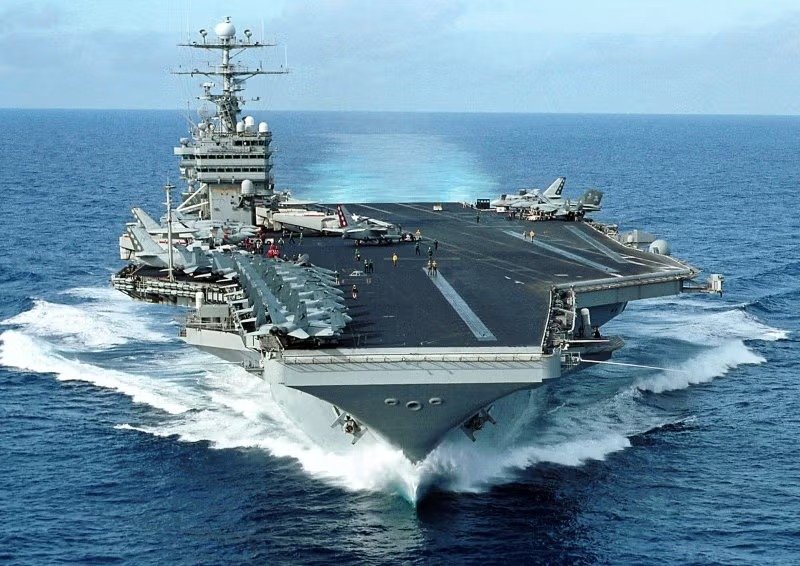
Washington, August 2026: The US aircraft carrier USS George Washington has arrived in the Middle East to relieve the USS Abraham Lincoln, which has been deployed for more than 250 days while supporting American military operations linked to the conflict with Iran. The rotation comes amid growing concerns over the strain that prolonged deployments are placing on sailors and the broader operational capacity of the US Navy.
The George Washington, a Nimitz-class nuclear-powered aircraft carrier normally based at Yokosuka, Japan, had been operating in the western Pacific and South China Sea before being redirected towards the Middle East. The carrier departed Da Nang, Vietnam, last week accompanied by a cruiser and a destroyer. It subsequently travelled through the Singapore Strait and Strait of Malacca before heading across the Indian Ocean towards the Middle East.
The US military confirmed on Thursday that the George Washington and its accompanying carrier strike group were operating in the region. Its arrival provides a planned relief for the Abraham Lincoln, whose unusually lengthy deployment has increasingly attracted scrutiny from lawmakers, military officials and families of sailors serving aboard the carrier.
The USS Abraham Lincoln departed San Diego on November 21, 2025, for what was initially planned as a regular deployment. It was redirected to the Middle East in January 2026, ahead of the US military campaign against Iran that began on February 28. Aircraft operating from the carrier subsequently participated in the American bombing campaign known as “Epic Fury”, while the carrier later supported a US blockade of Iranian ports.
The Lincoln has now spent more than 250 days deployed and more than 200 days without a port call, according to US officials and lawmakers. The extended period at sea has raised concerns because port visits are considered important for replenishing supplies, conducting maintenance, allowing sailors to rest and providing access to essential services away from the ship.
Democratic Senator Richard Blumenthal, a member of the Senate Armed Services Committee, highlighted some of the concerns in a letter addressed to Defence Secretary Pete Hegseth and Acting Navy Secretary Hung Cao. He cited reports of shortages of basic supplies, water contamination, plumbing issues, declining mental health, flight-deck safety concerns and disruptions to the postal system.
The Navy has acknowledged shortages and problems affecting mail delivery but has rejected suggestions of a broader increase in mental health problems or suicide attempts aboard the Lincoln. Hegseth has also dismissed reports suggesting that conditions aboard the carrier had deteriorated to an extreme level.
President Donald Trump has likewise downplayed concerns over the length of the carrier's deployment. On August 14, he said the Lincoln's more than 250-day mission was “not nearly long enough”, while confirming that another aircraft carrier would eventually replace it.
Although the rotation was reportedly planned before concerns about conditions aboard the Lincoln became public, the prolonged deployment has highlighted the competing demands facing the US Navy. Washington is attempting to maintain a substantial military presence in the Middle East while simultaneously addressing growing security challenges in the Indo-Pacific.
The redeployment of the George Washington is particularly significant because the carrier normally serves as a major component of the US military presence in the western Pacific. Its movement away from Japan temporarily reduces the number of American aircraft carriers available in the Indo-Pacific and has raised questions about how Washington will balance its commitments amid China's expanding military capabilities.
Commissioned in 1992, the USS George Washington is a 333-metre-long nuclear-powered Nimitz-class carrier capable of operating several dozen aircraft. It can accommodate more than 6,000 personnel and functions as a mobile air base capable of conducting sustained operations far from American shores.
With the George Washington now operating in the Middle East, it joins the USS George H.W. Bush in the region. The latest deployment follows the departure of the USS Gerald R. Ford from the Mediterranean in May, reducing the number of US carriers available for operations in and around the Middle East.
The carrier rotation has also renewed debate over the US Navy's ability to sustain lengthy deployments. The Navy currently has 11 aircraft carriers in active service, but each requires substantial maintenance, training and recovery time following extended operations.
Military analysts have warned that the impact of prolonged operations associated with the Iran conflict could continue to affect the fleet for years. Former Navy officer and Hudson Institute researcher Bryan Clark has estimated that it could take as long as three years for the fleet to return to an optimal level of readiness.
The arrival of the George Washington is therefore more than a routine changeover. While it offers relief to sailors aboard the Lincoln and ensures continuity of US naval operations in the Middle East, it also underscores the difficult strategic choices confronting Washington. The US Navy must maintain pressure and operational readiness in the Middle East while ensuring that its forces in the Indo-Pacific remain capable of responding to China's growing military presence and other emerging security challenges.
(Disclaimer :The content of this article is sourced from a news agency and has not been edited by the Mavericknews30 team.)