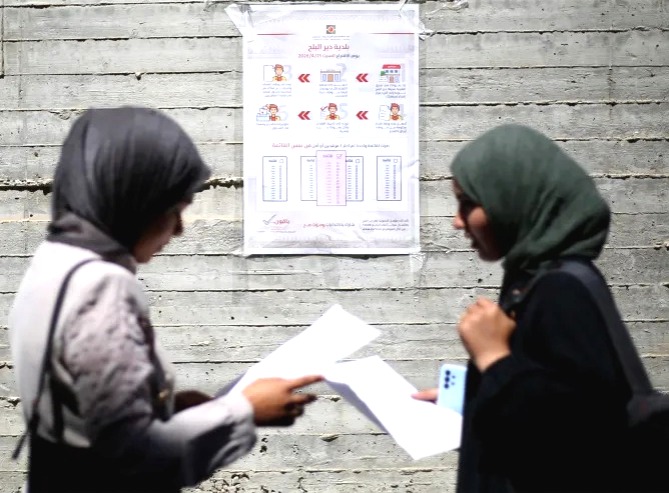
Palestinians In Gaza Heading To Poll; Deir El-Balah Residents To Vote In Symbolic Local Election Amid Shattered Infrastructure.

Gaza; April 2026: Palestinians in Gaza are heading to the polls tommorow (April 25th 2026) for their first local elections since 2005. They are using a newly amended electoral system that combines proportional representation in municipalities with individual candidacy in village councils.
While the Palestinian cabinet initially planned for nationwide elections, voting across most of Gaza has been postponed due to the war, except for Deir el-Balah. There, 70,000 eligible voters will cast ballots in 12 polling centres across the city. Many Palestinians view this election as symbolic, a statement that Gaza remains an integral part of the Palestinian political system despite efforts and proposals aiming to separate it from the West Bank.
It will be Gaza’s first vote of any kind since 2006, when Hamas won the PA’s legislative elections and later seized control of Gaza following a brief civil war with PA President Mahmoud Abbas’ Fatah party, dominant in the West Bank. The polls will be the fifth municipal elections in the West Bank since 2005.
In January, the PA said it would extend those elections to Gaza “wherever possible”, a move analysts see as a symbolic effort to show Gaza remains part of a future Palestinian state. For Palestinians in Deir al-Balah, including Adham Al-Bardini, the vote on Saturday marks an opportunity for political expression after the Hamas-led attacks of October 07, 2023 that sparked Israel’s devastating two-year assault on Gaza.
In Deir al‑Balah, large banners bearing the logos of rival candidate lists decorate the streets. Voting will be held in 12 polling centres including open fields and tents.
Fareed Taamallah, spokesman for the PA Central Elections Commission, said roughly 70,000 Palestinians were eligible to vote in Deir al‑Balah, a city he said was chosen because it suffered less damage than the rest of the largely ruined territory. Four lists are fielding candidates in the election, including one that has several candidates who residents and analysts regard as pro-Hamas.
Change can happen if there is a concrete strategy, domestically adopted and supported by the international community. However, there is a major question mark regarding the ability of these municipalities to operate effectively. Can they move beyond the humanitarian crisis to provide basic municipal services? With dilapidated roads, and fragmented water infrastructure, the challenge is immense.
Hamas has not explicitly fielded a list or endorsed any candidate, citing disagreements with Abbas over a PA decree that requires candidates to accept terms including recognition of Israel. Other factions are also boycotting the vote, meaning Fatah is expected to sweep larger city councils in the West Bank. But despite its official boycott of the vote, Hamas “may be betting on winning in this election” and could use pro-Hamas candidates’ performance to gauge its popularity, said Hani Al-Masri, a West Bank political analyst.
Hamas spokesperson Hazem Qassem said the group would respect the election results. Sources in the group told Reuters that it will deploy police and security forces to secure voting sites. Hamas have reasserted control of Deir al-Balah and other areas in a stretch of Gaza’s coast from which Israeli forces have withdrawn under an October 2025 ceasefire. Israel retains control of more than 53% of Gaza.
Some public opinion polling shows Hamas remains popular in Gaza and the West Bank, despite the devastation wrought by the war. In Gaza, an October 2025 poll by the Palestinian Center for Policy and Survey Research found that 41% of Palestinians there support Hamas, followed by 29% for Fatah.
The vote comes as U.S. President Donald Trump’s so-called “Board of Peace” pushes a plan for Gaza’s future that would see the territory rebuilt from scratch under the administration of an apolitical committee of Palestinian technocrats.
The plan calls on Hamas to hand over Gaza governance to the committee as it lays down its weapons and Israeli forces withdraw from the Strip. Hamas has so far rejected disarmament, accusing Israel of failing to abide by the October ceasefire. The plan notably does not mention the West Bank, which, along with the Gaza Strip, Palestinians have long sought for a future state, and where the PA exercises limited self-rule.
Palestinian political analyst Reham Owda said the municipal elections were “a symbolic step to send a message to the world, to the Board of Peace, and to Israel that the Gaza Strip is an inseparable part of the Palestinian political system”.
For everyone there at Deir El Balah, young or aged, the vote, even at the local level, offers an opportunity to rebuild lives after conflict. “Everyone wants to improve the country, especially after two years of war, what we witnessed, and the destruction”, some of the locals have said.
Meanwhile the ceasefire has done nothing to improve daily living conditions for Palestinian civilians. The volume of humanitarian assistance entering Gaza falls far short of what is truly needed to meet the scale of this crisis.
Israel remains completely reliant on a controversial humanitarian strategy regarding the entry of medical supplies into the Strip. Israel is allowing more commercial trucks to access Gaza on a daily basis; however, these commercial goods are sold in local markets at exorbitant prices that many people cannot afford, adding another layer to the crisis itself.
On the medical front, hospitals are still operating under severe constraints. Key officials from the Gaza Health Ministry have informed us that many types of medical supplies have been depleted from pharmaceutical warehouses.
The World Health Organisation (WHO) is facing restrictions on the entry of resources. Medical facilities are dangerously inadequate; there are no MRI scanners, ventilators are scarce, and even Intensive Care Units are operating with very limited capabilities. Meaningful change is far from being reached.
Team Maverick.





Tuchel Defends Tactical Choices After England’s World Cup Exit, Vows Team Will ‘Keep Hunting’ Success
Miami, July 2026 : England head coach Thomas Tuchel has firmly defended his tactical decis…

Tuchel Defends Tactical Choices After England’s World Cup Exit, Vows Team Will ‘Keep Hunting’ Success
Miami, July 2026 : England head coach Thomas Tuchel has firmly defended his tactical …