Mumbai–Pune Expressway ‘Missing Link’: A Modern Highway Accelerating Development Fusion of speed, safety, and modern engineering

April 2026 : The Mumbai–Pune Expressway is considered the backbone of Maharashtra’s progress. This route, which drives the state’s industrial, economic, and social activities, is now reaching a new height with the ‘Missing Link’ project. Far beyond merely easing traffic, this project is becoming extremely significant for the state’s broader development.
Being the busiest highway in the state, it handles thousands of vehicles every day. However, the steep curves, gradients, landslides during monsoon in the Bor Ghat section, and resulting traffic congestion have remained major long-standing problems. As a permanent solution to these challenges, the concept of the ‘Missing Link’ project was introduced, and it was approved by the government on August 29, 2018. This ambitious project, worth approximately ₹6,695 crore, has now been physically completed.
Background: From Problems to Solutions
The stretch from Adoshi Tunnel to Khandala Exit is currently six-laned, but nearly ten lanes of traffic converge here. Due to difficult geographical conditions in the ghat section, traffic speed often slows down. During monsoon, the risk of landslides increases, and some lanes have to be closed, leading to time loss, higher accident risk, and economic losses.
To address these issues permanently, the ‘Missing Link’ was developed as an alternative, safer, and straighter route.
Project Structure: Shorter Distance, Time Saving
Under this project, a new direct route has been constructed between Khopoli and Kusgaon. The total length is 19.84 km. Out of this, 5.86 km of the existing road has been upgraded from six lanes to eight lanes, while the remaining 13.3 km is completely a new alignment.
This new route reduces travel distance by about 6 km and saves 20 to 30 minutes of travel time, making journeys faster and smoother for commuters.
An Engineering Marvel
- Listed in Guinness World Records as the world’s widest tunnel
- India’s first expressway becoming faster and safer through the Missing Link
- The 23.5-meter-wide tunnel is built 180 meters below Lonavala Lake
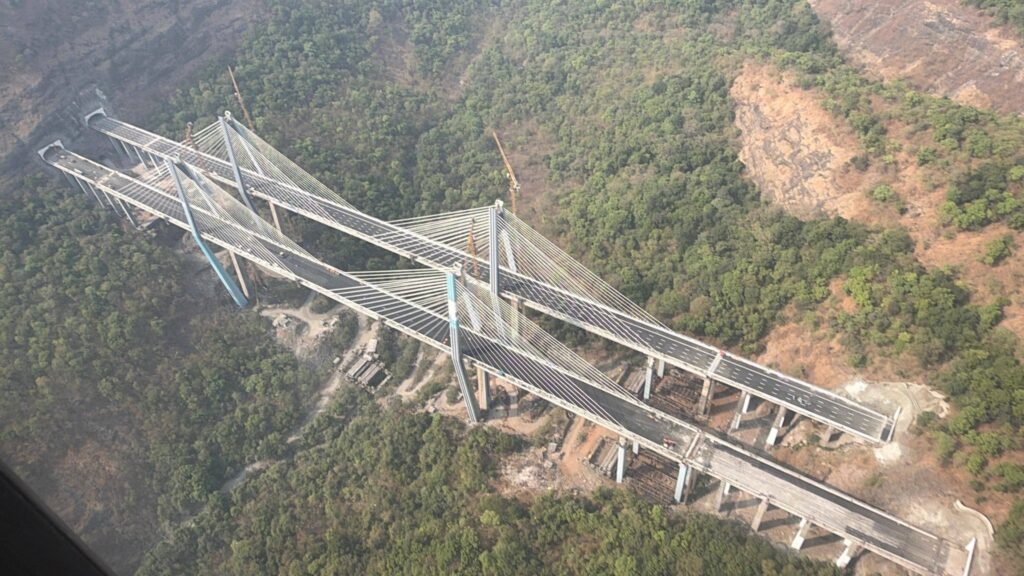
- Includes a 650-meter cable-stayed bridge with India’s tallest pylon (182 meters)
This Missing Link ensures a safer and faster travel experience while saving time and fuel. It is also recorded in the Guinness Book of World Records as the world’s widest tunnel.
Advanced Engineering Design
The project includes:
- Two parallel tunnels (1.64 km and 8.92 km)
- Massive viaduct structures
- Designed for vehicle speeds up to 120 km/h
It stands as an excellent example of modern engineering excellence.
Advanced Safety Systems
Highest priority has been given to passenger safety. The tunnels are equipped with:
- Water mist fire suppression system
- SCADA-based monitoring system
- ANPR cameras
- Voice evacuation system
- Advanced ventilation system
- SOS emergency facilities
These systems ensure immediate response during accidents or emergencies.
Major Benefits of the Missing Link
- Travel time reduced by about 30 minutes
- Reduction in accidents by avoiding dangerous ghat curves
- Smooth traffic flow with reduced congestion
- Estimated daily fuel savings of around ₹1 crore
- Faster, safer, and more economical travel experience
Overcoming Major Challenges
The project faced several challenges including:
- Tunnel excavation in mountainous terrain
- Dense forest area restrictions
- Heavy monsoon disruptions
- Oxygen supply and safety management in tunnels
- Dependence on foreign agencies for technical testing
- COVID-19 pandemic delays
Despite these obstacles, the project was successfully completed.
A Major Step Towards Development
The Mumbai–Pune Missing Link is not just a road, but a blend of modern technology, planning, and vision. It will not only ease travel but also significantly boost Maharashtra’s economic and industrial growth.
Highways act as lifelines of any economy. This route connects Mumbai and Pune—two major economic hubs—serving industries, IT, manufacturing, and services sectors. The Missing Link will further accelerate trade and investment by making travel faster and safer.
Expansion of Connectivity
The project improves connectivity for regions like Khopoli, Lonavala, and Kusgaon, bringing development opportunities to rural and semi-urban areas. It will also improve access to healthcare, education, and employment.
Tourism and Local Economy
The Mumbai–Pune corridor is a major tourism route. Easier access to Lonavala and Khandala will boost tourism, benefiting hotels, local businesses, and the service sector, while generating employment opportunities.
Sustainable Development
Smoother traffic flow will reduce congestion and fuel consumption, helping lower environmental impact. The project contributes to sustainable and balanced infrastructure development.
The Mumbai–Pune Missing Link is not just a travel route—it is a transformative highway driving Maharashtra’s economic growth, connectivity, safety, and sustainable development into a new era.







Qatar Condemns Drone Attacks on Saudi Oil Facilities, Reaffirms Full Support for Kingdom
Doha, July 2026 : Qatar on Monday strongly condemned the attempted drone attacks targeting…

Qatar Condemns Drone Attacks on Saudi Oil Facilities, Reaffirms Full Support for Kingdom
Doha, July 2026 : Qatar on Monday strongly condemned the attempted drone attacks targeting …