Centre Signs Reform-Linked MoUs with Andaman & Nicobar Islands and West Bengal under Jal Jeevan Mission 2.0

Continuing the nationwide rollout of reform linked implementation under Jal Jeevan Mission 2.0; UT of Andaman and Nicobar Islands and State of West Bengal signed MoUs with the Union Government today. The MoUs mark a significant milestone in advancing transparent, accountable and community- centered model of rural water supply management aligned with the vision of Viksit Bharat @2047.
The reform‑linked MoU mandates a Gram Panchayat‑led, service‑based and community‑centered model of rural water governance, aligned with the objectives of Jal Jeevan Mission 2.0.
The MoUs were signed during separate scheduled meetings under the presence of the Union Minister of Jal Shakti, Shri C.R. Patil, Minister of State, Ministry of Jal Shakti Shri V. Somanna, Secretary, DDWS Shri Ashok K. K. Meena along with senior officers from DDWS.
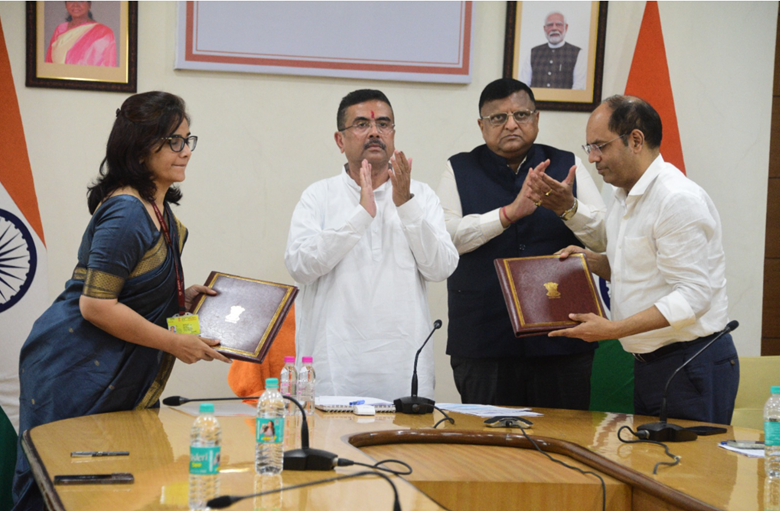
For UT of Andaman and Nicobar Islands, the MoU was signed between Smt. Swati Meena Naik, Joint Secretary (Water), DDWS, and Dr. Sachin Shinde, Secretary, Commissioner-cum-Secretary, UT of Andaman and Nicobar Islands. The MoU was exchanged between Shri Vinod Kumar Yadav, Resident Commissioner, A&N Islands and Shri Arun Kumar, Under Secretary, JJM at the DDWS office, New Delhi.
The MoU with UT of Andaman and Nicobar Islands was exchanged in the virtual presence of the Lieutenant Governor of Andaman and Nicobar Islands, Admiral D.K Joshi; Dr. Chandra Bhushan Kumar, Chief Secretary, A&N Islands along with senior officials from the Union Territory.
Marking a key step in Centre-State collaboration, the MoU with the State of West Bengal was formally signed at Chief Minster’s office, West Bengal in the august presence of Chief Minister of West Bengal Shri Suvendu Adhikari, Shri Manoj Kr. Agarwal, Chief Secretary, Government of West Bengal along with senior officials from the State Government. Shri Dushyant Nariala, Principal resident commissioner, West Bengal was present at DDWS office during the process.
The MoU was signed and exchanged between Smt. Swati Meena Naik, Joint Secretary (Water), DDWS, and Shri Narayan Swaroop Nigam, Principal Secretary, PHE Department, West Bengal in the office of Chief Minister, West Bengal.
Addressing the gathering, Union Minister of Jal Shakti, Shri C. R. Patil, said that under the visionary leadership of Prime Minister Shri Narendra Modi, Jal Jeevan Mission has reached extensively at the rural level, and the mission has emerged as a people‑centric movement aimed at enhancing dignity, health and empowerment in rural areas.
Highlighting the evolution of the Mission’s timeline, Shri Patil stated that while the original deadline was May 2024, it has been extended till December 2028 under the guidance of the Prime Minister, with the aim of achieving 100 per cent tap water coverage and sanitation across the country.
The Union Minister commended the Union Territory for its exemplary status as a pioneer in achieving 100% rural tap water coverage and obtaining ‘Har Ghar Jal’ certification across its blocks. He lauded the administration for fully funding 100% of the financial outlays required for 40% of its remaining balance works.
Further, the UT administration was urged to swiftly complete the financial reconciliation of all ongoing water infrastructure schemes to maintain accounting transparency.
Under his addressal to the State of West Bengal, Shri C. R Patil urged the Chief Minister of West Bengal to review the issues related to water within the state and take corrective measures to speed up JJM 2.0 implementation. The Union Minister requested for immediate physical reviews in the historically lagging districts of Darjeeling, Kalimpong, and Purulia. He also urged for Jal Sanchay Jan Bhagidari (community participation) implementation along with an active focus on Karmabhoomi se Matrubhoomi campaign.
While addressing the legal and structural boundaries of the newly signed MoU, Shri C.R. Patil urged the UT/State government to abide by the JJM 2.0 guidelines. As part of these guidelines, he called for strict enforcement of the Operation and Maintenance (O&M) policy by both the UT/State. He stated that the absolute responsibility for village-level infrastructure operations, daily maintenance, and local water tariff/revenue collection must be legally and structurally transferred to the respective Village Water and Sanitation Committees (VWSCs).
Shri Patil further stated that Jal Jeevan Mission is not merely a scheme, but a life‑impacting mission that is bringing about fundamental improvements in health, dignity and quality of life, particularly for women and rural communities. Thus, regular and continuous drinking water supply must be ensured in every village, and public grievances should be addressed promptly.
Lieutenant Governor of Andaman and Nicobar Islands, Admiral D.K Joshi highlighted the UT’s achievement as Andaman and Nicobar Islands achieved 100% coverage of rural households with tap water supply in the year 2021. He stated that to ensure seamless community-led infrastructure management under the new phase of JJM 2.0, the UT has already rolled out decentralised trial runs. A comprehensive pilot project has been successfully completed in the Sippighat Gram Panchayat. He also mentioned that UT administration safely closed out the initial phase of Jal Jeevan Mission, successfully consuming its allocated budget across 40 fully completed rural water projects.
Further, he highlighted upon the vulnerabilities of the Andaman and Nicobar Islands as it lacks expansive riverine systems or permanent natural inland water bodies, making its baseline water supply entirely dependent on captured rainwater harvested directly into localised reservoirs. In order to curb the issues, he sought central support. He expressed his confidence that the newly signed MoU will cement a shared resolve between the Ministry of Jal Shakti and the local administration to fortify these vulnerable supply systems
Chief Minister of West Bengal, Shri Suvendu Adhikari, highlighted that the Central Government has systematically provided massive financial backing to the state. He expressed his gratitude towards the central government for continuous support and showed confidence that with the newly reached agreement for JJM 2.0, the state government will work for the people of Bengal ensuring clean drinking water supply to all the rural households. He asserted that his government would function with absolute transparency to fulfil the promises made under the leadership of Prime Minister Narendra Modi’s ‘Har Ghar Jal’ vision.
Additionally, the Chief Minister requested to expedite financial and technical support for pending irrigation projects in West Bengal, keeping in mind the state’s fragile financial health and its critical reliance on central handholding for public welfare.
In his opening remarks, Shri Ashok K.K Meena, Secretary, DDWS highlighted that the MoU signing is a shared commitment between the Centre and the UT/State under the Jal Jeevan Mission for providing safe, pure and sustainable drinking water to every household. He further emphasized that under this agreement, Gram Panchayats are now entrusted with the responsibility of managing village water systems and collecting water taxes to ensure long-term sustainability. To support this, he called upon district administrations to hold regular meetings of the District Water and Sanitation Mission (DWSM) so that finalisation of village-level saturation plan is carried, leading to certification of the panchayats as ‘Har Ghar Jal’.
India Post Invites Citizens to Design Official Mascot, Announces Rs 2 Lakh Prize Pool
New Delhi, July 2026 : The Department of Posts has launched the ‘India Post Mascot D…

India Post Invites Citizens to Design Official Mascot, Announces Rs 2 Lakh Prize Pool
New Delhi, July 2026 : The Department of Posts has launched the ‘India Post …