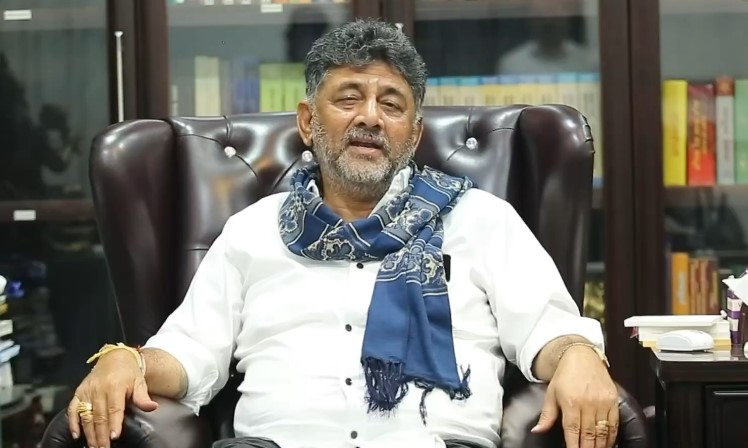
From Congress Strategist to Karnataka’s Top Post: D.K. Shivakumar’s Four-Decade Political Rise

Bengaluru, May 28: Karnataka Deputy Chief Minister and Karnataka Pradesh Congress Committee (KPCC) President D.K. Shivakumar is all set to become the next Chief Minister of Karnataka following the resignation of Siddaramaiah, marking the beginning of a new political chapter in the state.
Widely regarded as the Congress party’s most influential strategist and organisational leader in Karnataka, Shivakumar’s political rise has been shaped by more than four decades of grassroots mobilisation, electoral success, political resilience and administrative experience.
From being a student activist in the early 1980s to emerging as the most powerful Congress leader in Karnataka after Siddaramaiah, Shivakumar has built a reputation as a leader capable of handling both electoral battles and political crises.
A native of Kanakapura in Ramanagara district, Shivakumar entered politics through the National Students’ Union of India (NSUI) during his college days. Congress leaders often recall that his early political growth received encouragement from former Prime Minister Rajiv Gandhi, who identified him as a promising young leader.
Shivakumar first contested the Karnataka Assembly election in 1985 from the Sathanur constituency against former Prime Minister H.D. Deve Gowda. Though he lost the election, the contest brought him into mainstream state politics.
In 1989, he won from Sathanur and entered the Karnataka Legislative Assembly for the first time. That victory marked the beginning of a long legislative career. Over the years, he established himself as one of the Congress party’s most dependable electoral leaders and has gone on to become an eight-time MLA.
Throughout his political journey, Shivakumar handled several key portfolios in Karnataka governments and earned a reputation as a politically astute and administratively active minister.
Between 1990 and 1992, he served as Minister for Prisons and Home Guards in the Congress government. During this period, he introduced reforms focused on rehabilitation programmes, skill development and welfare measures for prison inmates.
From 1999 to 2004, he served as Karnataka’s Minister for Urban Development, where he focused on civic administration, urban infrastructure and strengthening municipal governance systems across the state.
However, one of the most significant phases of his administrative career came during his tenure as Karnataka’s Energy Minister between 2014 and 2018.
During this period, Karnataka witnessed a major expansion in renewable energy generation, particularly in the solar sector. Under Shivakumar’s leadership, Karnataka crossed the 6,000 MW mark in solar energy production and emerged as one of India’s leading renewable energy states.
The Pavagada Solar Park, developed during his tenure, became one of the largest solar parks in the world. Spread across thousands of acres of semi-arid land, the project transformed barren terrain into a major renewable energy hub and became one of the flagship achievements of Karnataka’s energy sector.
Shivakumar also introduced the “Surya Raitha” initiative, a farmer-focused programme aimed at enabling farmers to generate solar energy and reduce their dependence on conventional electricity sources. The initiative was widely appreciated for linking renewable energy with rural development and agricultural sustainability.
Between 2018 and 2019, Shivakumar handled the important portfolios of Major Irrigation and Medical Education during a politically turbulent phase in Karnataka marked by coalition government challenges and drought conditions in several regions.
But perhaps the defining turning point in Shivakumar’s political career came in 2019.
That year, he was arrested by the Enforcement Directorate (ED) in a money laundering case and spent nearly 50 days in Delhi’s Tihar Jail amid intense political developments in Karnataka.
The episode dramatically reshaped his political image within the Congress party.
Shivakumar repeatedly maintained that he was given two choices — either join the BJP or face imprisonment — and that he chose jail over switching political loyalties.
Congress leaders later projected the episode as proof of his loyalty and commitment to the party during a difficult political period.
The political significance of the episode increased further when Congress Parliamentary Party Chairperson Sonia Gandhi personally visited him in Tihar Jail. The gesture was widely interpreted within political circles as a clear endorsement of Shivakumar by the Congress high command.
Following his release, Shivakumar received a massive welcome from Congress workers in Karnataka. Soon afterward, he was appointed President of the Karnataka Pradesh Congress Committee in 2020.
As KPCC President, Shivakumar undertook an aggressive organisational rebuilding exercise across Karnataka.
He focused on booth-level strengthening, cadre mobilisation, district outreach and reconnecting with grassroots workers who had become demoralised after the Congress party’s electoral setbacks in previous years.
Under his leadership, the Congress organisation regained momentum across the state. Party workers often credit Shivakumar for reviving organisational discipline and energising local leadership structures.
His role became particularly crucial during the 2023 Karnataka Assembly elections.
Shivakumar led several statewide campaigns, public outreach programmes and strategic political initiatives that helped the Congress return to power with a decisive mandate.
Following the Congress victory, a prolonged leadership discussion took place within the party regarding the Chief Minister’s post. Eventually, Siddaramaiah became Chief Minister while Shivakumar was appointed Deputy Chief Minister and entrusted with major portfolios including Water Resources and Bengaluru City Development.
Despite not becoming Chief Minister at the time, Shivakumar continued to remain one of the most influential figures in the government.
As Deputy Chief Minister, he played a central role in implementing the Congress government’s flagship “Five Guarantee” welfare schemes, which the government claims have benefited more than seven crore people across Karnataka.
The Congress government under Siddaramaiah and Shivakumar also announced infrastructure and development projects worth nearly Rs 1.5 lakh crore, focusing heavily on urban infrastructure, transport, mobility and water security.
As Water Resources Minister, Shivakumar supervised the completion of Cauvery Phase V, which added 775 MLD of drinking water supply to Bengaluru and surrounding areas.
He also pushed forward several large-scale projects including Cauvery Stage VI, Mekedatu, Mahadayi and Yettinahole, all aimed at strengthening Karnataka’s long-term drinking water and irrigation infrastructure.
The Yettinahole project, according to government estimates, is expected to provide drinking water to nearly 7.6 million people in drought-prone and water-scarce regions of Karnataka.
Shivakumar additionally oversaw the modernisation and replacement of crest gates at the Tungabhadra Dam, a critical initiative aimed at improving reservoir safety and protecting irrigation needs in the region.
As Bengaluru City Development Minister, Shivakumar focused heavily on infrastructure expansion and digital governance initiatives.
Under his leadership, more than 25 lakh property records were digitised through the E-Khata system, while the “Nambike Nakshe” initiative streamlined approval procedures for building plans and urban development projects.
His office also pursued ambitious mobility and infrastructure projects, including Bengaluru’s proposed tunnel road network designed to reduce congestion and improve travel efficiency in the rapidly growing metropolis.
Shivakumar has additionally championed Bengaluru’s electric mobility push. Under his leadership, the city expanded EV infrastructure significantly, with over 4,400 EV charging stations installed across Bengaluru as part of efforts to transform the city into India’s EV capital.
Within the Congress party, Shivakumar is widely recognised as an effective election manager and organisational strategist.
He is credited with helping the party secure several important by-election victories in constituencies such as Shorapur, Sandur, Shiggaon, Channapatna, Bagalkot and Davanagere South.
Apart from Karnataka politics, Shivakumar has also played key organisational roles for the Congress during elections and political crises in Maharashtra, Gujarat, Rajasthan and Madhya Pradesh.
He campaigned extensively in Kerala, Assam and Tamil Nadu during major elections and was frequently deployed by the Congress high command during politically sensitive situations.
Congress leaders often describe Shivakumar as a leader who combines organisational management, electoral planning and crisis handling abilities.
Party insiders also note that despite his strong ambition, Shivakumar has repeatedly prioritised organisational unity during critical political moments.
His supporters view him as a leader focused on combining welfare governance with large-scale infrastructure development and technology-driven administration.
His ongoing priorities include Bengaluru Metro expansion, tunnel road projects, water security programmes, renewable energy expansion and major urban modernisation initiatives.
From strengthening grassroots politics and managing difficult political crises to leading renewable energy expansion and urban infrastructure projects, Shivakumar has emerged as one of Karnataka’s most influential contemporary political figures.
With Siddaramaiah stepping down, Karnataka now enters a new political phase, with D.K. Shivakumar preparing to take charge of the state at a time of rising public expectations, expanding urban challenges and intense political competition.
Team Maverick



Shivakumar Says Congress United, Assures Women Will Get Cabinet Berth
Bengaluru, Aug 2026 : Karnataka Chief Minister D.K. Shivakumar on Monday sought to dismiss…
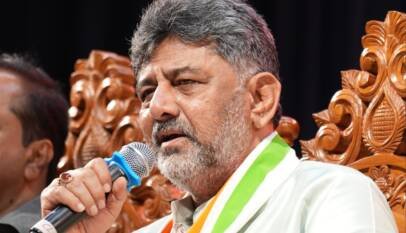
Shivakumar Says Congress United, Assures Women Will Get Cabinet Berth
Bengaluru, Aug 2026 : Karnataka Chief Minister D.K. Shivakumar on Monday sought to dismiss …