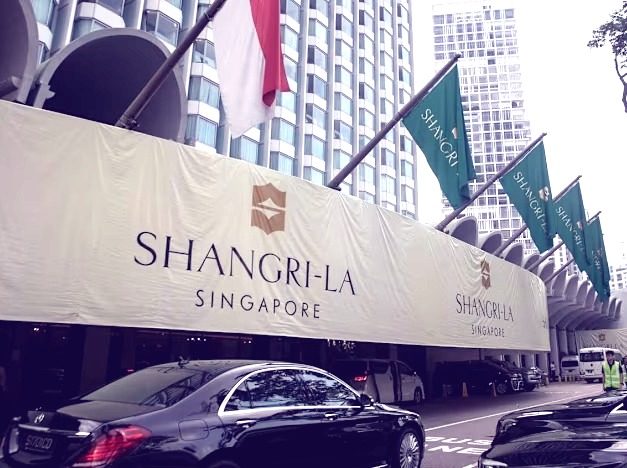
World Defence Officials To Gather At Singapore For Shangri-La-Dialogue From May 31st.

Singapore City; May 2026: The Annual Shanri-La-Dialogue (SLD) is poned to be organised from today (29th May 2026 at the Shangri La Hotel in Singapore City. Hundreds of delegates from the global security community have gathered in Singapore for the Shangri-La Dialogue, Asia’s premier defence summit. This year the Dialogue commemorates its 23rd edition from today (29th May Friday) till 31st May 2026 (Sunday).
The dialogue is a platform for government officials, business leaders, and security experts to discuss pressing regional security concerns. It involves speeches, debates, as well as private meetings on the sidelines. The forum is held annually by the International Institute for Strategic Studies (IISS). The Dialogue enables decision-makers from across the Asia-Pacific, North America, Europe, the Middle East and beyond to gather together to discuss the most pressing regional security issues and to share policy responses. It features plenary debates led by government ministers, as well as important opportunities for bilateral discussions among delegations.
This years Dialogue comes at a time when global affairs appear increasingly governed by raw power and direct bargaining.
Within the first few months of 2026, we have already seen a daring raid in Venezuela and a war in the Middle East. Meanwhile, United States President Donald Trump went to Beijing for what he called a “G2” summit with Chinese President Xi Jinping, reinforcing perceptions that consequential decisions are negotiated between major powers. Broader multilateral forums with smaller states can risk appearing secondary.
Indeed, White House Deputy Chief of Staff for Policy and Homeland Security Advisor Stephen Miller said in January that the “real world” is governed by “strength, force, and power”, dismissing international law and associated rules as “international well-being”. Yet, trying to enforce order in a rule-less vacuum is a challenge, even for superpowers. The presence of rules and norms makes it easier for countries to pursue their interests by creating a common baseline for conduct.
The US Navy, for example, has been a strong proponent of the United Nations Convention on the Law of the Sea (UNCLOS) as a basis for freedom of navigation and other practices, even though the US is not a signatory.
Yet, for rules to be written and norms to endure requires persuasion, not coercion. In this light, the SLD’s role in facilitating conversations about Asian security issues with broader regional consultation is both timely and important.
The SLD is an example of a “track 1.5” dialogue that involves participation from both defence officials and leading academics. It provides opportunities for them to converse and build trust between each other, and this matters in at least two ways for Asia.
First, regional leadership is often in the spotlight. While observers are still interested in whether the American and Chinese defence ministers show up, the SLD is a useful platform for Asian leaders to explain their views and receive constructive feedback.
In 2024, Philippine President Ferdinand Marcos Jr spoke at length about his country’s stance on not just maritime security, but issues such as nuclear disarmament and climate change as well.
This year, Vietnamese President To Lam will be delivering the keynote address. While his specific focus remains to be seen, he is the first Vietnamese leader to open the dialogue and will offer his country’s view on pertinent security issues.
Second, the SLD allows for candid exchanges at all levels. This is not a minor accomplishment. Officials from small states can meet with foreign counterparts between sessions, or even over meals to discuss sensitive issues. Taken together, these can create the conditions to lay out new rules and norms.
Granted, rules and norms will not directly prevent a determined power from using force to achieve their goals. Nor do they grant small states the power to shape the global security environment alone.
Rather, these structures give small states a fighting chance to pursue their interests and ensure their survival.
In Singapore’s case, proactive support for UNCLOS not only defends the country’s interests such as keeping trade routes open but also enhances its relevance on the world stage. Notably, a new “high seas treaty” on managing biological diversity under UNCLOS was concluded in 2023 under the stewardship of Singapore’s Ambassador for the Oceans and Law of the Sea Issues, Mrs. Rena Lee.
This shows how smaller states can still shape international governance on problems that no country can tackle alone.
International rules and norms also encourage like-minded states to form broad networks to push back against challenges. The Future of Investment and Trade Partnership (FIT-P), for example, was established by Singapore and 13 other countries to support open and fair trade in the aftermath of trade disruptions from larger powers.
Crucially, international rules and norms give small states the option to not choose sides. In a rule-less world where “might makes right”, small states would be pressured to side with the dominant or rising power to ensure their own security.
For many Southeast Asia states, strategic neutrality and working with willing partners are central to national security and prosperity. Being forced to choose sides would be counter to these interests.
Talk alone is insufficient for creating global stability. Practical solutions to security issues are required. In this respect, the SLD is an opportunity for countries to lay the foundation for issue-based partnerships through exchanges of expertise and innovation.
Critical undersea infrastructure (CUI) is one such challenge. In October 2025, Southeast Asian leaders developed a concept paper on the security of undersea communication cables, energy cables and fuel pipelines. But the physical vulnerability of these structures emphasises the need to accelerate its implementation.
The SLD can not only facilitate deeper partnerships between Southeast Asian governments that are closer to home, but also spur new partnerships with Baltic states that have more experience in CUI issues specifically. More broadly, Singapore can also draw on longstanding, mutually beneficial relationships with key partners such as the US, China and others to confront shared security challenges.
Power and capabilities still matter deeply when it comes to ensuring a state’s security. But for small states such as Singapore, rules and norms in the international system are their first line of defence. And the SLD is just the kind of platform to uphold them.
Team Maverick.





Telangana CM Pushes Skill Training, Research and Overseas Job Support
Hyderabad, July 2026 : Telangana Chief Minister A. Revanth Reddy on Friday proposed settin…

Telangana CM Pushes Skill Training, Research and Overseas Job Support
Hyderabad, July 2026 : Telangana Chief Minister A. Revanth Reddy on Friday proposed setting …