Deep Fake Artificial Intelligence Is At Tandem To Deceit Insurers At Large.

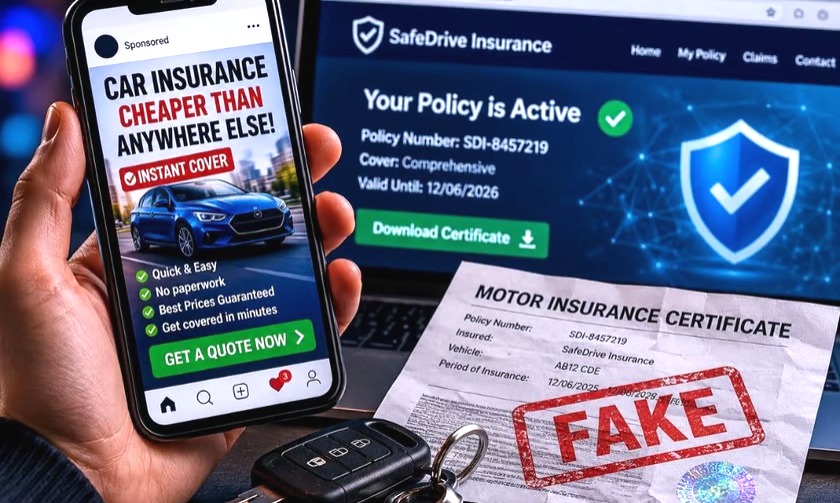
June 2026: Ghost brokers are increasingly using artificial intelligence to create entirely fake motor insurance policies, bypassing insurers altogether and leaving drivers unknowingly uninsured.
“It is a completely fabricated document generated by AI and completely worthless”, said Katriona Cunningham, Underwriting Fraud Lead at Aviva in the United Kingdom. “Where we detect it now is either a roadside check, an MIB check, or if the customer that isn’t actually a customer thinks they’re an Aviva customer and is involved in a claim”.
The Insurance Fraud Bureau (IFB) tracked a 52% rise in ghost broking cases between 2022 and 2024, while Aviva has recorded a 22% increase since 2023. Research published by the Financial Conduct Authority (FCA) in May 2026 found that 49% of young drivers had purchased insurance through social media or messaging platforms, while 04 in 10 said they would not feel confident identifying a fake policy.
Ghost broking has existed for years through practices such as fronting, policy manipulation and fraudulent applications. What Cunningham is now seeing is fundamentally different. Rather than altering genuine policies, fraudsters are increasingly creating entirely fictitious ones.
What began as stolen books of cover sold in person migrated to social media and messaging platforms before evolving again in late 2025 and into 2026. Cunningham said fraudsters are increasingly using portal templates that can be replicated across multiple operations, making sophisticated ghost broking schemes easier to scale.
“I consider my job to be selling car insurance online as a legitimate career”, Cunningham said, describing the mindset of those behind the operations. She added that the portals can appear convincing enough to pass initial scrutiny before being exposed through more detailed checks by insurers, law enforcement or industry databases. The consequences can be severe. Cunningham described a case in Northern Ireland where a young woman who believed she had purchased legitimate cover was prosecuted for driving without insurance after discovering the broker had disappeared.
“The outcome being that she’s then prosecuted as being a victim of fraud”, Cunningham said.
The financial impact extends beyond individual victims. Aviva estimates those caught by ghost brokers lose around £2,000 on average, including approximately £1,700 paid to the fraudster and a further £300 in fees. One suspected ghost broker identified by the insurer is believed to have generated around £150,000 through fake motor insurance sales alone.
The wider market also absorbs part of the cost. The Motor Insurers Bureau (MIB) provides compensation arrangements for victims of uninsured driving, with funding ultimately drawn from the wider insurance market through industry levies. Legitimate brokers are also competing against fraudulently low prices that carry none of the costs associated with underwriting, regulation or claims obligations.
Around 15% of young drivers say they cannot afford legitimate insurance. Cunningham identifies first-time buyers and newcomers to the UK as particularly vulnerable to ghost brokers, with social media increasingly becoming the primary route through which fraudulent offers reach consumers.
“The algorithms are smart”, Cunningham said. She argues consumers should treat unusually cheap insurance quotes with the same suspicion they would apply to heavily discounted luxury goods. If a policy appears significantly cheaper than the rest of the market, it may be too good to be true. Cunningham believes tackling the problem requires a combination of stronger enforcement, tougher penalties and greater public awareness.
She has called for social media platforms to restrict insurance advertising to FCA-authorised firms and for greater education around insurance fraud through schools and driver training. On that last point, she was specific: Cunningham proposed adding a question on purchasing legitimate car insurance to the UK driver theory test, arguing it would reach first-time buyers at exactly the moment they need the guidance, before they encounter fraudulent offers.
“If high premiums and complex products are driving consumers towards illegitimate channels, regulators are likely to expect firms not just to reject claims after the fact, but to show they have actively reduced the risk of harm in the first place,” said Mark Hemsted, Partner at Clyde & Co in London.
Emma Fuller, Partner at DAC Beachcroft and a member of the Motor Sector Focus Team at the Forum of Insurance Lawyers (FOIL) in London, said enforcement remains challenging. “Although more can be done to prevent ghost broking, enforcement is unfortunately difficult. Fraudsters operate across multiple platforms and frequently change identities. Once they have sold a few policies, they often disappear, but will resurface in another form.”
The challenge for the industry is that artificial intelligence appears to be making the problem easier to scale. As Fuller noted, fraudsters who disappear after a handful of sales can quickly resurface elsewhere under a new identity. For consumers, that can mean discovering the fraud only when they attempt to claim, are stopped by police or, as in the Northern Ireland case Cunningham described, find themselves prosecuted despite believing they had purchased legitimate cover.
Team Maverick.





Shivakumar Says Congress United, Assures Women Will Get Cabinet Berth
Bengaluru, Aug 2026 : Karnataka Chief Minister D.K. Shivakumar on Monday sought to dismiss…
Shivakumar Says Congress United, Assures Women Will Get Cabinet Berth
Bengaluru, Aug 2026 : Karnataka Chief Minister D.K. Shivakumar on Monday sought to dismiss …