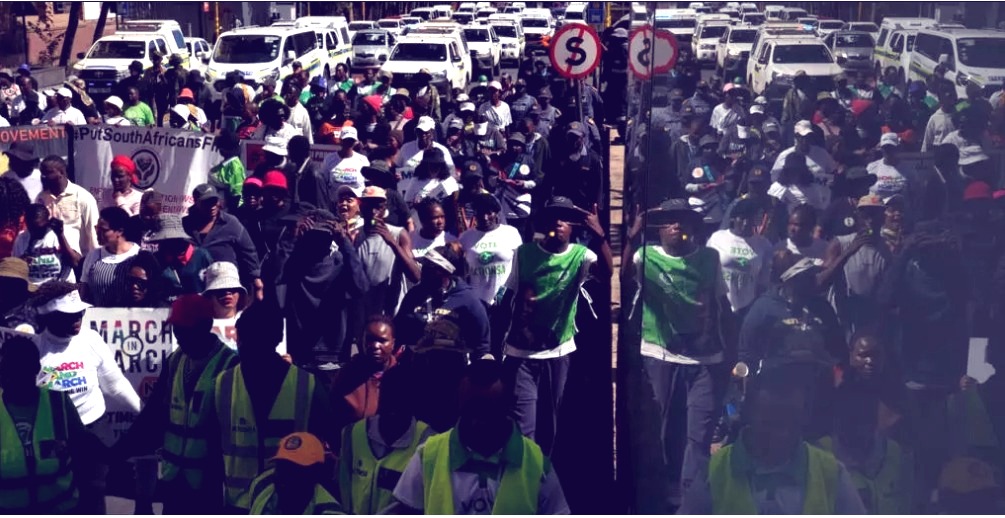
Tensions Flare In South Africa As Migrants Discover Themselves ‘Scapegoats’.

Johannesburg; June 2026: South Africa is once again facing a rise in anti-migrant tensions, with vigilante groups reportedly going door to door demanding that undocumented foreign nationals leave the country by the end of June this month/year (2026).
Eminent Post-apartheid specialist Cécile Perrot has advocated that the violence reflects deeper social and economic problems and that migrants have increasingly become scapegoats for poverty and unemployment.
The latest unrest has alarmed neighbouring countries. Mozambique says hundreds of its citizens have already returned home, while countries including Ghana and Nigeria have moved to repatriate their nationals. Meanwhile, Kenya, Lesotho and Zimbabwe have urged their citizens to exercise caution.
South African police have also warned anti-immigration groups not to take the law into their own hands after two Mozambicans were killed in the southern coastal town of Mossel Bay. Authorities said 02 people from Mozambique were killed during activities associated with anti-foreigner movement stemming during the weekend. Police rejected a statement by the Mozambican government that 05 of its citizens were killed as a “direct consequence of the xenophobic attacks”.
Cecile Perrot, a professor at Rennes 2 University, explains why she believes anti-migrant violence is increasing, who is behind the campaigns and why the South African government has come under criticism for its response.
The professor has asserted that: “The NGO Xeno Watch has recorded more than 1,000 instances of attacks since 1994, with a surge starting in 2008. But these attacks take many different forms. They can be individual attacks, assaults and battery, or shops owned by migrants being looted or burned simply because they belong to a foreign nationality. At a macro level, it’s the context of endemic poverty and unemployment, coupled with a feeling that migrants are responsible for this deteriorating living situation. This trend is further fuelled by social media, which amplifies hate speech against migrants. Migrants are made scapegoats”, while accusing further that, “These are movements fuelled by civil society organisations. Operation Dudula emerged in 2021-2022 and gained notoriety, particularly for blocking access to hospitals and schools. Their actions were even declared illegal by the South African courts last year. This gave them a certain political stature”.
More recently, last year, there was the March and March movement, launched by Jacinta Ngobese-Zuma, a radio presenter with a significant audience. All these organisations benefit from a favourable context in the country. Civil society as a whole is either indifferent to the plight of migrants or in favour of deportation, especially of undocumented migrants. Meanwhile, the government is also quite passive in the face of these movements, and may even sometimes express its support.
Professor Cecile further reiterated that: “the discourse is primarily focused on undocumented migrants, whose numbers are the subject of much speculation. By definition, the figures are questionable. Estimates range from 4 million to 15 million. These undocumented migrants are accused of “stealing jobs” and “taking advantage of South Africa’s highly developed social welfare system at the expense of locals. This idea that migrants are stealing jobs seems unfounded given the jobs migrants actually hold. Very often, it’s small businesses or anything related to personal services, like cleaning houses”.
It is of omnipotent importance, that several countries has already flagged these concerns to the South African Government; but there is evidently lesser actions, recently, the South African Home Minister described xenophobic attacks as crimes, not xenophobia. In other words, the term xenophobia was dismissed. There is probably an element of political strategy involved. The fact that migrants are being used as scapegoats also diverts attention from the government’s weaknesses and missteps in terms of employment, education, and healthcare. It provides an easy target.
Team Maverick.







Japan Set To Replace Its Nuclear Reactors By The Year 2050.
Tokyo; June 2026: Japan’s Ministry Of Industries today (Saturday – 06th June 2026) h…

Japan Set To Replace Its Nuclear Reactors By The Year 2050.
Tokyo; June 2026: Japan’s Ministry Of Industries today (Saturday – 06th June 2026) has …