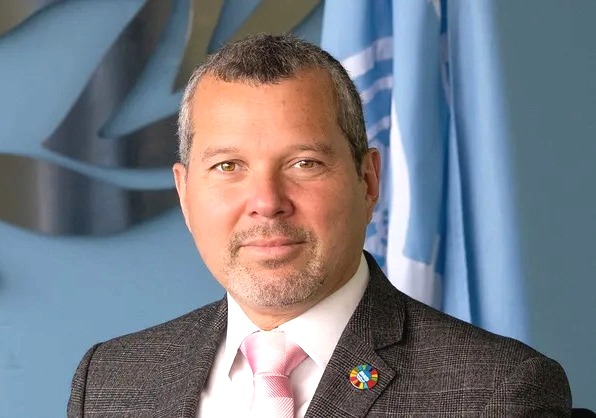
International Maritime Organization Secretary General Has Flagged That Safe Passage Through Strait Of Hormuz Has Eroded.

London; June 2026: International Maritime Organization (IMO) Secretary-General Arsenio Dominguez has again put seafarer welfare and safety as the top priority at time when a growing number of vessels attempt to transit the Strait of Hormuz.
“I am increasingly concerned by reports that vessels continue to attempt to transit the Strait of Hormuz without any credible security guarantees, despite well‑established risks and the fact that seafarers have already been killed, injured and others detained in recent incidents”, Dominguez said in a statement today (Wednesday – 10th June 2026).
“My primary concern is for the safety and lives of the seafarers being placed in these situations. They must not be exposed to conditions where the risks are known, significant, and clearly beyond mitigation. The current situation remains highly volatile, with no reliable security assurances in place. Under such circumstances, safe passage cannot be considered to exist”.
The IMO Secretary-General’s statement came as transits of the Strait of Hormuz grow despite the potential risks. Exact numbers of transits are hard to quantify with many vessels running dark, turning off AIS transponders. Vortexa, a leading tanker tracker has cited in its May 29th report that dark transits of the Strait peaked at 65.2% of crossings in May. Transits are being made both to the north of the Traffic Separation Scheme (TSS) via route prescribed by Iran which the country says requires approval and payment of a toll, and a southern route closer to Oman with apparent guidance from US forces, which stops short of escorts.
The Joint Maritime Information Center (JMIC) has lowered its threat level for the Strait from Critical to Severe in recent days. “Due to the number of safe transits conducted via the southern route, this threat level has been reduced from Critical to Severe”, JMIC said in an update dated 09th June. It put the number of transits on 08th June as just 08, based on commercially available data, compared to an average of 138 per day prior to 28 February.
With the conflict between US – Israel and Iran now having passed the 100-day mark the commercial pressure for ships stranded in the Arabian Gulf to exit will grow, as will the push to restart oil and gas exports through the Strait. US Energy Secretary Chris Wright said yesterday (Tuesday – 09th June) that ship traffic and oil exports through the Strait were growing and would “continue to grow”.
IMO Secretary-General Dominguez was clear that commercial concerns should not be allowed to override crew safety concerns. “No commercial or operational consideration can justify exposing seafarers to such levels of danger. The protection of their lives must remain the overriding priority at all times”, he stated. “I urge all stakeholders to act with the highest level of responsibility and reiterate my call on all parties to refrain from any actions that place innocent civilian seafarers at risk”.
VORTEXA REPORT DATED 29TH MAY 2026 –
Vortexa has tracked hundreds of dark transits through the Strait of Hormuz since 01st March this year, which is just the aftermath of Israel-US joint attack on 28th February, representing 57% of all transits recorded over the period. This trend has only intensified through the crisis: the share of outbound laden vessels transiting dark stood at 58.5% in March, dipped to 54% in April as overall transit volumes peaked, and rose to 65.2% in May. As total transit activity moderated, the vessels still willing to cross are increasingly doing so dark.
But the more important shift is not just the scale of dark activity; it is who is participating. What began as a behaviour largely associated with Iran-linked tonnage has broadened materially. Non-Iranian operators now account for the majority of dark outbound laden transits through the Strait. AIS-off movements through Hormuz are no longer only a sanctions-evasion signal. They have become a wider commercial response to conflict risk, operational uncertainty, and the need to keep Gulf cargo moving through one of the world’s most important energy chokepoints.
For the market, the implication is clear: Gulf exports have not stopped, but a growing share of the physical flow is becoming harder to observe in real time. That matters for load timing, origin attribution, destination reads, and near-term availability signals.
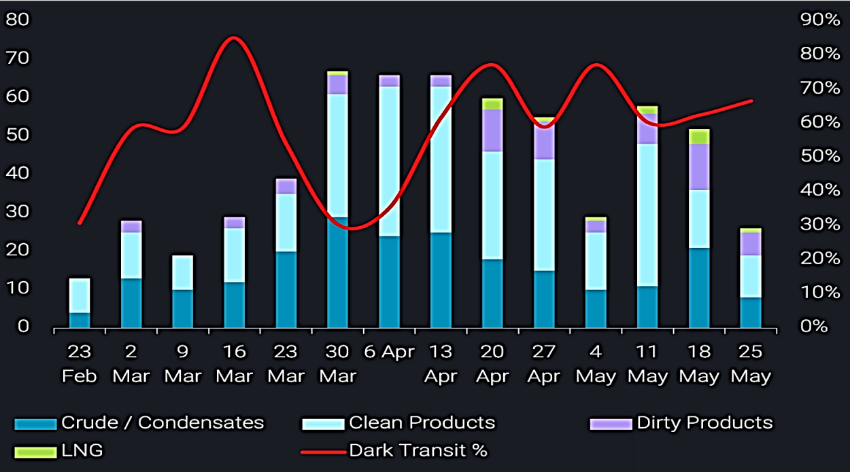
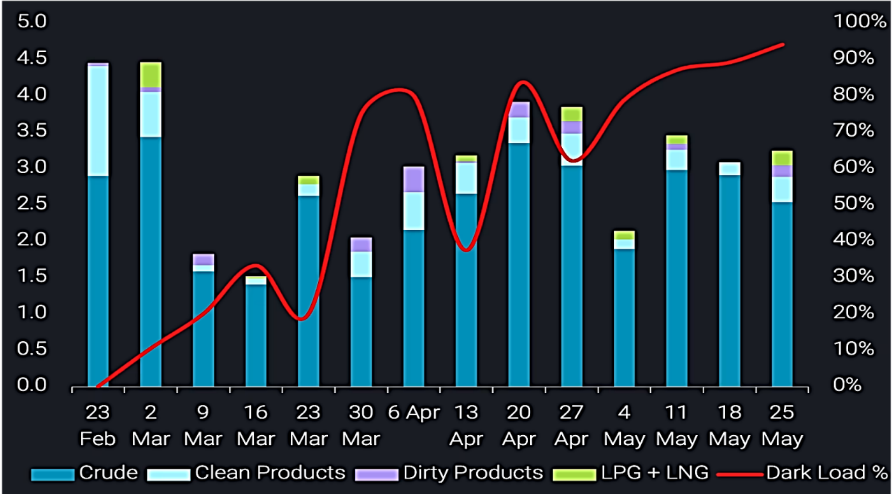
The Hormuz transit data captures only one channel. Vortexa-confirmed dark loading activity simultaneously increased sharply from April to May. Early in the crisis, dark loads were more concentrated around Gulf terminals inside the Strait, including Das Island, Zirku, and Jebel Dhanna.
By May, the centre of gravity had shifted outward, with Fujairah terminal loads and Fujairah-area STS activity becoming a much larger part of the picture.
The UAE departures chart makes the scale of this shift explicit. Overall departures from UAE have remained substantial throughout the crisis, but the share of those loads occurring dark has risen from negligible levels in early March to above 90% in the most recent weeks. The export system is adapting, not stopping – with more cargo moving through channels where the loading event is harder to observe through AIS.
VLCC-class vessels have consistently represented around 59% of dark loads across April and May, making them the dominant size class by a significant margin. That points to a clear commercial incentive: when visibility and routing are constrained, operators are still trying to move the largest possible parcels through whichever channel remains available.
For vessels still transiting the Strait, crude and condensates remain the largest category of dark outbound laden movements, accounting for around 40% of the total. But the breadth of the trend is notable.
Clean products account for nearly a quarter of dark outbound laden transits, dirty products close to 18%, and LPG around 14%. LNG also appears in the data from April into May, showing that the deterioration in visibility is not limited to crude or sanctioned flows.
That matters because the market impact is broader than crude balances alone. When clean products, LPG, and LNG also move with reduced AIS visibility, the uncertainty extends into refinery supply, product availability, regional inventories, and destination-level demand reads.
Around a quarter to a third of dark outbound laden transits each month are VLCC+ class vessels. Some of these movements appear to feed into the same offshore transfer and staging zones now becoming more prominent outside Hormuz.
Team Maverick.






Shivakumar Meets Sonia, Rahul and Priyanka Gandhi Amid Karnataka Cabinet Discontent
New Delhi, June 2026 : Karnataka Chief Minister D.K. Shivakumar on Wednesday met senior Co…

Shivakumar Meets Sonia, Rahul and Priyanka Gandhi Amid Karnataka Cabinet Discontent
New Delhi, June 2026 : Karnataka Chief Minister D.K. Shivakumar on Wednesday met senior …