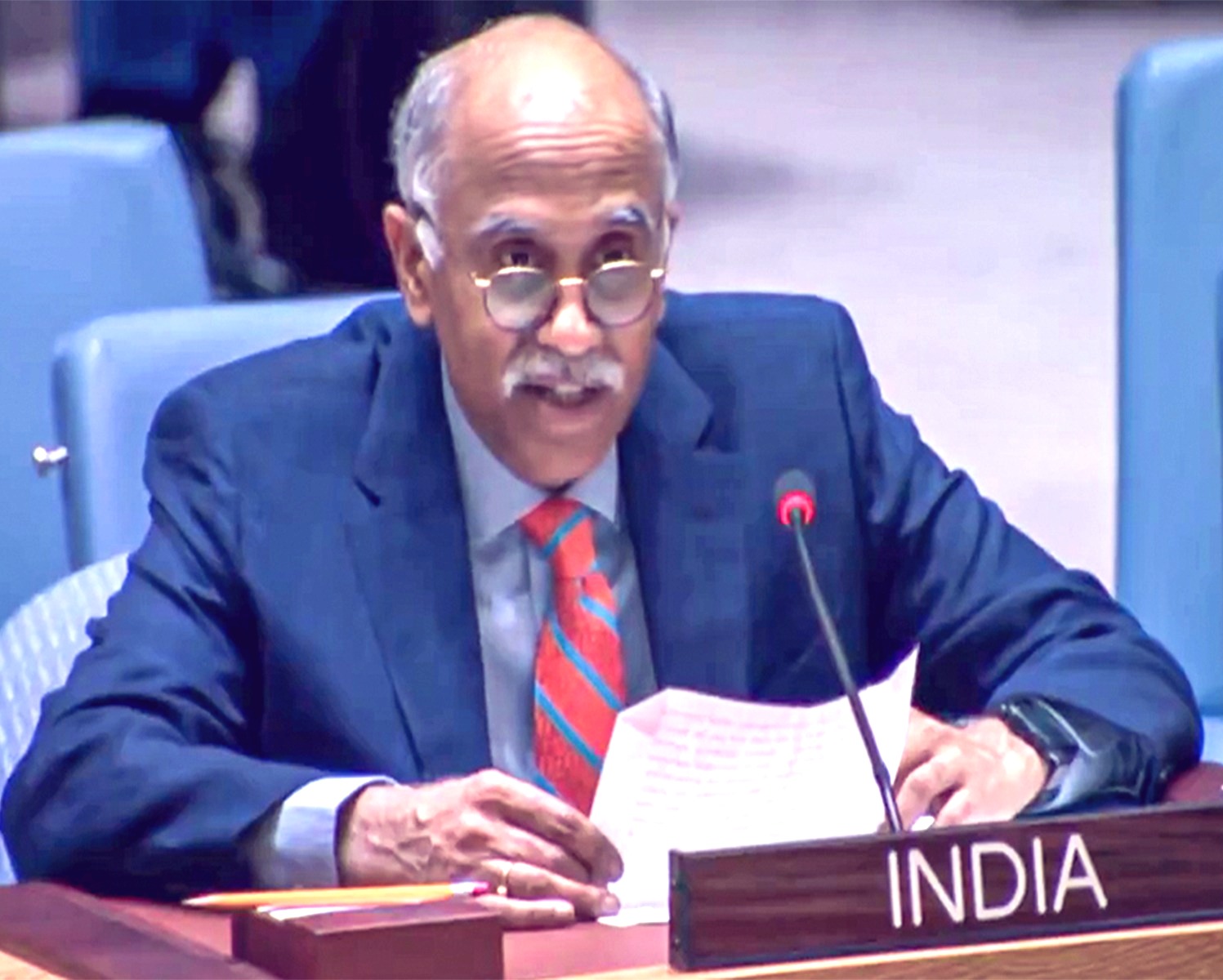
India Flags Multilateralism Is Under Threat In The Present Geopolitical Situation.

New York; January 2026: While speaking at the UN Security Council Open Debate on “Reaffirming International Rule of Law: Pathways to Reinvigorating Peace, Justice, and Multilateralism”, India’s Permanent Representative to the UN, Ambassador Harish Parvathaneni argued that the credibility of multilateralism and the international rule of law. “The Rule of law is at the very heart of the core mandate of the United Nations Security Council maintenance of international peace and security. It is critical in addressing conflicts and fostering trust among member states”, the Ambassador said.
He noted that multilateralism based on universal membership, with the UN at its core, is under significant strain, while calling for comprehensive reforms of the United Nations Security Council (UNSC) on grounds of multilateralism and changes in global dynamics, noting that the current structure reflects a “geopolitical reality of a bygone era”.
Beyond budgetary challenges, he pointed to paralysis and lack of effectiveness in addressing conflicts as major shortcomings, leading to a growing perception that the UN is failing to deliver on its primary mandate of maintaining international peace and security, warning that this trend risks further weakening multilateral institutions.
Ambassador Parvathaneni emphasised that the rule of law lies at the heart of the Security Council’s mandate but stressed that it cannot remain theoretical, while calling for a shift from abstract legal constructs to pragmatic solutions that deliver tangible outcomes for people.
“The rule of law is barren without enforceability. The focus must shift from arcane constructs to pragmatic solutions and outcomes that positively impact the daily lives of our citizens”, the Ambassador said. Further, highlighting the rapid transformation across political, economic, and technological domains, he underscored the need for continuous review and updating of international need for continuous review and updating of international legal and institutional frameworks to prevent obsolescence, arguing that for multilateralism and international rule of law to remain effective and credible, global governance structures must evolve in line with changing power dynamics, demographics, and global challenges.
“Continuous review, updation and reinvigoration are an imperative to avoid obsolescence”, he stated.
Parvathaneni reiterated India’s long-standing position that reform of the Security Council must include expansion in both permanent and non-permanent categories to enhance its legitimacy, representativeness, and effectiveness.
“For multilateralism and international rule of law to remain effective and credible, global governance structures must evolve to reflect contemporary realities. The current architecture of the United Nations, particularly the composition of the Security Council, reflects a geopolitical reality of a bygone era”, he noted.
“In light of the profound global transformation of the last eight decades in power dynamics, demographics, and the nature of global challenges, there is an urgent and compelling need to undertake comprehensive reform, including expansion in the permanent and non-permanent categories”, he added.
The Indian envoy has also called for greater synergy among the UN’s principal organs to advance the rule of law, advocating process-oriented reforms, predictable and adequate resources, capacity-building, and technical assistance tailored to local contexts. At the same time, he cautioned against the misuse of international law to interfere in the internal affairs of states or undermine their sovereignty and territorial integrity.
While stressing the need for adaptability, he warned that rigid and selective application of international legal principles could accelerate application of international legal principles could accelerate the emergence of alternative formats of global engagement. “International rule of law should not be weaponised to question state sovereignty and interfere in internal affairs of states”, he said.
While responding to Pakistani narratives about Operation Sindoor, the Indian Envoy has stated that,
the Pakistan representative has “a single-point agenda” to harm India and its people. Ambassador Parvathaneni said Pakistan had advanced a “false and self-serving account” of Operation Sindoor carried out in May last year, stressing that the facts were clear and well documented. He recalled that Pakistan sponsored terrorists killed 26 innocent civilians in a brutal attack in Pahalgam, an act of terrorism that was condemned by the Security Council itself.
“This august body itself called for holding the perpetrators, organisers, financiers and sponsors of this reprehensible act of terrorism accountable and brought to justice. That is exactly what we did”, he said. The Indian envoy underlined that India’s response was “measured, non-escalatory and responsible” and was aimed solely at dismantling terrorist infrastructure and disabling terrorists.
The Indian Armed Forces launched Operation Sindoor in the early hours of May 7, 2025, which targeted 09 terror camps in Pakistan and Pakistan-occupied Jammu and Kashmir (PoJK) as a retaliatory response to the April 22 terror attack in Pahalgam, Jammu and Kashmir. He added that Pakistan had continued to threaten further attacks on India until May 09th following which the Pakistani military reached out to India seeking a cessation of hostilities.
“The destruction caused to multiple Pakistani airbases by the Indian operation, including images of destroyed runways and burnt-out hangars, are in the public domain”, he said.
Responding to Pakistan’s reference to a “new normal”, Ambassador Parvathaneni asserted that terrorism could never be normalised. “It is not normal to tolerate Pakistan’s continued use of terrorism as an instrument of state policy”, he said, adding that the Security Council must not become a forum to legitimise terrorism.
“We will do whatever required to protect and ensure the safety and security of our citizens”, he added.
The Indian envoy further stated that Pakistan has no locus standi to comment on Jammu and Kashmir, reiterating that the Union Territory “has been, is, and will always remain an integral and inalienable part of India”.
On the Indus Waters Treaty, Ambassador Parvathaneni said India had entered into the agreement 65 years ago in good faith, but Pakistan had repeatedly violated its spirit through wars and sustained
cross-border terrorism. He said India was compelled to place the treaty in abeyance until Pakistan
credibly and irrevocably ends its support for terrorism. He further advised Pakistan to introspect on
its own adherence to the rule of law, pointing to the role of its armed forces in constitutional developments, including the 27th amendment and the granting of lifetime immunity to its Chief of Defence Forces.
“Pakistan is well advised to introspect about the rule of law. It could start by asking itself how it has let its armed forces engineer a constitutional coup through the 27th amendment and giving life-time immunity to its Chief of Defence Forces”, the envoy said.
Concluding his remarks, Ambassador Parvathaneni emphasised that the application of international rule of law must be consistent, objective, and free from double standards if the United Nations is to retain its relevance and authority in a rapidly changing world. “The application of international rule of law calls for consistency, objectivity and predictability with no double standards”.
Team Maverick.




Markel And Willis Launch Nuclear Insurance Facility Amid Atomic Resurgence.
May 2026: Markel International has teamed up with broker Willis to roll out a dedicated in…

Markel And Willis Launch Nuclear Insurance Facility Amid Atomic Resurgence.
May 2026: Markel International has teamed up with broker Willis to roll out a …