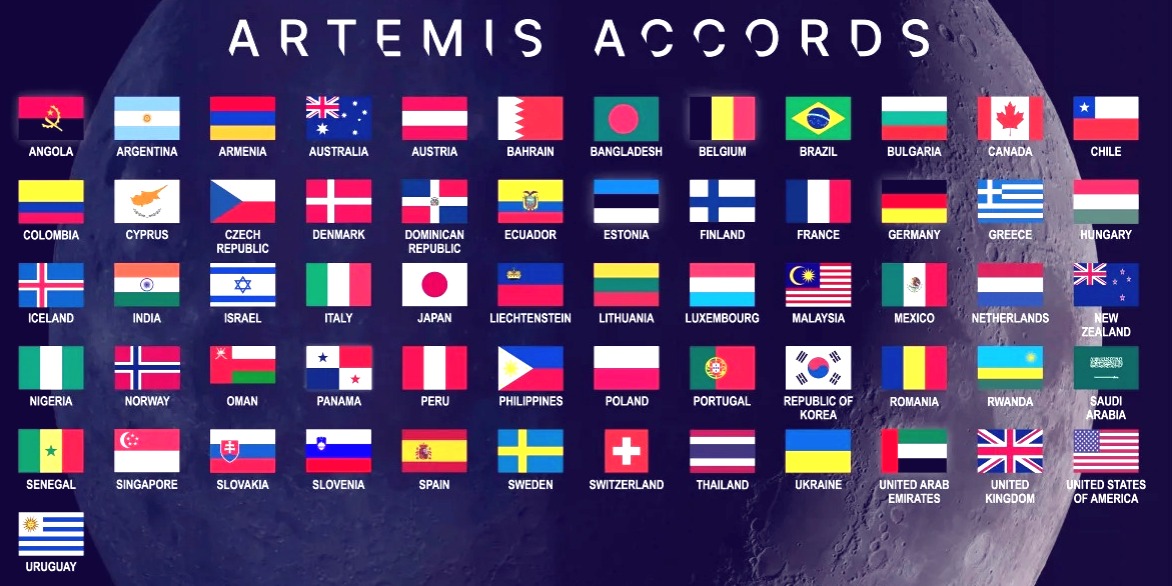
NASA Welcomes Oman As The Newest Artemis Accords Signatory.

Florida; January 2026: The Sultanate of Oman have signed the Artemis Accords during a ceremony in Muscat attended by NASA on 26th January 2026 (Monday), becoming the 61st nation to commit to responsible space exploration for the benefit of all humanity.
“Oman’s accession to the Artemis Accords sets an important example about the value of responsible behavior and shared pursuit of discovery”, said NASA Administrator Jared Isaacman in recorded remarks during the ceremony. “Oman joins the U.S. and our other partners on ensuring the peaceful exploration of space for generations to come. We are returning humans to the Moon and laying the groundwork for future missions. A community of like-minded nations will be the foundation of our success”.
U.S. Ambassador to the Sultanate of Oman Ana Escrogima and NASA’s Deputy Associate Administrator Casey Swails participated in the event held on the opening day of the Middle East Space Conference, an international forum on space and innovation in the region. Said al-Maawali, Oman’s Minister of transportation, communication, and information technology signed on behalf of the country.
In 2020, during the first Trump Administration, the United States, led by NASA and the U.S. Department of State, joined with seven other founding nations to establish the Artemis Accords, responding to the growing interest in lunar activities by both governments and private companies.
The accords introduced the first set of practical principles aimed at enhancing the safety, transparency, and coordination of civil space exploration on the Moon, Mars, and beyond.
Signing the Artemis Accords means to explore peaceably and transparently, to render aid to those in need, to enable access to scientific data that all of humanity can learn from, to ensure activities do not interfere with those of others, to preserve historically significant sites and artifacts, and to develop best practices for how to conduct space exploration activities for the benefit of all.
More countries are expected to sign the Artemis Accords in the months and years ahead, as NASA continues its work to establish a safe, peaceful, and prosperous future in space.
ARTEMIS ACCORD:
The purpose of these Accords is to establish a common vision via a practical set of principles, guidelines, and best practices to enhance the governance of the civil exploration and use of outer space with the intention of advancing the Artemis Program. Adherence to a practical set of principles, guidelines, and best practices in carrying out activities in outer space is intended to increase the safety of operations, reduce uncertainty, and promote the sustainable and beneficial use of space for all humankind. The Accords represent a political commitment to the principles described herein, many of which provide for operational implementation of important obligations contained in the Outer Space Treaty and other instruments.
The principles set out in these Accords are intended to apply to civil space activities conducted by the civil space agencies of each Signatory. These activities may take place on the Moon, Mars, comets, and asteroids, including their surfaces and subsurfaces, as well as in orbit of the Moon or Mars, in the Lagrangian points for the Earth-Moon system, and in transit between these celestial bodies and locations. The Signatories intend to implement the principles set out in these Accords through their own activities by taking, as appropriate, measures such as mission planning and contractual mechanisms with entities acting on their behalf.
Implementation:
Cooperative activities regarding the exploration and use of outer space may be implemented
through appropriate instruments, such as Memoranda of Understanding, Implementing Arrangements under existing Government-to-Government Agreements, Agency-to-Agency arrangements, or other instruments. These instruments should reference these Accords and include appropriate provisions for implementing the principles contained in these Accords.
- In the instruments described in this Section, the Signatories or their subordinate agencies should describe the nature, scope, and objectives of the civil cooperative activity;
- The Signatories’ bilateral instruments referred to above are expected to contain other provisions necessary to conduct such cooperation, including those related to liability, intellectual property, and the transfer of goods and technical data;
- All cooperative activities should be carried out in accordance with the legal obligations applicable to each Signatory;
- Each Signatory commits to taking appropriate steps to ensure that entities acting on its behalf comply with the principles of these Accords.
Team Maverick.








Top 10 Monsoon Destinations in India That Come Alive During the Rainy Season
Hyderabad, July 2026 : The arrival of the southwest monsoon transforms India into a specta…

Top 10 Monsoon Destinations in India That Come Alive During the Rainy Season
Hyderabad, July 2026 : The arrival of the southwest monsoon transforms India into a …