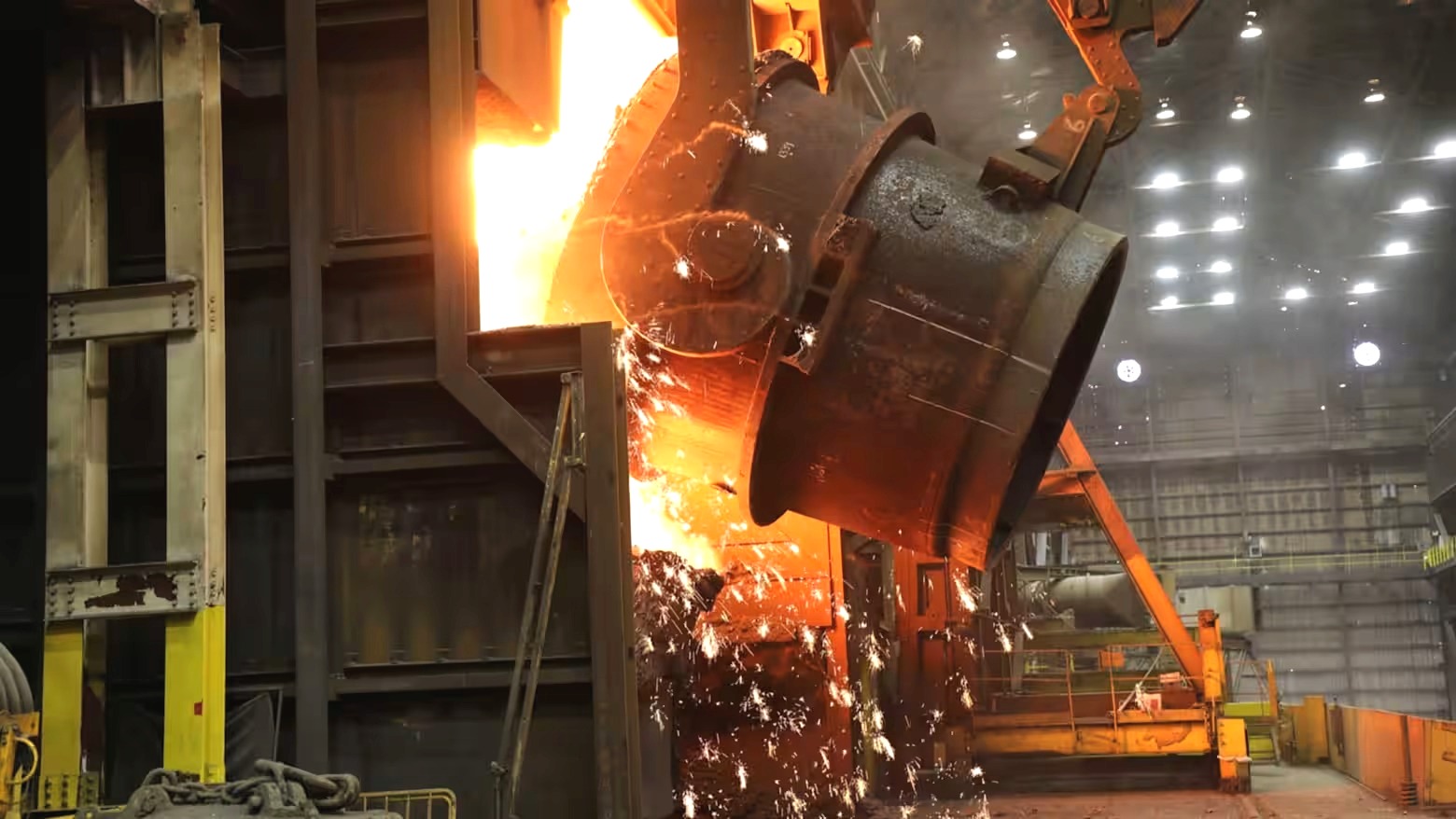
United States Surges Ahead Of Japan In Steel Production Since 1999.

Washington DC; January 2026: By the end of 2025, United States have surged ahead, in steel production, of Japan to become the world’s third-largest steel producer, followed after China and India. This is the first time since 1999 that the U.S. has produced more steel than Japan.
“US crude steel production in 2025 was up 3.1% to 82 million tons, the first rise in two years, according to the World Steel Association, and the growth is due in large part to the Donald Trump administration’s tariff policies”. Last year, Trump initially placed 25% tariffs on imported steel and aluminum products. Those tariff rates were later doubled to 50%, which has helped drastically boost steel production in the United States.
Leon Topalian, the CEO of the steel production company Nucor, said in a recent earnings call that Trump’s tariffs were not hurting American manufacturing, and in fact, were a bright spot in the nation’s economy. He said, “the demand, the robustness that we see in this economy, again, I think 2026 is shaping up to be a very, very solid year for Nucor”.
The tariffs have driven up U.S. steel prices. Hot-rolled steel coils used in manufacturing and other industries were priced at $983 per ton as of January 12th, the highest since the price hit $993 in late May, according to U.S. research firm Steel Bench marker. The figure is double the global export price and a 30% jump over January 2025, when Trump took office for his second term.
U.S. domestic steel shipments in November were up 5% on the year, according to the American Iron and Steel Institute.
Demand is growing for steel used in the construction of data centers and power plants, driven by the AI boom. Private-sector construction spending for data centers more than doubled in the two years through January 2025, according to the U.S. Department of Commerce.
Nippon Steel, which acquired US Steel for about $14.1 billion last June, plans to invest billions of dollars in the U.S. to mass-produce high-grade steel for data centers and other applications. With tariffs driving up prices and strong domestic demand, the U.S. is becoming an attractive destination for foreign investors.
Acquisitions are ramping up, in anticipation of future growth. U.S. electric arc furnace steelmaker Steel Dynamics announced on Jan. 6 that it had partnered with Australian energy company SGH to propose the acquisition of BlueScope Steel, Australia’s largest steel company, for 13.2 billion Australian dollars ($9.13 billion).

Meanwhile, Steel Dynamics is hoping to acquire BlueScope’s North American operations. BlueScope operates an electric arc furnace steel mill in the Midwest U.S. state of Ohio with an annual production capacity of 3.3 million tons, and is strong in steel products for the automotive and construction industries. BlueScope’s board of directors rejected the acquisition proposal on January 07th, saying it undervalued the company. SGH and Steel Dynamics may increase their offer in the future.
Steel Dynamics is the fourth-largest steel company in the U.S. and the second largest in electric arc furnace production, after Nucor. Its strength lies in efficient production, with all aspects of raw material recycling, processing, manufacturing and logistics completed domestically.
While investment is concentrating in the U.S., the global steel market faces a challenging environment due to a decline in the consumption of steel for construction in China, which accounts for one-third of global steel consumption. Excess cheap steel from China is being exported, worsening global market conditions.
“The direction of steel market conditions differs between regions that restrict imported steel through protectionist measures and other regions”, said SMBC Nikko Securities senior analyst Atsushi Yamaguchi, adding that market polarization will intensify further after 2026. Yamaguchi has further reiterated that the profit environment for the steel industries of Japan, South Korea, Taiwan and China, which are highly dependent on exports, will become even more severe.
Although the American’s rhetoric of Trump’s policies that have bolstered the steel production in the United States appears to be the cause, but there is a very realistic information which has been sourced from Japan.
Japan’s crude steel production in 2025 fell to its lowest level since 1969, sliding 4% on the year to 80.67 million metric tons, according to data released Thursday by the Japan Iron and Steel Federation (JISF).
With China’s steel exports remaining near record highs, a slumping market is becoming the norm. Major Japanese steelmakers are speeding up their shift toward growth markets such as India and the U.S. to keep production at a scale that will let them maintain their industrial strength.
Construction demand has declined amid project delays caused by labor shortages, contributing to stagnant steel demand. The ongoing contraction in domestic new automobile sales has underpinned weaker steel demand as well, while China has also been a major factor. Although China’s crude steel production is now on a downward trend, the country’s slumping real estate sector and general economic slowdown have left it with cheap steel originally meant for such uses as construction. China has instead exported that extra steel, worsening global market conditions.
China’s steel exports for January-September 2025 rose 9.2% on the year to 87.96 million tons according to JISF figures, the highest ever for that period. Preliminary trade statistics released Thursday show steel imports to Japan from China growing 1.5% in 2025, adding to the influx of cheap steel.
Protectionism has become more widespread globally, especially in the U.S. Since around 2024, more countries have imposed high tariffs on steel in an effort to keep the market downturn sparked by China from affecting their domestic markets.
Japan has also been impacted by anti-dumping measures that shut imports out of destinations such as South Korea and the European Union. Although around 40% of Japan’s steel products are exported, preliminary trade statistics indicate that shipments were down 4.2% to 30.08 million tons in 2025, declining for the second consecutive year.
“The steel industry, with its high proportion of exports, will continue to face tough conditions in 2026 as well”, said Tadashi Imai, Nippon Steel’s President and COO. Given last year’s weak demand for both domestic steel and exports, this sentiment is shared by many.
Major steelmakers have been working to consolidate and streamline production facilities in recent years in response to the situation. Nippon Steel began restructuring efforts around 2020, cutting its number of blast furnaces from 15 to 10. JFE Holdings suspended operations at one blast furnace in 2023 and plans to halt operations at another in fiscal 2027.
Major players in the industry do not foresee growth in the domestic market, and are therefore looking for new opportunities overseas.
Team Maverick.




Govt. to formulate policy to provide relief in encroachment cases involving poor and landless families: CM
Chief Minister Thakur Sukhvinder Singh Sukhu today laid the foundation stone of the new Mu…

Govt. to formulate policy to provide relief in encroachment cases involving poor and landless families: CM
Chief Minister Thakur Sukhvinder Singh Sukhu today laid the foundation stone of the new …