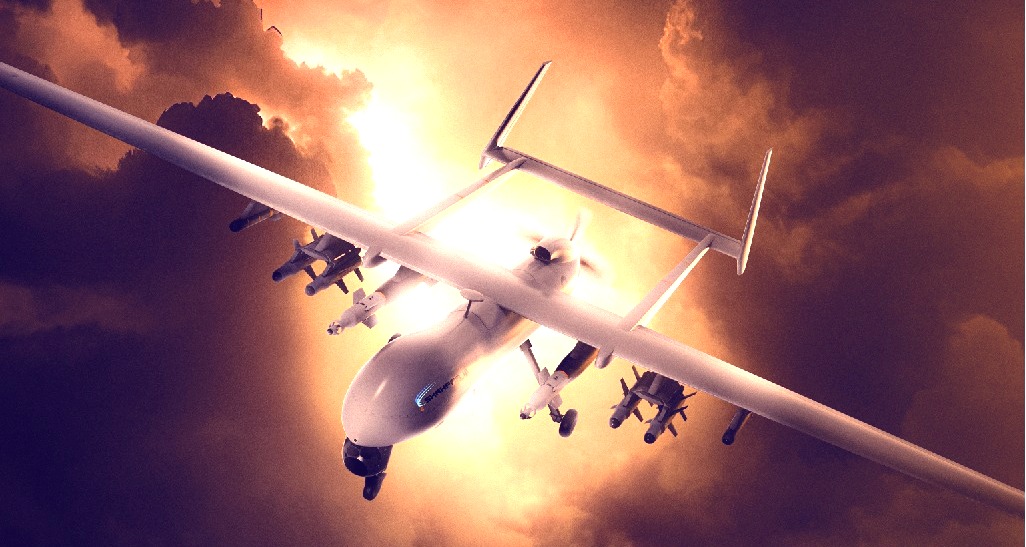
World Defence Show, Riyadh: Pakistan Unveils Export-Ready Shahpar III MALE Combat Drone For Strike Missions.

Riyadh; February 2026: Pakistan’s Global Industrial and Defence Solutions has presented the Shahpar III as an export-ready Medium Altitude Long Endurance (MALE) Unmanned Combat Aerial Vehicle (UAV) combat drone with SATCOM, long endurance, and multi-weapon capability. The system signals Pakistan’s push into higher-end armed drone markets traditionally dominated by Turkish, Chinese, and Western platforms.
Pakistan’s Global Industrial and Defence Solutions (GIDS) present the Shahpar III not as a concept model, but as an export-ready “Group 4+” MALE UCAV built around long-range connectivity and multi-store strike options. The program entered the public spotlight in mid-2023 when GIDS outlined the aircraft’s ambition to step beyond earlier Shahpar variants into a heavier ISR and precision-attack bracket, targeting customers that want persistent surveillance paired with credible stand-off firepower in a single platform.
The Shahpar III is built around the classic MALE recipe, but with several design cues that signal its priorities. The air vehicle features a roughly 64 ft wingspan, high-aspect ratio wing and a bulbous nose section intended to house satellite communications equipment for beyond-line-of-sight control. The platform is designed for a 300 km line-of-sight control radius and beyond-line-of-sight connectivity extending to approximately 3,000 km, supported by a chin-mounted electro-optical sensor turret and an underbelly antenna layout optimised for persistent ISR and target cueing missions. Maximum take-off weight is reported at around 1,650 kg, with 06 underwing hardpoints placing Shahpar III firmly in the payload-flexible class rather than the light-attack segment.
That hardpoint architecture matters because GIDS is selling Shahpar III as a strike multiplier. Company officials have stated the UCAV can operate up to 35,000 ft, remain airborne for roughly 24 hours, and carry payloads of up to 500 kg. If achieved with meaningful endurance, this allows operators to mix sensors, datalink kits, and a practical weapons load rather than choosing one or the other. The concept of operations emphasizes firing heavier stand-off effects from national airspace, with a 250 km class cruise-missile shot frequently highlighted as a core value proposition for deterrence and escalation control.
On the weapons side, GIDS is clearly positioning Shahpar III as the airborne node in a broader Pakistani guided-munitions ecosystem. The drone is designed to carry indigenous weapons such as Barq air-to-surface missiles and Al Battaar laser-guided bomb kits, with integration flexibility for additional stores depending on customer requirements. Range-extension and guidance kits displayed alongside the aircraft, including indigenous glide kits advertised with ranges up to 100 km and laser kits for Mk 82-class bombs in the 8 km range, illustrate how the platform is intended to deliver modular strike packages rather than a fixed loadout.
GIDS officials indicated that the program progressed toward a maiden flight in late 2023, with a high-profile public unveiling following at a major defence exhibition in 2024 where the system was presented as a national capability milestone. Development costs have been estimated at roughly $100 million, with an emphasis on domestic avionics and flight control, including a dual-redundant flight control computer based on a 1553 architecture. This focus signals a deliberate effort to professionalize reliability and supportability for military customers that demand sovereign control and long-term sustainment.
Shahpar III fits squarely into the mission sets that have defined Medium Altitude and Long Endurance (MALE) combat drones over the past decade: persistent ISR, armed overwatch, and time-sensitive precision strikes. The combination of SATCOM-enabled control and six external stations supports a doctrine in which the aircraft loiters at altitude, searches with an EO-IR turret, and prosecutes targets using laser-guided weapons or glide kits when permissive corridors exist. In maritime roles, the same persistence can be leveraged for coastal surveillance, ship tracking, and cueing of other shooters across wide littoral areas.
For potential customers, the most realistic employment model is not a single “killer drone” narrative, but a layered system of systems approach. Shahpar III would function as an airborne sensor and strike platform integrated into national intelligence and fires networks. A Gulf operator, for example, could maintain SATCOM-controlled orbits over sea lanes while keeping ground control elements ashore, then use guided munitions for rapid response against fast attack craft, radar sites, or mobile launchers. States facing dispersed insurgent threats could prioritize endurance and night operations to compress the kill chain while reducing risk to manned aviation.
Current operators have not been formally disclosed for Shahpar III, although the Shahpar family already serves Pakistani military users and has been actively marketed abroad. GIDS has stated it exports defence products to approximately 14 countries, including Saudi Arabia and the United Arab Emirates, which helps explain the emphasis placed on Riyadh as a launch venue. Earlier Shahpar variants have been demonstrated to delegations from multiple regions, suggesting a similar export trajectory once Shahpar III reaches full operational maturity.
There are two Variants:
• Shahpar-III (140 hp): Version fitted with 140 hp engine.
• Shahpar-III (170 hp): Version fitted with more powerful 170 hp engine
Against competitors, Shahpar III is positioned between lightweight export MALE drones and premium Western systems. Compared with Bayraktar TB2, which carries a much lighter payload, Shahpar III is optimised for heavier stores and longer-reach control. Against platforms such as Anka-S, the weight class is closer, with differentiation likely to hinge on weapons integration, industrial cooperation, and cost. Compared to Chinese MALE offerings that dominate cost-sensitive markets, Shahpar III’s potential advantage lies in flexibility, integration of indigenous weapons, and willingness to offer localisation and technology cooperation aligned with host-nation industrial strategies.
Team Maverick.







Deschamps Admits France Fell Short as Spain End World Cup Dream with 2-0 Semifinal Win
Arlington (Texas), July 2026 : France head coach Didier Deschamps admitted his side was ou…

Deschamps Admits France Fell Short as Spain End World Cup Dream with 2-0 Semifinal Win
Arlington (Texas), July 2026 : France head coach Didier Deschamps admitted his side was …