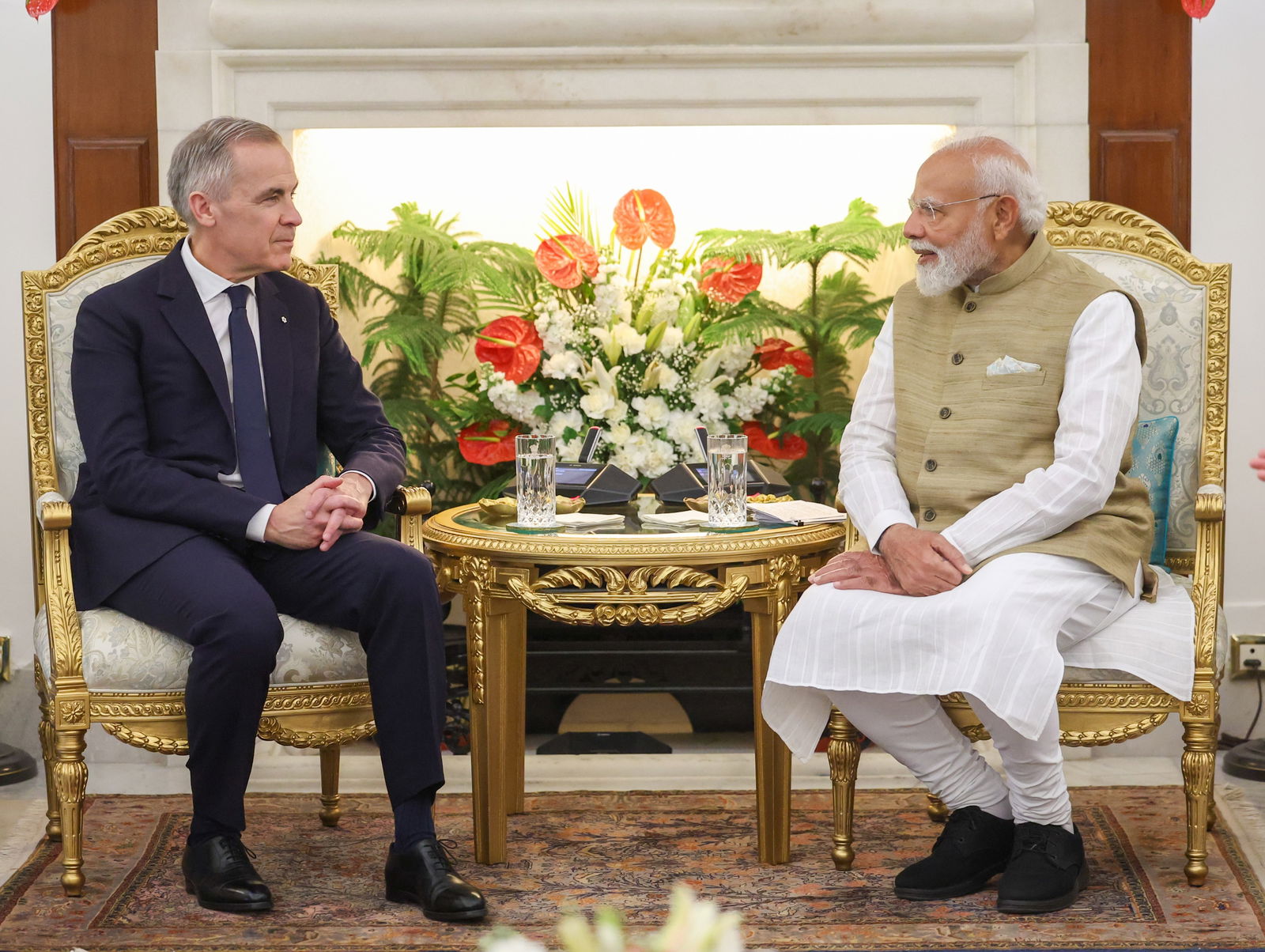
Prime Minister Carney Secures Ambitious New Partnership With India Focused On Energy, Talent, And Technology.

New Delhi; March 2026: In a rapidly changing world, Canada is focused on what it can control. Canada is building its economic strength at home and diversifying partnerships abroad. As one of the world’s fastest-growing major economy, India presents extraordinary opportunities. With a population of 1.4 billion, India’s energy demand is increasing faster than anywhere else in the world, which is equal to that of China and Southeast Asia combined.
On the otherside, Canada is an energy and agricultural superpower, and a leader in critical minerals, artificial intelligence (AI), and advanced manufacturing, precisely the sectors India is scaling at speed.
Canada and India have had an historically strong, productive relationship. In 2024, total direct and indirect Canadian investment in India surpassed $110 billion. As both the nations embark on parallel missions to build and transform respective economies and diversify key supply chains, it is forging a new partnership to leverage each other’s strength and ambition.
To that end, the Prime Minister, Mark Carney, visited Mumbai and New Delhi, India, from 28th February 2026 to 02nd March 2026. This marked the first bilateral visit to India by a Canadian Prime Minister since 2018. With this visit, in addition to ministerial and official level meetings, there has been more engagement between the Canadian and Indian governments this year than in any year over the past two decades.
In New Delhi, Prime Minister Carney met with the Prime Minister of India, Narendra Modi. Following their meeting, the leaders released a joint statement, welcomed 05 Memorandums of Understanding (MOU), and announced a broad range of ambitious initiatives that will renew and expand the Canada-India partnership across energy and critical minerals, technology and AI, talent and culture, and defence.
Foundational to the Canada-India strategic partnership is a strong and stable cooperation in trade. In New Delhi, Prime Minister Carney and Prime Minister Modi confirmed that Canada and India will conclude a new Comprehensive Economic Partnership Agreement (CEPA) this year, following a meeting of chief negotiators in New Delhi and the finalisation and signing of the Terms of Reference for the CEPA. The CEPA will advance Canada’s goal to more than double two-way trade to $70 billion by 2030.
To leverage the individual strengths as complementary economies, Canada and India announced a new Strategic Energy Partnership, including in LNG, LPG, uranium, solar, and hydrogen. As the first steps, the leaders welcomed:
• A landmark $2.6 billion agreement between the Government of India and Saskatoon-based Cameco to supply nearly 22 million pounds of uranium to India for nuclear energy generation from 2027 to 2035.
• 02 MOUs to intensify cooperation on critical minerals and energy sources, supporting technical and commercial engagement, and diversifying supply chains.
• Strengthened collaboration on clean energy initiatives in solar, wind, biofuels, and hydropower, including announcing that Canada intends to join the International Solar Alliance and is upgrading to full membership status in the Global Biofuels Alliance.
• Intensified engagement on LPG with the aim to conclude Canada’s first long-term LPG arrangement with India.
Canada and India have vibrant ties across commerce and culture, including through the over 1.8 million Canadians of Indian origin. To create more cultural and educational opportunities, Canada and India are strengthening our people-to-people ties through the following initiatives:
• The launch of the new Canada-India Talent and Innovation Strategy to deepen education collaboration, with 13 new partnerships between Canadian and Indian universities, a Dalhousie University innovation campus in partnership with the Indian Institute of Technology Tirupati and the Indian Institute of Science Education and Research Tirupati, as well as new University of Toronto and McGill University Centres of Excellence in India.
• Greater student and faculty exchanges and research collaboration, including 300 funded Indian student researcher positions as well as up to $100 million from the University of Toronto for up to 200 fully funded scholarships for Indian students and outbound opportunities for Canadian students.
• $10 million in Indo-Pacific scholarships and fellowships under Canada’s Indo-Pacific Strategy, including support for over 85 Canadian graduate students and researchers to study in and collaborate with leading Indian academics.
• An MOU on cultural cooperation, including collaboration and exchanges among institutions in the performing arts, visual arts, music, books, and other creative industries, as well as entertainment technologies.
Canada and India have immense strengths and growing ambitions in the technology sector, particularly in AI, quantum, and aerospace. To forge new partnerships for workers and businesses, the prime ministers also announced:
• The Canadian Space Agency (CSA) and the Indian Space Research Organisation (ISRO) agreed to cooperate on Earth observation and intend to explore joint initiatives on space exploration and quantum technologies, leveraging space-based technologies to support innovation and disaster resilience.
• HCL Technologies, India’s third-largest IT services company, will expand its operations in Canada, increasing its workforce by 75% by 2030 and creating thousands of high-paying careers in Canada.
• An MOU under the Australia-Canada-India Technology and Innovation Partnership to formalise strengthened collaboration on the development and deployment of AI, as well as industry cooperation.
To build on this vital work, Prime Minister Carney extended an invitation to Prime Minister Modi to visit Canada.
To catalyse new investment in Canada, Prime Minister Carney met with business leaders across various sectors: including technology, manufacturing, and energy, with a combined market capitalisation of approximately $600 billion. The Prime Minister was accompanied by members of his Cabinet and parliamentarians, as well as senior executives from the 09 major Canadian pension funds. They focused on the potential for new investments in and exports from Canada’s infrastructure, energy, manufacturing, mining, and defence sectors. The Canadian delegation emphasised Canada’s competitive advantages in energy, defence, agriculture, critical minerals, AI, quantum computing, and health technology, and its role as a premier destination for global capital and investment.
The visit saw more than 10 commercial agreements that will create thousands of careers in Canada, boost bilateral investment, and secure new opportunities for Canadian workers and businesses. Combined, these partnerships are worth over $5.5 billion, building the foundations for increased Canadian exports to India. In total, Canada’s new government has helped secure agreements worth $85 billion in global investment in the last 10 months.
Canada is a Pacific nation, and stronger ties in the Indo-Pacific are crucial to our security and sovereignty. Canada and India will increase defence cooperation, including maritime security, and identify opportunities for bilateral and multilateral naval activities to deepen interoperability and promote knowledge exchange, underscoring our shared commitment to security and resilience.
Importantly, building on progress made in recent talks, the leaders agreed to advance bilateral cooperation on security and law enforcement. This includes issues of mutual concern to Canada and India, such as the illegal flow of drugs, particularly fentanyl precursors, and transnational organised criminal networks. Prime Minister Carney also underscored that Canada will continue to take measures to combat transnational repression.
In 10 months, Canada has secured more than 20 economic and security partnerships across four continents, attracted unprecedented levels of new foreign investment, and renewed Canada’s relationships with global giants. Canada’s new government is building a stronger, more resilient, more independent Canadian economy.
The Honourable Prime Minister of Canada, Mark Carney has asserted, “India is the fastest-growing major economy and a powerhouse of global commerce and technology. In a rapidly changing world, Canada and India are transforming their economies to be more diversified, more independent, and more resilient. Our strategic partnership, and the speed at which it are working to unleash its potential in energy, talent, and AI, is the result of two confident, ambitious nations who want to build the future, together”.
Team Maverick.



Pakistan Appoint Mike Smith as Test Batting Coach Amid Batting Crisis
Mumbai, Aug 2026 : Pakistan have appointed former South African first-class cricketer and …

Pakistan Appoint Mike Smith as Test Batting Coach Amid Batting Crisis
Mumbai, Aug 2026 : Pakistan have appointed former South African first-class cricketer and Level …