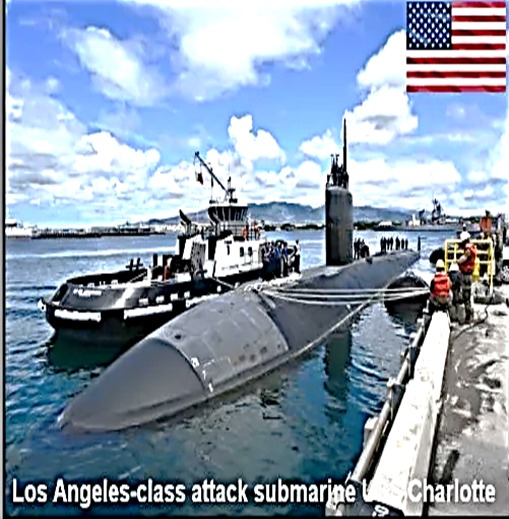
How US Navy Submarine USS Charlotte Sank Iranian Frigate IRIS Dena With 02 MK-48 Torpedoes.

Washington DC; March 2026: The US Navy demonstrated the reach of its submarine force after the Los Angeles-class attack submarine USS Charlotte (SSN 766) reportedly sank the Iranian Navy frigate IRIS Dena in the Indian Ocean with two MK 48 heavyweight torpedoes.
US officials said the submarine had fired 02 torpedoes during the engagement, resulting in the rapid loss of the Iranian warship. IRIS Dena, a domestically produced Moudge-class frigate, had been operating far from Iranian waters as part of Tehran’s expanding blue water naval deployments. The incident underscores the vulnerability of surface ships to modern submarine attacks and highlights the continuing dominance of US nuclear-powered attack submarines in open ocean warfare.
The incident occurred on 04th March 2026, approximately 40 nautical miles (74 km) south of Sri Lanka near Galle, where IRIS Dena was transiting international waters following participation in multinational naval exercises in the Bay of Bengal. In the aftermath of the torpedo strike, the Iranian frigate transmitted a distress signal. Sri Lankan naval and air units subsequently launched a rescue operation that recovered several survivors, though reports indicated significant casualties among the crew. These circumstances illustrate the growing maritime confrontation between the United States and Iran across the wider Indian Ocean territories.
From a military capability perspective, the strike underscores the continued operational value of US nuclear-powered attack submarines in maritime conflict. USS Charlotte belongs to the Los Angeles-class attack submarine fleet, a class of nuclear-powered submarines developed during the Cold War to ensure US naval dominance in undersea warfare. More than 60 units were built, making it one of the largest nuclear attack submarine programs ever produced. These submarines were designed primarily for anti-submarine warfare (ASW), intelligence gathering, and the destruction of enemy surface ships, while also supporting land-attack missions using cruise missiles and special operations deployment.
Powered by an S6G nuclear reactor, Los Angeles-class submarines can remain submerged for extended periods, with endurance limited mainly by crew supplies rather than fuel. The platform can reach submerged speeds exceeding 30 knots (≈56 km/h) and is equipped with advanced sonar systems enabling long-range detection and tracking of surface ships and submarines. With a length of about 110 metres, a beam of 10 metre, and a submerged displacement of roughly 6,900 tons, these submarines combine high speed, stealth, and significant firepower, allowing them to operate covertly across large ocean areas.
USS Charlotte, commissioned in 1994 as part of the improved Los Angeles-class variants, incorporates enhanced quieting technologies and upgraded combat systems compared with earlier boats. The submarine is equipped with four 533-mm torpedo tubes and a 12-cell vertical launch system (VLS) capable of firing Tomahawk land-attack cruise missiles. Its onboard weapons inventory includes MK-48 heavyweight torpedoes, which remain the primary anti-ship and anti-submarine weapon used by US attack submarines.
The weapon reportedly used in the attack, the MK-48 Advanced Capability (ADCAP) torpedo, represents the US Navy’s principal heavyweight underwater strike weapon designed to destroy both submarines and large surface combatants. The torpedo measures approximately 5.8 metres in length, weighs around 1,700 kg, and carries a high-explosive warhead of roughly 295 kg. It is initially guided via a wire connection to the launching submarine, allowing the crew to update targeting data during the engagement before the weapon transitions to autonomous active and passive acoustic homing during the final attack phase.
A defining characteristic of the MK-48 is its ability to detonate beneath the keel of a target ship rather than impacting the hull directly. When the warhead explodes under the vessel, it produces a powerful gas bubble and hydrodynamic shockwave that lifts the ship before the collapsing water column breaks the vessel’s structural backbone. This under-keel detonation technique can catastrophically damage ships significantly larger than the torpedo itself and often results in rapid structural failure.
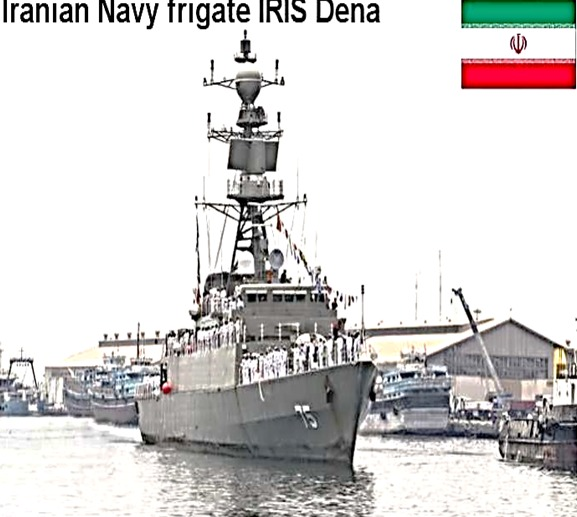
The destroyed vessel, IRIS Dena, was part of Iran’s domestically produced Moudge-class frigate program, which aims to provide the Iranian Navy with multi-mission surface combatants capable of operating beyond the Persian Gulf. The frigate had an estimated displacement of about 1,500 tons, a length of approximately 95 metres, and a top speed close to 30 knots (≈56 km/h). It was equipped with anti-ship missiles derived from the Noor or Qader missile family, a 76-mm naval gun, torpedoes, and surface-to-air missile systems for point air defense. The ship also featured a helicopter deck and hangar capable of supporting maritime patrol or ASW helicopters during long-distance deployments.
Operationally, the sinking of IRIS Dena demonstrates the vulnerability of surface warships to stealth-submarine attacks in open-ocean environments, particularly when operating without robust anti-submarine escort or airborne surveillance. Submarines remain uniquely capable of covertly tracking and engaging naval targets at long distances, enabling them to impose maritime denial across wide operational areas while remaining extremely difficult to detect.
Strategically, the engagement underscores the United States’ ability to project undersea power across the Indian Ocean and disrupt Iranian naval deployments well beyond the Strait of Hormuz. With the potential confirmation of this event, the destruction of a modern Iranian frigate operating thousands of kilometres from Iranian territory would represent both an operational setback for Tehran’s naval presence and a demonstration of US submarine dominance in contested maritime territories.
As tensions between the United States and Iran continue to escalate at sea, US submarines are likely to remain a central component of American naval strategy, providing stealthy strike capabilities to neutralise adversary surface forces while minimising exposure of US fleets operating in contested waters.
Team Maverick.





Adani Group Invests ₹1.5 Lakh Crore in Record Year, Charts Infrastructure and AI-Led Growth Path
Ahmedabad, June 2026 : Adani Group Chairman Gautam Adani used the company’s Annual General…

Adani Group Invests ₹1.5 Lakh Crore in Record Year, Charts Infrastructure and AI-Led Growth Path
Ahmedabad, June 2026 : Adani Group Chairman Gautam Adani used the company’s Annual General …