
As Israel-US Opted For Ukrainian Drones; Russia Shares Intelligence With Iran.

Kyiv/Jerusalem; March 2026: US and Israeli officials are negotiating with Ukraine to purchase Ukrainian interceptor drones in mitigating the Iranian Shahed drones. Official sources have asserted that parties are also discussing the transfer of Ukrainian technologies “that listen out” incoming enemy drones and “disrupt their communication signals”, likely referring to acoustic sensors and electronic warfare (EW).
It is not any secret that Ukraine manufactures and widely relies on relatively cheap Shahed interceptor drones that cost only a few thousand dollars each to produce. Ukraine has years of experience defending against almost nightly large-scale Russian drone and missile strike packages, which have included Iranian-origin strike drones much like those the United States and its allies currently face in the Middle East. Ukraine also has a reported 90% interception rate of such drones.
As per official sources, United Kingdom have sent Ukrainian-trained British drone operators to the Middle East on 03rd March to defend British bases in the region, and that the UK plans to deploy more later in the week. These British drone operators have experience working in Ukraine, where they learned about layering sensing, warning, and targeting drones.
What is regarded to be a counter retaliatory step, the Russian Government has given Iran the locations of US military assets, including warships and aircraft, since the US-Israeli February 28 strikes against Iran. Russia’s provision of targeting information to strike US forces in the Middle East is looked upon as a “pretty comprehensive effort”. Russia’s reported intelligence sharing fits the pattern of Iran’s strikes against US command and control infrastructure, radars, and temporary structures. The Center for Naval Analyses (CNA) Principal Research Scientist Mike Peterson stated that Russia could be giving Iran high-quality satellite imagery with which Iran could identify what bases the United States and its allies are currently using and other information, such as the location of aircraft, intelligence stations, and logistics flows.
Iran may not have regular access to high-quality satellite imagery, even from commercially available sources, and may be relying on Russia to get such imagery. Prominent commercial publisher of satellite imagery, Planet Labs, enacted a policy on March 06, subjecting all new imagery collected over the Gulf States and adjacent conflict zones, excluding Iran, to a mandatory 96-hour delay before making it publicly available, and other companies have held policies to never release images of US or allied bases. Russian intelligence sharing, thus, may be supporting Iranian strikes on US military assets.
As reiterated in one of Maverick News 30’s previous analysis that although China has opted to remain a non-partisan nation in the Iran War, may be preparing to provide Iran with financial assistance and missile components. China has historically provided Iran with sodium perchlorate to support Iran’s ballistic missile program. Sodium perchlorate is a chemical precursor for solid missile propellant. As per official data, Iran has received 2,000 tons of sodium perchlorate in several shipments that arrived in Bandar Abbas, Iran, from China. These shipments came amid Iranian efforts to rebuild its ballistic missile program following the June 2025 Israel-Iran war.
Yesterday, on march 06th – the US President have said that the United States would only accept Iranian “unconditional surrender – could be a formal Iranian surrender”. Trump said that an Iranian “unconditional surrender” could also be achieved when Iran can no longer fight against the United States “because they don’t have anyone or anything to fight with”. White House Press Secretary Karoline Leavitt told Fox that “unconditional surrender” is achieved when “Iran can no longer pose a threat to the U.S. and our troops in the Middle East”.
The US-Israeli combined force has continued strikes targeting Iranian ballistic missile infrastructure in order to degrade Iranian missile capabilities and ultimately destroy the Iranian ballistic missile program. Iranian missile forces are already badly degraded. US Central Command (CENTCOM) Commander Admiral Brad Cooper stated on March 5 that ballistic missile attacks from Iran have declined by roughly 90 percent since the strikes began.
The IDF also estimated that Iran has around 100 to 200 missile launchers remaining. Cooper added that the operation aims to “raze or level Iran’s ballistic missile industrial base” and systematically dismantle Iran’s missile production capability. Cooper’s comments are consistent with the doctrinal definition of destroy, which is when an enemy force loses the physical means or will to fight. A destroyed force cannot function without being entirely rebuilt. A campaign that destroys Iran’s ballistic missile launchers, stockpiles, and production facilities would accomplish this military objective. Satellite imagery from March 04th & 05th shows strikes on multiple ballistic missile facilities, including the Imam Ali Missile Base in Khorramabad, Lorestan Province, the Heydar Karar missile base in Tehran Province, and a ballistic missile launch site in Zanjan Province.
Furthermore, satellite imagery from March 06, also shows strikes on the Yazd Province missile base. The Israel Defense Forces (IDF) stated on March 06 that it had struck over 400 targets in western Iran, including ballistic missile launchers, as part of efforts to reduce missile fire toward Israeli territory. These strikes aimed to degrade Iran’s ability to launch ballistic missiles and limit the regime’s remaining launcher inventory.
Team Maverick.







AAIB Interim Statement on the Progress of Investigation into the Accident Involving Air India Flight AI-171
Today marks one year since the tragic accident involving Air India Flight AI-171, a Boeing…
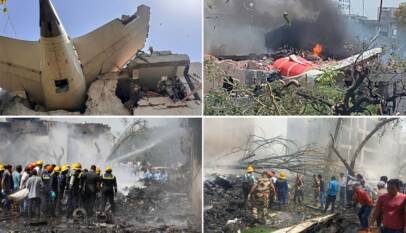
AAIB Interim Statement on the Progress of Investigation into the Accident Involving Air India Flight AI-171
Today marks one year since the tragic accident involving Air India Flight AI-171, a …