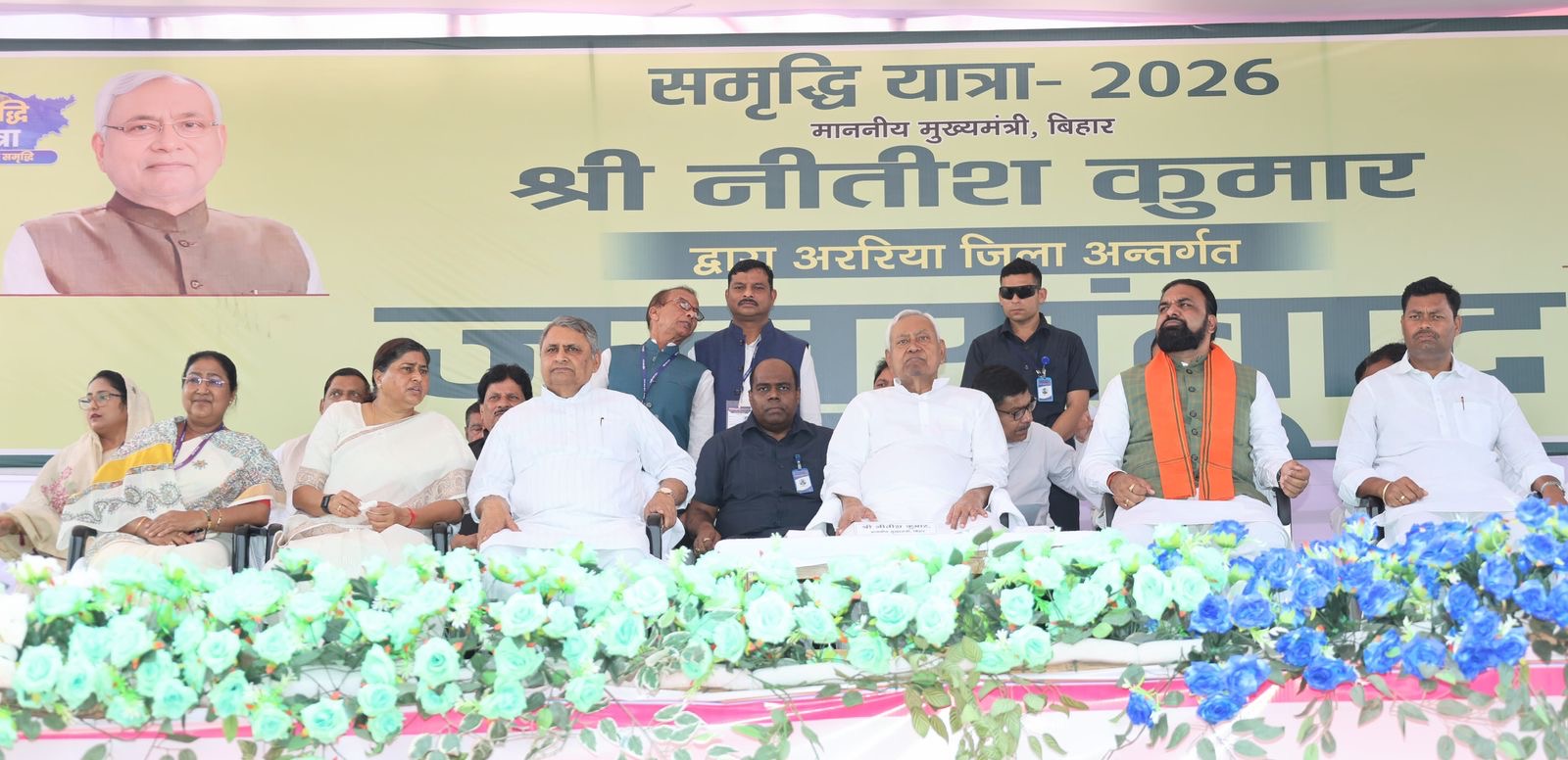
CM Nitish Kumar participated in the public dialogue programme organized in Araria under the Samriddhi Yatra.

Patna, March 2026: Chief Minister Nitish Kumar today participated in a public dialogue programme organized in Araria district as part of the state government’s Samriddhi Yatra. The event was held at the campus of Araria College, where the Chief Minister interacted with local residents, officials, and representatives from various communities.
Addressing the gathering, the Chief Minister said that the people of the state are well aware that when the National Democratic Alliance government came to power in Bihar for the first time on November 24, 2005, the government’s foremost priority was to establish the rule of law and initiate comprehensive development. He said that since that time, the government has consistently worked towards improving the state’s infrastructure, strengthening governance, and creating better opportunities for citizens.
Nitish Kumar reminded the audience about the difficult conditions that prevailed in Bihar before 2005. According to him, the law-and-order situation was extremely weak at that time, and people often felt unsafe stepping out of their homes after evening hours. Social tensions and disputes were common, and communal conflicts between different communities occurred frequently. Educational facilities were limited and poorly maintained, and the healthcare system lacked proper infrastructure and resources. Roads were few and in extremely poor condition, while electricity supply was limited to only a handful of areas.
The Chief Minister emphasized that the situation has changed significantly over the years. Today, he said, there is no atmosphere of fear or insecurity in the state. Instead, Bihar has witnessed the strengthening of social harmony, mutual respect, and communal peace. The government has taken several steps to prevent social conflicts and ensure lasting peace in society.
One of the measures mentioned by the Chief Minister was the decision taken in 2006 to begin constructing boundary walls around graveyards in order to prevent disputes related to land and religious sites. He noted that large-scale boundary construction for graveyards has been completed across the state. Similarly, since 2016, the government has also undertaken the fencing and protection of Hindu temples that are more than sixty years old. These steps were taken to prevent theft and other incidents and to ensure that religious sites remain safe and secure.
Nitish Kumar said that one of the government’s earliest priorities after coming to power was improving the education system. The government initiated large-scale recruitment of teachers and expanded educational infrastructure by opening new schools across the state. Special schemes were introduced to encourage students, especially girls, to continue their education. These included the distribution of school uniforms and the well-known bicycle scheme that helped students travel to schools located far from their homes.
He stated that in recent years the government has further strengthened the teaching workforce through new recruitments. Since 2023, the Bihar Public Service Commission has recruited approximately 2.58 lakh government teachers. Earlier, beginning in 2006, around 3.68 lakh contract teachers were appointed to meet the urgent demand for teaching staff in schools. Out of these, nearly 28,976 teachers have since been regularized through recruitment by the Bihar Public Service Commission.
The Chief Minister explained that the government also made it easier for contract teachers to become permanent government teachers by allowing them to qualify through a simplified examination process instead of the standard BPSC exam. Contract teachers were given multiple opportunities to appear for this examination. So far, four rounds of examinations have been conducted, and about 2.66 lakh contract teachers have successfully passed. Approximately 73,000 teachers are still remaining, and they will be given one more opportunity to qualify. With these appointments, the total number of government teachers in Bihar has now reached around 5.24 lakh.
Nitish Kumar further said that apart from these appointments, the Bihar Public Service Commission has also begun the recruitment process for an additional 45,000 teaching posts, which will further strengthen the education system in the state.
Turning to the healthcare sector, the Chief Minister said that earlier the state’s health system was extremely weak and inadequate. Primary health centres across Bihar used to receive very few patients, often only around 39 patients per month on average. This meant that only one or two patients visited a primary health centre in a day.
Since 2006, however, the government has taken major steps to transform healthcare facilities. Free medicines and treatment have been made available in government hospitals, and infrastructure has been upgraded significantly. As a result, the number of patients visiting primary health centres has increased dramatically. Today, on average, about 11,600 patients visit these centres every month.
Nitish Kumar also highlighted the expansion of medical education in the state. Earlier, Bihar had only six medical colleges, but their number has now increased to twelve. The government is also working to establish six more medical colleges in the near future, and construction work for medical colleges in the remaining districts is progressing rapidly.
He added that the Patna Medical College and Hospital is being upgraded with a capacity of 5,400 beds, making it one of the largest hospitals in the country. Additionally, five other old medical colleges have also been expanded and modernized.
The Chief Minister spoke about the caste-based survey conducted in Bihar in 2023. Through this survey, the government collected detailed data about the economic conditions of people from different communities. The survey identified approximately 94 lakh poor families in the state, including people from upper castes, backward classes, extremely backward classes, Dalits, Mahadalits, and minority communities.
To support these families, the government has initiated programmes to connect them with employment opportunities and financial assistance. Under these initiatives, financial assistance of up to ₹2 lakh is being provided to help families start their own livelihoods. So far, around 83.2 lakh families have already been linked to employment programmes or provided financial support, and the remaining families will receive assistance in the coming months. The Chief Minister said that if necessary, even more financial support may be provided beyond the ₹2 lakh limit.
Nitish Kumar also spoke about the empowerment of women in Bihar. In 2006, the state government introduced 50 percent reservation for women in Panchayati Raj institutions, and the same policy was implemented in urban local bodies in 2007. Since then, four rounds of elections have been conducted under this system.
The Chief Minister also mentioned that in 2013 the government introduced 35 percent reservation for women in the police force. Today, Bihar has one of the highest numbers of women police personnel in the country. Since 2016, women have also been given 35 percent reservation in all government jobs in the state.
Nitish Kumar highlighted the expansion of self-help groups in Bihar as another major achievement. Earlier, the number of such groups in the state was very small. In 2006, the government launched a programme with financial assistance from the World Bank to form self-help groups under the initiative called Jeevika.
Today, the number of self-help groups in Bihar has grown to over 11.05 lakh, and the number of women associated with these groups has crossed 1.69 crore. Since 2024, the government has also begun forming self-help groups in urban areas. Currently, around 77,000 such groups exist in cities, involving approximately 10.78 lakh women.
The Chief Minister said that during the Pragati Yatra conducted in December 2024 and January–February 2025, he visited all districts of the state to review development work. Based on the observations made during that tour, the government approved 430 new development schemes to address remaining gaps in infrastructure and services. Work on these schemes has already begun across districts. So far, 21 schemes have been completed, and the remaining projects will be completed soon.
Nitish Kumar said that the Government of India has also extended full support to Bihar’s development initiatives. In the Union Budget of July 2024, the central government announced significant financial assistance for Bihar in sectors such as roads, industries, healthcare, tourism, and flood control. Similarly, in the February 2025 budget, new initiatives were announced for the state, including the establishment of a Makhana Board, development of airports, and financial support for irrigation projects such as the Western Kosi Canal.
He also mentioned that the Khelo India Youth Games were organized in Bihar in 2025, which he described as a matter of pride for the state.
Expressing gratitude to Prime Minister Narendra Modi, the Chief Minister said that the Prime Minister has visited Bihar several times and inaugurated or laid the foundation stones for numerous development projects. Work on these projects is now progressing rapidly.
Nitish Kumar concluded by saying that over the past four terms of his government—from 2005 to 2010, 2010 to 2015, 2015 to 2020, and 2020 to 2025—significant progress has been made in sectors such as education, healthcare, roads, electricity, agriculture, and women’s empowerment. The government is now preparing to accelerate development further through new initiatives and programmes aimed at increasing employment, strengthening industries, and improving the overall quality of life for citizens.

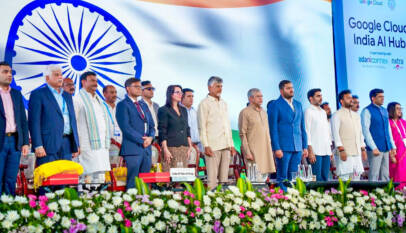
PM Modi, Australian Opposition Leader Angus Taylor Reaffirm Bipartisan Commitment to Stronger India-Australia Ties
Melbourne, July 2026 : Prime Minister Narendra Modi on Friday met Australian Opposition Le…
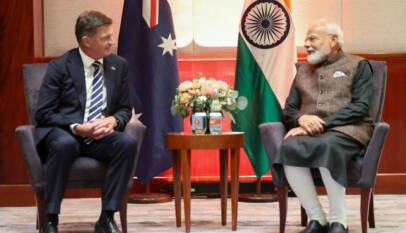
PM Modi, Australian Opposition Leader Angus Taylor Reaffirm Bipartisan Commitment to Stronger India-Australia Ties
Melbourne, July 2026 : Prime Minister Narendra Modi on Friday met Australian Opposition Leader …